

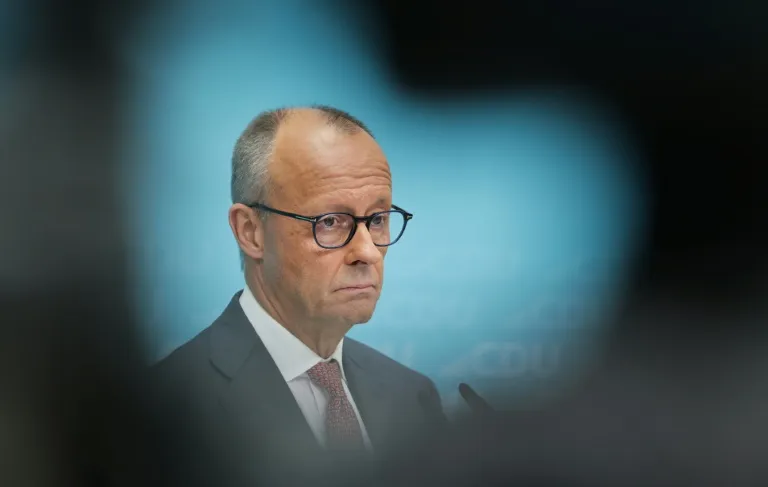
Friedrich Merz, leader of the center-right Christian Democratic Union (CDU), has declared a strong commitment to maintaining the current ruling coalition, emphasizing its critical role in safeguarding Germany’s democratic future. Speaking after significant electoral losses for his party, Merz stated, “We are determined to live up to the historic responsibilities our country is facing.” He framed the coalition, which includes the center-left Social Democratic Party (SPD), as essential, asserting, “It is about nothing less, and nothing more, than the democratic future of our country.”
Election Results Signal Political Shift
The recent elections in the northeastern state of Mecklenburg-Western Pomerania and the city-state of Berlin delivered stark results for the CDU. In Mecklenburg-Western Pomerania, the party suffered its most significant defeat since its inception in 1945, failing to secure any representation in the state parliament. The far-right Alternative for Germany (AfD) emerged as the leading party in this region. Merz characterized the outcome as a “heavy blow” and a “profound turning point,” describing it as a “dramatic, unprecedented result for the CDU in Germany.”
Similarly, in Berlin, the CDU was relegated to second place, overtaken by the far-left Die Linke party. The AfD also demonstrated considerable strength in the capital, making substantial gains. These electoral setbacks have intensified scrutiny on Merz’s leadership, with some calls for his resignation after just 16 months at the helm of the CDU.
Coalition Stability and Reform Agenda
Despite the challenging electoral landscape and internal pressures, Merz reiterated his intention to remain in his post. He signaled a determination to press forward with key economic and social welfare reforms that have been hard-won through coalition negotiations. The SPD, while also acknowledging the need to remain in the coalition, has indicated a desire to revisit and potentially alter aspects of the planned reform agenda.
Merz acknowledged the public’s concerns, stating, “But we know that we owe people answers to their worries, to their fears.” He pushed back against the notion that his personal popularity was the sole driver of the election defeats. “The reasons for these election results go far beyond my own person,” Merz asserted. He pointed to broader societal trends, observing, “We are witnessing a profound transformation of the political party system in Germany as well as in many other countries around the world.”
Broader Political Realignment
The election outcomes in both Mecklenburg-Western Pomerania and Berlin underscore a wider trend of political realignment occurring not only within Germany but across many other nations. The rise of nationalist and populist parties, such as the AfD, reflects a growing segment of the electorate seeking alternatives to established political forces. This phenomenon presents a complex challenge for traditional parties like the CDU and SPD, requiring them to adapt their platforms and communication strategies to resonate with a changing voter base.
The CDU’s Path Forward
The CDU faces a critical juncture. While Merz’s commitment to the coalition signals a desire for stability, the party must also address the underlying reasons for its declining support. This includes understanding and responding to voter anxieties regarding economic security, social change, and national identity. The party’s ability to reconnect with its traditional base while also attracting new voters will be crucial for its long-term viability.
Furthermore, the CDU must navigate the complexities of governing within a coalition that includes the SPD, whose policy priorities may diverge. Finding common ground on essential reforms while also asserting its own political vision will be a delicate balancing act. The emphasis on Germany’s “democratic future” suggests a recognition that the current political challenges are not merely about electoral performance but about the fundamental health and direction of the nation’s political system.
Conclusion: Navigating Uncertainty
Friedrich Merz’s pledge to keep the ruling coalition intact underscores a commitment to political stability amidst significant electoral headwinds. The recent election results in Mecklenburg-Western Pomerania and Berlin highlight a shifting political landscape in Germany, marked by the rise of the AfD and challenges for established parties. As the CDU leader seeks to push through reforms and address public concerns, the focus remains on navigating these turbulent political waters to ensure the long-term democratic health of the nation. The coming months will likely reveal how effectively the coalition can adapt to these evolving political dynamics and regain public trust.
