

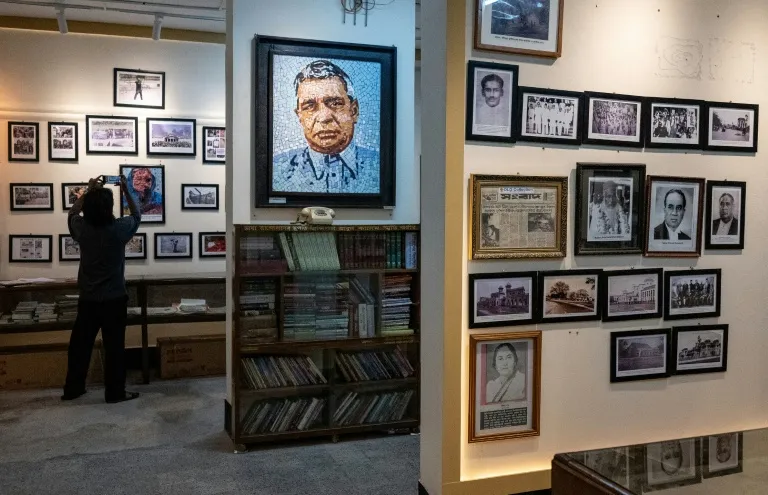
A photograph of Muhammad Ali Jinnah, the founder of Pakistan, displayed at a new museum exhibit at Dhaka University this month, has ignited controversy and highlighted deep-seated disputes over how Bangladesh commemorates its complex past. The incident underscores the politically charged nature of national identity, religion, and language that have shaped Bangladesh, particularly in the wake of the 2024 revolution that led to the ousting of former Prime Minister Sheikh Hasina.
Historical Context: Partition and Independence
Bangladesh and Pakistan were once unified as the eastern and western wings of a single nation, established in 1947 following the partition of British India. Separated by over 1,500 kilometers of Indian territory, the two regions eventually diverged, culminating in Bangladesh’s hard-won independence from Pakistan after a brutal liberation war in 1971. During this conflict, Pakistani forces were accused of widespread atrocities, and while Bangladeshi estimates of casualties run into the millions, hundreds of thousands are believed to have perished. Many in Bangladesh continue to seek an official apology from Islamabad for the events of 1971.
Jinnah’s Symbolism and Political Resonance
While Muhammad Ali Jinnah was not primarily an Islamist ideologue, his leadership in advocating for a separate Muslim homeland has made him a significant, albeit contentious, symbol for certain political factions in Bangladesh. Opposition Islamist politicians often invoke Jinnah to emphasize the nation’s Muslim identity. Political analyst Altaf Parvez noted that Jinnah has historically not been celebrated in Bangladesh, suggesting that the current environment is conducive to the rise of Islamist politics, which may see Jinnah as a figurehead to rally support.
The Dhaka University Incident
The photograph of Jinnah was part of a chronological display at the Dhaka University Central Students Union (DUCSU) museum, which is currently led by the student wing of Bangladesh’s largest Islamist party. DUCSU leader SM Farhad defended the display, stating it aimed to present a comprehensive history of the university. He criticized the actions of those who removed the photograph, referring to it as a “mob attack” and asserting that the display was historically accurate.
However, critics contend that the inclusion and subsequent removal of Jinnah’s photograph represent an attempt to manipulate historical narratives. They argue that highlighting Jinnah serves to diminish the legacy of Sheikh Mujibur Rahman, the revered founding president and independence leader of Bangladesh. Abu Tayyab Habildar, the student who physically removed Jinnah’s photograph, declared Jinnah a “villain,” citing his opposition to the Bengali language during the pre-partition era.
Contested Legacies and Shifting Narratives
The legacy of Sheikh Mujibur Rahman himself is also a subject of intense debate and political division. His daughter, Sheikh Hasina, whose long tenure as Prime Minister concluded with a student-led revolution in 2024, was known for her authoritarian style of governance, which drew significant opposition. Following her removal from power, Hasina has faced severe legal repercussions, including a death sentence in absentia, and her former political party, the Awami League, has been banned. During the 2024 uprising, Rahman’s former residence, which had been converted into a museum, was set ablaze.
SM Farhad, the DUCSU leader, suggested that the university museum’s renovation was necessary to counter what he perceived as a narrative dominated by the Awami League. He stated the intention was to “renovate” the museum to present a more balanced historical account. Conversely, some students believe that removing historical figures, regardless of their controversial status, is not the appropriate way to address historical discrepancies. Mahafuzur Rahman, a 19-year-old student, expressed that Jinnah, like other figures, is “part of history” and his photograph should not have been removed.
An Empty Space and Ongoing Debate
The space on the museum wall where Jinnah’s photograph was displayed now remains conspicuously empty. The incident has reopened discussions about historical interpretation, national identity, and the ongoing political dynamics within Bangladesh, demonstrating how past events and figures continue to influence present-day discourse.
Conclusion
The controversy surrounding Muhammad Ali Jinnah’s photograph at Dhaka University serves as a potent reminder of the enduring impact of historical events on contemporary Bangladeshi society. It highlights the ongoing struggle to reconcile differing interpretations of the nation’s founding, its relationship with Pakistan, and the complex legacies of its key historical figures. As Bangladesh navigates its political future, the way it chooses to remember and represent its past will undoubtedly remain a central and sensitive issue.
