

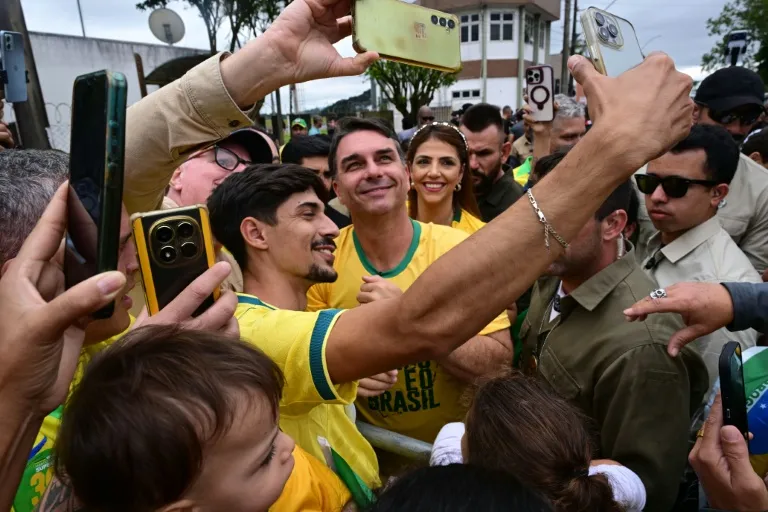
Flavio Bolsonaro, a prominent right-wing senator and son of former President Jair Bolsonaro, is experiencing a surge in voter support, narrowing the gap with leftist President Luiz Inacio Lula da Silva in recent polls. This shift comes as a judicial investigation involving a Supreme Court justice has inadvertently benefited Bolsonaro’s campaign, casting a shadow over Lula’s standing.
Bolsonaro Closes the Gap in Hypothetical Runoff
A recent survey conducted by Quaest pollster revealed that in a hypothetical October 25 runoff election, Flavio Bolsonaro would garner 42% of the vote, narrowly trailing President Lula da Silva’s 41%. This slim margin falls within the poll’s margin of error, indicating a potentially tight electoral contest. Flavio Bolsonaro, who has been under investigation for alleged corruption and money laundering related to the financing of a film about his father, appears to be capitalizing on a broader political climate influenced by judicial controversies.
Judicial Probe Engulfs Lula’s Campaign
The political landscape has been significantly impacted by revelations stemming from an investigation into Daniel Vorcaro, a jailed banker accused of orchestrating a major financial fraud. While Flavio Bolsonaro himself faces scrutiny over the film’s funding, which was reportedly backed by Vorcaro, the investigation has unearthed more damaging connections. Police reports detailing numerous conversations between Vorcaro and a phone number linked to Supreme Court Justice Alexandre de Moraes have become a focal point. Justice Moraes presided over the trial that led to Jair Bolsonaro’s conviction for an attempted coup following his 2022 election defeat, making him a contentious figure among right-wing supporters.
Political analyst Andre Rosa commented on the situation, suggesting that Flavio Bolsonaro is emerging from the scandal in a stronger position than President Lula. According to Rosa, the Bolsonarists have successfully linked Lula’s image with that of Justice Moraes in the minds of undecided voters, providing Bolsonaro with crucial breathing room. This strategy, encapsulated by Flavio Bolsonaro’s assertion that “voting for Lula means voting for Moraes,” aims to associate the current president with a figure perceived negatively by a segment of the electorate.
‘Swamp of Corruption’ Narrative Gains Traction
The opposition has actively promoted the narrative that the current administration is entangled in a “swamp of corruption,” leveraging the judicial controversies to their advantage. Senator Rogerio Marinho, Flavio Bolsonaro’s campaign manager, has labeled Justice Moraes a “pop star of the left” and stated that “Moraes and Lula are two sides of the same coin, and that is the Brazilian population’s perception.” This messaging seeks to erode public trust in institutions and the current government.
Data analytics firm Datrix reported that social media discussions surrounding Justice Moraes and the Supreme Federal Court (STF) crisis have surpassed mentions of financial entities and Flavio Bolsonaro himself. This indicates the significant public attention and debate generated by the judicial proceedings.
Lula’s Defense and Campaign Challenges
President Lula da Silva has responded to the accusations by stating that if Justice Moraes is found guilty, he must face consequences. However, Lula has also defended the justice’s actions, asserting that “Alexandre de Moraes has done an extraordinary job safeguarding democracy.” Despite these defenses, the crisis within the STF has exacerbated existing distrust in institutions, a sentiment that appears to be impacting Lula’s campaign more severely than anticipated.
Geraldo Monteiro, an expert at the State University of Rio de Janeiro, noted that the prevailing public image is one of pervasive corruption, with citizens feeling that “nobody does anything.” He also characterized President Lula’s campaign as “a bit lacklustre,” suggesting a need for more dynamic engagement with voters.
Marco Aurelio de Carvalho, a coordinator for Lula’s campaign, has attempted to distance the administration from the STF crisis, stating, “The STF crisis is not our crisis. They are trying to pin it on us.”
Criticism Over Pre-Election Spending Announcements
President Lula’s administration has also faced criticism for recent policy announcements made shortly before the October 4 first-round voting. These include an increase in benefits under the government’s social welfare program and the provision of free GLP-1 weight-loss drugs through the public healthcare system. Critics, including a columnist for the UOL news site, have suggested these measures are politically motivated attempts to boost popularity, drawing parallels to past populist tactics.
Laercio Barbosa, a 70-year-old chemistry teacher and Lula supporter, expressed concern over the political climate. Speaking at a campaign rally, he advised the president, “needs to realise that today, unfortunately, anti-establishment rhetoric is in the hands of the right,” highlighting the challenge Lula faces in countering the opposition’s effective use of populist messaging.
Conclusion: A Shifting Political Landscape
The unfolding judicial scandal, coupled with perceptions of Lula’s campaign and recent policy decisions, has created a dynamic and unpredictable electoral environment in Brazil. Flavio Bolsonaro’s ability to leverage these circumstances to gain ground in the polls underscores the complex interplay between political maneuvering, judicial investigations, and public sentiment in the lead-up to the election.
