

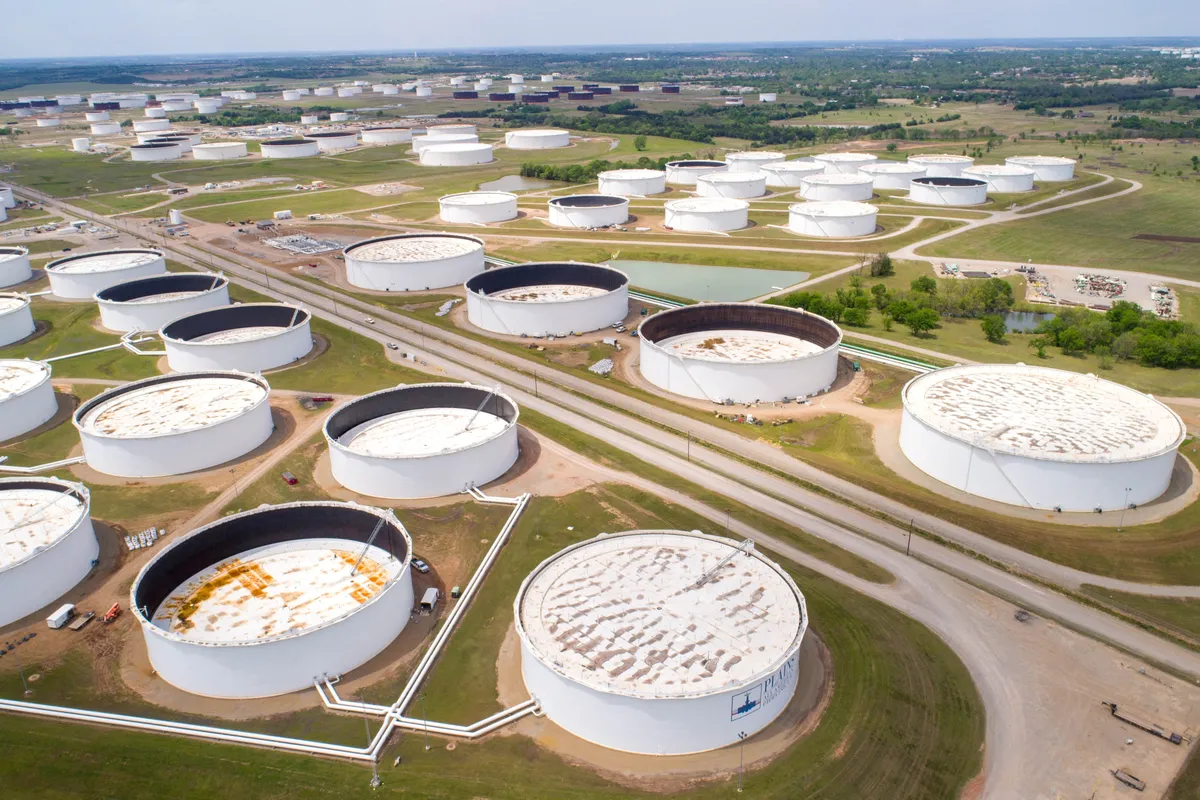
Cushing Storage Levels Plummet to Near Operational Minimum
Oil inventories at Cushing, Oklahoma, a pivotal hub for global crude distribution, are rapidly approaching critically low levels. This development comes as the world grapples with significant supply disruptions, exacerbated by geopolitical tensions and a surge in global demand for American oil.
Cushing, recognized as one of the world’s largest oil storage centers, has witnessed a dramatic decline in its reserves since the onset of recent conflicts. The disruption of tanker traffic through the Strait of Hormuz has significantly impacted the flow of oil, prompting refiners worldwide to secure any available crude to compensate for the substantial daily volume previously channeled through the vital waterway. It is estimated that the global oil market has lost over a billion barrels of supply since the conflict began.
The strategic importance of Cushing in the international market cannot be overstated. It serves as the primary delivery point for West Texas Intermediate (WTI) crude, the benchmark for a major global oil contract. The storage levels at Cushing directly influence the pricing of oil futures, which represent billions of dollars in daily trading activity.
Refiners Face Potential Operational Challenges
Sources familiar with the matter indicate that Phillips 66, a major refiner, anticipates that storage levels at Cushing could reach their operational minimum. For Phillips 66 and numerous other U.S. refiners, Cushing is a crucial source of crude oil for their facilities located in the Midwest farm belt and the Gulf Coast export hub.
Official government data released on Wednesday shows that inventories at Cushing stood at 22.4 million barrels as of May 29. This represents a decrease of approximately 4 million barrels compared to February 27, the day preceding the commencement of the U.S.-Israeli conflict with Iran. Further analysis from oil storage data provider AlphaBBL, which utilizes drones, planes, and satellites for measurement, reveals a dip of 500,000 barrels between May 29 and June 2.
Jeremy Irwin, global crude lead for the analytics firm Energy Aspects, explained that operational challenges can emerge when Cushing’s inventory falls below 20 million barrels. Such low levels have not been observed since the United States lifted its oil export controls in 2015, according to government figures. Cushing has a total working capacity of 78.4 million barrels, as reported by the Energy Information Administration.
Irwin elaborated, “At operational minimum levels, there is not enough oil in a tank to pump out and transfer between tanks, and blending becomes a challenge, which could delay or cut outbound flow of oil from Cushing.” He also noted that the ability to completely empty certain tanks is hindered by their design, with some lacking outlets at the base, complicating the removal of oil from the very bottom.
Export Surge Drives Down U.S. Inventories
Across the United States, other storage hubs have also experienced significant drawdowns in recent weeks, coinciding with a substantial increase in the nation’s crude exports. U.S. crude exports reached a record high of 5.6 million barrels per day in May, driven by heightened demand from Asian and European refiners seeking alternatives amidst the Middle East crisis.
Overall, U.S. crude inventories have seen a marked decline, falling to 43.4 million barrels. This represents a decrease of approximately 63.9 million barrels, or 7.5%, since the conflict began, following six consecutive weeks of inventory draws. The reduction is attributed to significant drawdowns in both commercial stocks and the Strategic Petroleum Reserve.
Cushing’s Enduring Influence on Global Oil Prices
While the direct impact of the Cushing hub on global oil prices has diminished over the past two decades due to increased production in other U.S. regions, particularly Texas, its strategic location remains critical. Cushing is ideally positioned to receive crude from major U.S. shale fields and Canada. Its extensive network of tanks is connected to pipelines that supply refineries across the U.S. mid-continent and southern regions, and also feed oil to export terminals on the Gulf Coast.
Midwest refiners, who have limited access to imported oil, are particularly vulnerable to a significant drop in Cushing stocks to operational minimums. This situation also raises concerns about crude quality. Water and sediment often accumulate at the bottom of storage tanks, meaning the oil at the lowest levels may not meet the quality standards required by refiners or exporters.
Potential disruptions in crude quality or procurement could lead to increased prices for refiners, ultimately impacting consumers. American motorists are already facing some of the highest gasoline prices in years, and soaring diesel prices are a significant concern for farmers in the Midwest.
Industry Leaders Sound Alarm on Global Stockpiles
Executives from leading U.S. oil companies, Exxon and Chevron, have recently voiced concerns about the rapid depletion of global stockpiles and the associated risk of sharply higher oil prices in the coming weeks. Speaking at a conference in New York, Chevron chief Mike Wirth noted, “The buffers and shock absorbers are being steadily drawn down, and the ability for the market to absorb this imbalance is drastically diminished today versus where we started.”
Wirth added, “There’s more upward pressure that I would expect as we get into June and certainly into July.” This sentiment underscores the growing unease within the industry regarding market stability and the potential for further price volatility.
