

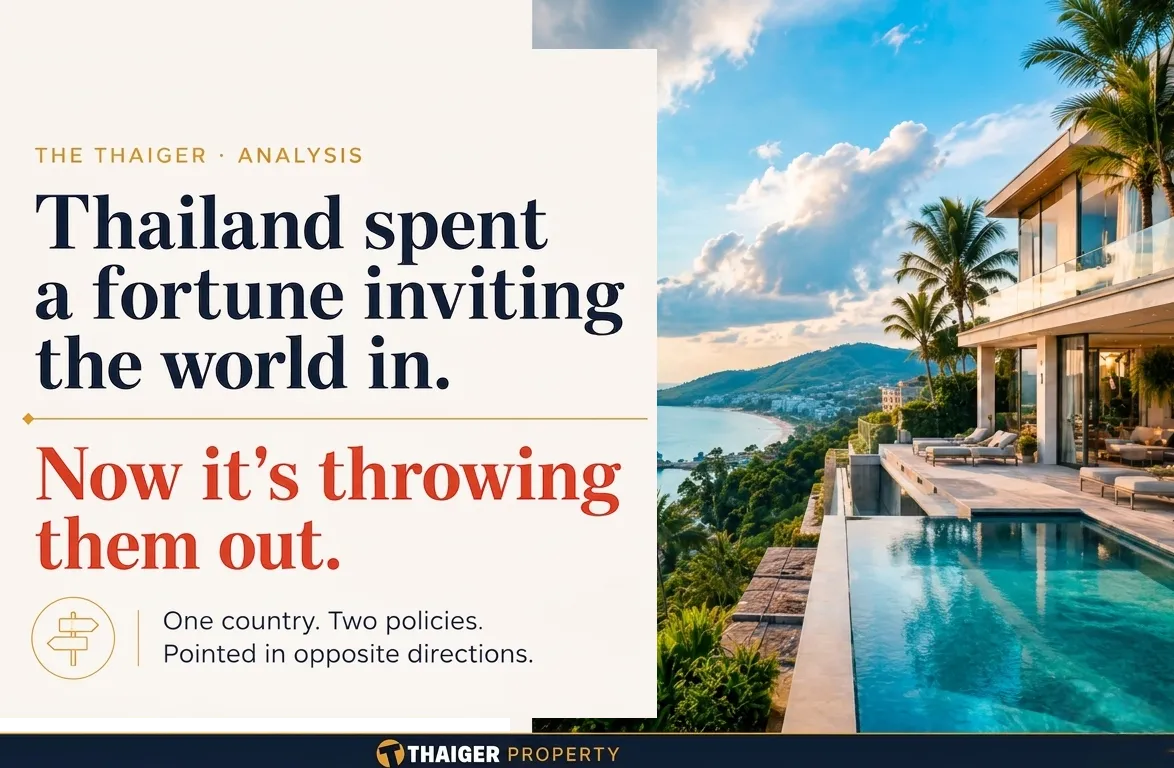
Thailand Faces Contradiction in Foreign Investment Policy
While Thailand is actively rewriting its business laws to attract global capital, a conflicting policy is leading to the prosecution of foreign individuals who have already invested in the country’s property market. This divergence presents a significant challenge to Thailand’s investment narrative and its long-term economic strategy.
Reforms Aim to Boost Competitiveness
Evidence of Thailand’s commitment to embracing foreign investment is a sweeping overhaul of the Foreign Business Act, approved in April 2025 and further solidified in January 2026. This reform will remove ten business categories, including software development, from restricted lists, allowing foreign tech companies to operate without local partners or special licenses. This initiative is a cornerstone of Thailand 4.0, the national vision to transform into a modern, high-value, and open economy. The underlying rationale is clear: Thailand has fallen behind regional competitors like Vietnam and Indonesia, and to meet OECD membership requirements, it must improve its openness scores and shed protectionist tendencies in favor of competitiveness.
Aggressive Property Sector Crackdown
However, in stark contrast to these efforts, another government sector is implementing an aggressive crackdown on the property and tourism industries, the most severe in two decades. New regulations mandate that Thai shareholders in foreign-linked companies must provide verifiable proof of their investment capital. Sophisticated analytical systems are being employed to identify discrepancies, such as modest-salaried individuals appearing to own multi-million-baht properties. A significant operation on Koh Phangan in May, prompted by a prime ministerial inspection, resulted in 22 arrests and the seizure of over 40 rai of land. The enforcement is escalating, with police summonses now issued under criminal procedures and enhanced data sharing among six agencies.
Addressing Genuine Abuse
Officials acknowledge the necessity of tackling genuine abuse within the system. The practice of Thai individuals acting as nominal shareholders without any financial contribution, decision-making power, or profit sharing is being targeted. Identifying individuals fronting numerous companies is seen not as a grey area but as outright fraud, and actions against such practices are deemed long overdue.
Unintended Consequences of Enforcement
The broad reach of the crackdown, however, is also ensnaring individuals who are not engaging in fraudulent activities. This includes retirees who purchased property a decade ago through structures recommended by reputable law firms and have since resided in the country and paid taxes. These individuals were not exploiting the system but were utilizing the only legal avenues available to them at the time.
A History of Withdrawn Opportunities
The narrative surrounding foreign property ownership in Thailand is marked by a series of missed opportunities. In late 2022, a proposed law would have allowed qualifying foreigners to legally own small plots of residential land, offering the first direct ownership route in twenty years. This bill was withdrawn within two weeks following opposition concerns about “selling off the country.” The existing workaround structures, such as leases, condo quotas, and nominee companies, were left in place. Further complicating matters, a Supreme Court ruling in March 2025 undermined the long-lease renewal structures that many foreign buyers had relied upon for security.
The Root of the Problem: Absence of Legal Pathways
The reliance on nominee companies and other workarounds can be understood as a symptom of a lack of clear, legal alternatives. The Foreign Business Act’s broad “other service businesses” clause, introduced in 1999, has been a significant factor in Thailand’s low openness scores and has driven foreigners to seek alternative methods. This restriction creates the very evasion it then seeks to punish.
A Coherent Strategy or a Policy Gap?
One interpretation suggests the dual approach of opening new business channels while prosecuting past rule-breakers is a deliberate strategy. This perspective posits that the crackdown serves as a necessary precursor to a more transparent and liberalized regime, preventing those who profited from evasion from easily integrating into the new system. However, this strategy is contingent on the promised reforms materializing. Without the subsequent reconstruction, the demolition efforts risk leaving the country with cleared land but no new development, and potential capital diverted elsewhere.
Regional Competition Intensifies
Neighboring countries have adopted more consistent approaches to foreign property ownership. Malaysia allows outright freehold ownership with safeguards for locals. Indonesia, while restricting freehold, offers long-term registered titles in foreign names. Dubai has become a global hub through clearly defined freehold zones. In contrast, Thailand’s current property landscape offers limited condo ownership, no direct land ownership route, a withdrawn ownership bill, and a lease structure weakened by judicial rulings, creating significant ambiguity for investors.
Call for Consistency and Political Will
The path forward requires consistency with the reforms already initiated. This includes reintroducing a land ownership framework similar to the 2022 proposal, incorporating safeguards for Thai citizens and preventing land banking. Strengthening lease structures and modernizing condo regulations are also crucial. Furthermore, the restrictive “other services” clause in the Foreign Business Act needs to be addressed to foster the growth of the modern economy envisioned by Thailand 4.0. The country that successfully pairs enforcement with a clear, legal welcome is poised to attract significant regional capital. The current approach risks seeing that capital flow to neighboring destinations while the market is tidied up without new investment.
The Path Forward: Building New Roads
The challenge for Thailand lies not in policy creation, as viable frameworks have been designed, but in the political will to implement and sustain them through electoral cycles. A 4.0 economy is ultimately defined by its ability to build new opportunities, not just police old ones. The question remains whether Thailand will commit to building these new roads or be left with cleared ground and missed opportunities.
Analysis based on publicly reported developments from 2025-2026. Professional legal or financial advice should be sought by individuals acting on any investment structures.
