

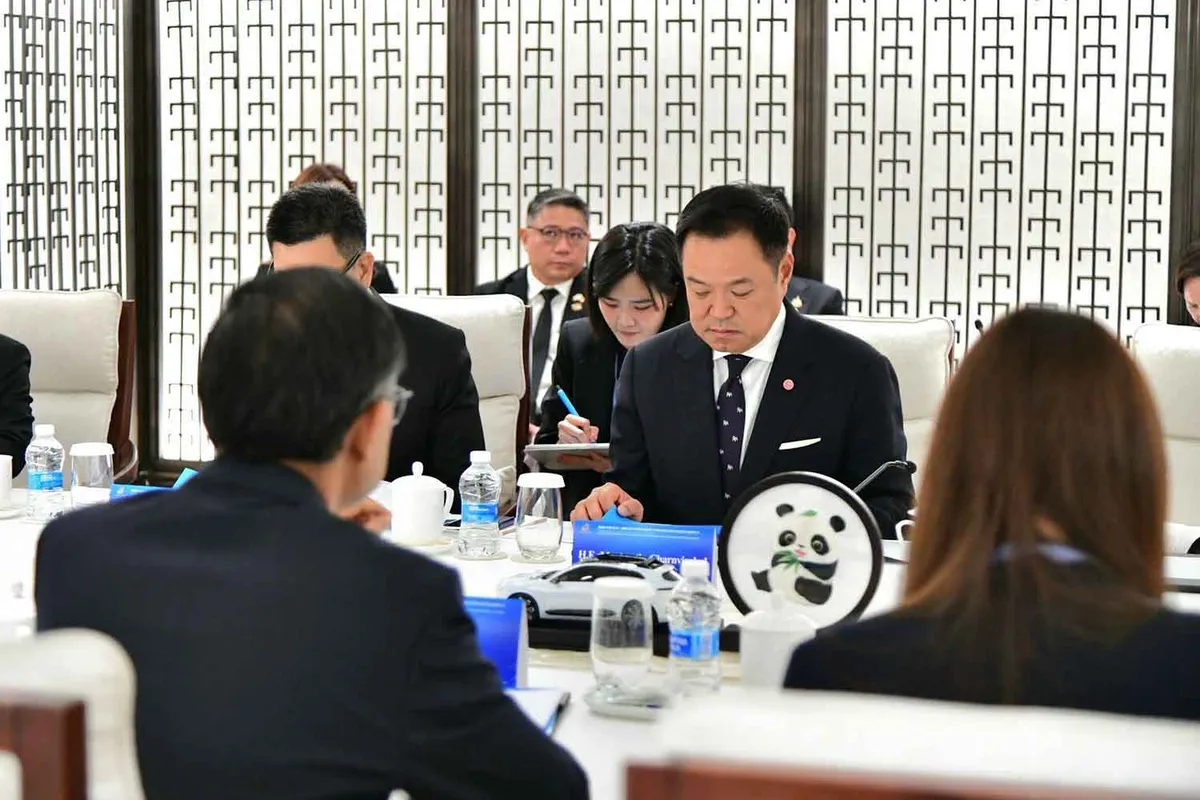
A recent investment roadshow in China has successfully attracted significant interest from leading Chinese companies, promising substantial financial inflows into Thailand’s electric vehicle (EV) and advanced technology sectors. The Thai delegation engaged in direct negotiations with four major corporations, securing commitments totaling approximately 70 billion baht. This figure includes 50 billion baht earmarked for expanding existing projects and over 20 billion baht designated for new investments.
Investment Exceeds Expectations Amid Shifting Geopolitics
The outcome of the investment drive surpassed initial expectations, according to Mr. Ekniti, who also serves as deputy prime minister. He attributed the robust response to evolving geopolitical landscapes, which are compelling Chinese manufacturers to diversify their production bases beyond mainland China. Thailand has emerged as a particularly attractive destination within Southeast Asia for this strategic diversification.
Key Investments and Expansion Plans
Several prominent companies have made significant commitments:
- Changan Automobile: The electric vehicle manufacturer has reaffirmed its plan to establish Thailand as its primary production hub for right-hand-drive vehicles outside of China. The company’s existing factory in Rayong province is set to become a crucial export center, serving markets covered by Thailand’s free trade agreements. Furthermore, Changan Automobile intends to double its annual production capacity to 200,000 vehicles.
- InnoLight Technology: This global leader in optical transceivers, a key player in AI and optical communications equipment, plans to expand its manufacturing footprint in Thailand. This expansion is projected to generate over 20,000 job opportunities. The company also intends to forge research partnerships with leading Thai universities, involving approximately 1,500 Thai engineers.
- Eoptolink Technology: Another significant entity in the optical communications sector, Eoptolink Technology, is already operating its first factory in Rayong and is actively constructing a second facility.
Strategic Partnerships and Future Industries
Discussions were also held with Xiaomi Corporation, the Chinese technology conglomerate. The Thai government is encouraging Xiaomi to leverage Thailand’s established smart electronics supply chain to develop the country into a manufacturing base for its smart home and Internet of Things (IoT) products. This move aligns with Thailand’s strategy to bolster its position in the future-oriented technology market.
Complementing these direct engagements, the Board of Investment (BoI) organized a business matching event in conjunction with the official opening of its new office in Chengdu. This event facilitated direct interaction between Thai and Chinese entrepreneurs, fostering opportunities for new partnerships and anticipated further investment generation.
A New Era of Industrial Transformation
Mr. Ekniti drew a parallel between the current wave of Chinese investment and the significant influx of Japanese manufacturers into Thailand’s Eastern Seaboard during the 1980s. That earlier period saw Thailand transform into a major regional manufacturing hub. He highlighted that while the scale of investment is comparable, the focus of this new wave is distinctly on future-oriented industries. These include cutting-edge sectors such as artificial intelligence, electric vehicles, and intelligent robotics, signaling a strategic shift towards high-value manufacturing and technological innovation.
The success of this roadshow underscores Thailand’s growing appeal as an investment destination, particularly for industries poised for significant growth in the coming decades. The government’s proactive engagement and the country’s strategic advantages appear to be paying dividends, positioning Thailand to capitalize on global manufacturing shifts and technological advancements.
