

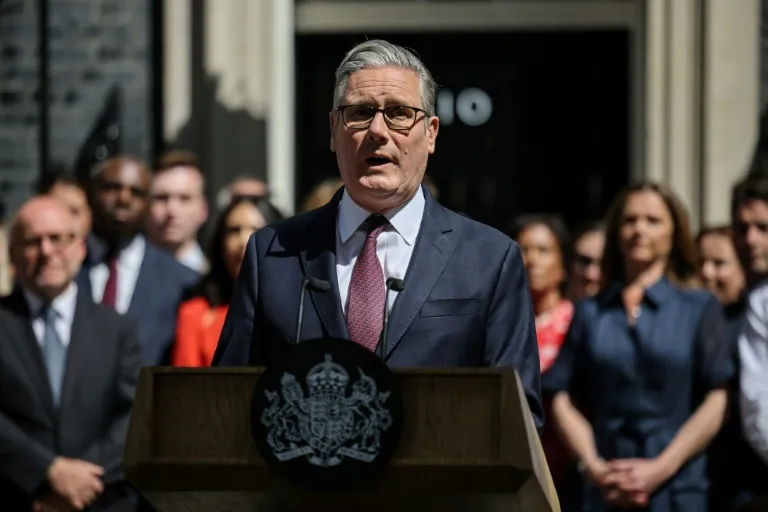
Andy Burnham is set to form the next UK government, taking over as Prime Minister following the resignation of Keir Starmer. Burnham, a prominent figure in the Labour Party, faces a daunting in-tray of economic and social challenges as he steps into Downing Street. His appointment marks a significant shift in leadership, with the country looking to him to navigate a turbulent political and economic landscape.
Starmer’s Farewell and Achievements
Keir Starmer concluded his tenure as Prime Minister by expressing pride in his government’s accomplishments. Speaking outside his Downing Street office, Starmer stated, “I am confident that Britain is now stronger and fairer than it was two years ago.” He added, “I go with good grace, I go with a smile, and I go proud of everything that we have achieved.” Starmer then proceeded to Buckingham Palace to formally offer his resignation to King Charles III.
Starmer led the Labour Party to a significant election victory in July 2024, ending 14 years of Conservative rule. However, his leadership was subsequently marred by a series of controversies, policy shifts, and public missteps, leading to his decision to step down as both Prime Minister and Labour Party leader in late June. Despite these challenges, Starmer’s government implemented a digital ID scheme, which his successor has since decided to scrap.
Burnham’s Mandate and Vision
Following Starmer’s resignation, Andy Burnham, the former Mayor of Greater Manchester, has been positioned by the Labour Party as their most viable candidate to lead the nation. Burnham, who recently returned to Parliament as a Member of Parliament, is now tasked with forming a new government. He is expected to outline his immediate priorities, which are reported to include restoring confidence in government and addressing the ongoing cost-of-living crisis. His agenda is also anticipated to focus on stimulating economic growth and empowering regional communities.
In an interview, Burnham indicated a desire to move past a decade of political instability, stating, “What we’ve been doing hasn’t been working. That’s the way I see it. I am going to try and do things in a different way.” He plans to adopt a distinct strategy for public spending and economic management, emphasizing early investment and intervention to foster individual success, rather than focusing on rectifying failures. Burnham has also pledged swift measures to alleviate the financial pressures faced by the public.
Key Challenges Facing the New Prime Minister
Burnham’s premiership begins under the shadow of considerable economic headwinds. The UK economy is experiencing sluggish growth, coupled with high levels of government borrowing and a rising welfare expenditure. The ongoing issue of irregular migrants arriving via small boats continues to be a significant concern, bolstering the support for anti-immigration parties like Reform UK.
Adding to these domestic pressures are international uncertainties. Fluctuations in energy prices, potentially exacerbated by geopolitical tensions such as the US-Iran conflict, and the unpredictable nature of global politics, including the stance of the US presidency under Donald Trump, present further risks to his administration.
The new Prime Minister must also contend with strict financial regulations that necessitate balancing government expenditure with tax revenues. This financial framework leaves little room for manoeuvre, particularly given the current economic climate.
Cabinet Appointments and Political Landscape
A key focus for the nation will be Burnham’s selection of senior cabinet members. The appointment of a new Chancellor of the Exchequer, to succeed Rachel Reeves, is particularly anticipated. Burnham, often referred to as the “King of the North” for his previous role in Greater Manchester, is seen by some as Labour’s best hope to counter the growing influence of Nigel Farage’s Reform UK party.
Burnham’s Political Trajectory
Burnham has a history in national politics, having served as an MP from 2001 to 2017 and holding ministerial positions under Prime Ministers Tony Blair and Gordon Brown. He has since cultivated a public image as a relatable figure, combining a down-to-earth demeanour with modern communication strategies.
With the next general election anticipated in 2029, Burnham has a limited timeframe of three years to enact significant change and demonstrate progress. He has described his ascent to the Labour leadership as the party’s “last chance” to regain public trust and deliver effective governance. Critics have previously questioned the preparedness of Starmer’s government for power, and Burnham faces scrutiny over how he intends to achieve his ambitious goals.
Early Policy Decisions
Burnham’s administration has already made its first significant policy decision by announcing the cancellation of Starmer’s national digital ID scheme. This project, estimated to cost £1.8 billion over three years, will see its resources redirected towards more pressing needs, such as assisting with the cost of living.
This move signals Burnham’s intention to prioritize immediate relief for citizens struggling with economic hardship and to differentiate his approach from that of his predecessor. The coming months will reveal the full extent of his strategy as he attempts to steer the country through its current difficulties and build a foundation for future stability.
Conclusion
The transition of power to Andy Burnham signifies a new chapter for the UK. As he steps into the role of Prime Minister, he inherits a nation grappling with economic fragility, international uncertainties, and public expectations for decisive leadership. His early policy choices, particularly the scrapping of the digital ID scheme and his focus on the cost of living, suggest a pragmatic approach aimed at addressing immediate concerns. The success of his premiership will depend on his ability to navigate these complex challenges, foster economic recovery, and restore public confidence in government within the limited timeframe he has.
