

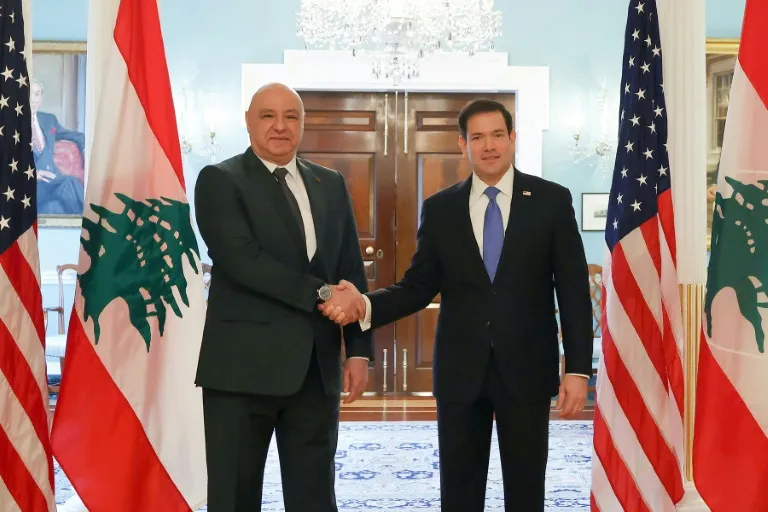
Lebanese President Michel Aoun is scheduled to meet with U.S. President Donald Trump in Washington, D.C., facing significant international pressure, particularly from the United States and Israel, to disarm the powerful Iran-backed militant group Hezbollah. This meeting marks the first visit by a Lebanese president to Washington since 2009 and comes at a critical juncture for Lebanon, which is seeking to navigate complex regional dynamics and secure its sovereignty.
Disarming Hezbollah: A Key Demand
The disarmament of Hezbollah has been consistently presented by Israel as a prerequisite for ending its military occupation of southern Lebanon. This demand is strongly supported by the U.S. administration. U.S. Secretary of State Marco Rubio, following a meeting with President Aoun, emphasized that lasting peace for Lebanon is contingent upon resolving the issue of Hezbollah’s armed presence. He commended the Lebanese government’s efforts to assert sovereignty, disarm Hezbollah, and dismantle what he termed its “terrorist infrastructure.”
President Aoun, a former army commander, has publicly committed to disarming Hezbollah since his election in early 2025 with Western backing, signaling a notable shift in Lebanon’s political landscape. However, Hezbollah has repeatedly refused to relinquish its weapons, citing its role as a resistance movement against Israeli occupation.
The Pilot Zones and Security Arrangements
As part of a recent framework agreement between the U.S. and Iran, and a subsequent deal between Lebanon and Israel, Israeli forces are slated to withdraw from southern Lebanon. This withdrawal is to be accompanied by the deployment of the Lebanese army to secure the region. The agreement includes the establishment of “pilot zones” where the Lebanese army will begin deploying to demonstrate its capacity to maintain security and disarm Hezbollah. The village of Zawtar al-Garhbiya is one such pilot zone where the army commenced deployment on Tuesday. Israel’s military has indicated it will adjust its own force posture in response to these developments.
These security arrangements are intended to serve as a proof of concept, showcasing the Lebanese army’s ability to manage security and disarm militant factions. However, Hezbollah has explicitly rejected both the framework agreement and the underlying negotiations between Lebanon and Israel. Analysts like Maha Yahya, director of the Carnegie Middle East Center, have expressed concerns that the agreement may be “deeply disadvantageous” to Lebanon, raising questions about the potential U.S. demands on the Lebanese government.
Aoun’s Objectives and U.S. Expectations
President Aoun’s agenda in Washington is expected to include seeking increased aid for the Lebanese army, a vital institution for maintaining stability within the country. In return, U.S. officials, including President Trump, will likely seek concrete assurances of Lebanon’s commitment to disarming Hezbollah. Robert Satloff, executive director at the Washington Institute, suggests that President Trump will be looking for tangible evidence of Aoun’s seriousness in this endeavor. Furthermore, U.S. expectations may extend to ensuring that Lebanese army officers perceived as collaborating with Hezbollah are removed, and ultimately, to achieving a comprehensive peace agreement between Lebanon and Israel.
Regional Context and Historical Background
The current situation is framed against a backdrop of prolonged regional conflict. Hezbollah has engaged in multiple confrontations with Israel, with the latest conflict resulting in over 4,300 reported fatalities in Lebanon, according to Lebanese authorities. The recent decrease in violence follows the framework agreement and the Lebanon-Israel deal. However, the broader geopolitical tensions remain, particularly concerning Iran’s role. Iran, which had insisted on Lebanon’s inclusion in its April ceasefire with Washington, has seen renewed attacks since July 7, indicating the volatile nature of regional dynamics.
President Aoun’s administration faces the delicate task of balancing domestic political realities, regional pressures, and international expectations. His commitment to disarming Hezbollah, while politically significant, runs counter to the group’s entrenched position. The success of the pilot zones and the broader security plan hinges on the cooperation of all parties involved, including Hezbollah, which has so far shown no inclination to disarm. The upcoming discussions in Washington are crucial for shaping the future trajectory of Lebanon’s security and its relationship with both regional powers and the United States.
Conclusion
The meeting between Presidents Aoun and Trump underscores the significant international focus on Lebanon’s internal security and its role in regional stability. The core issue remains the disarmament of Hezbollah, a complex challenge with deep historical roots and significant political implications for Lebanon. While the deployment of the Lebanese army in pilot zones represents a step towards asserting state control, the path forward will require careful diplomacy, sustained commitment from the Lebanese government, and a resolution to the broader regional conflicts that fuel such heavily armed non-state actors.
