

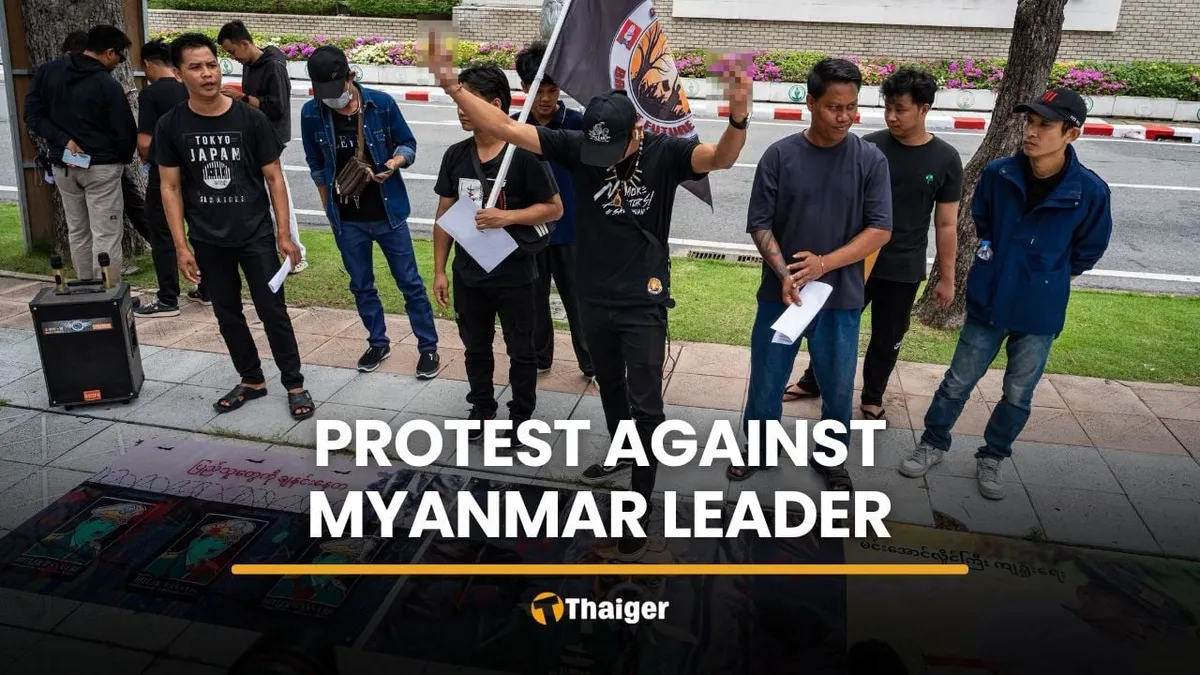
A coalition of migrant worker networks, Thai citizens, and advocacy groups protested outside the United Nations office in Thailand on August 6, expressing strong opposition to the Thai government’s engagement with Myanmar’s Senior General Min Aung Hlaing and representatives of the State Administration Council (SAC). The demonstration highlighted concerns that such interactions legitimize the SAC and negatively impact Myanmar’s migrant population in Thailand.
Protesters Voice Concerns Over Government Reception
The group, identified as Legacy The Bright Future, along with migrant worker networks and concerned Thai citizens, gathered to voice their dissent. Protesters engaged in music, singing, and the reading of a formal statement. This statement vehemently condemned Thailand’s decision to engage with Myanmar’s military leadership, arguing that it undermines Thailand’s international human rights standing. Furthermore, they asserted that this engagement allows the military administration in Myanmar to exert pressure on migrant workers who have sought refuge in Thailand.
Financial Pressures on Migrant Workers
A significant point of contention raised by the protesters revolved around financial regulations imposed on Myanmar workers in Thailand. Specifically, concerns were voiced regarding new rules that reportedly require these workers to transfer at least 25% of their income back to Myanmar through state-approved banks as a condition for renewing their work permits. The protesters argued that this mandate effectively compels migrant workers to financially support the SAC, the ruling body in Myanmar led by Min Aung Hlaing.
Beyond the mandatory income transfer, Bright Future also alleged that migrant workers are subjected to unofficial fees, ranging from 1,000 to 3,000 baht per person, to access Certificate of Identity (CI) centers. These payments, according to the group, are collected without any official receipts. Protesters claimed that individuals who refuse to pay these unofficial charges are denied services, even if they have made official appointments and paid the required fees.
Broader Condemnations of the SAC
The protest extended beyond financial grievances to encompass broader condemnations of the Myanmar military’s actions. Protesters explicitly denounced alleged war crimes attributed to the SAC, citing incidents such as the bombing of civilian areas, the burning of villages, and the arrest of political opponents. The demonstrators drew a connection between the ongoing instability in Myanmar and issues along the Thai-Myanmar border, including the movement of refugees, transnational crime, call center scams, and drug trafficking.
Demands Presented to the Thai Government
During the demonstration, Bright Future presented a three-point list of demands to the Thai government. These demands aimed to pressure Thailand to alter its approach to engaging with the SAC:
- End Engagement with SAC Leadership: The group called for Thailand to cease all cooperation with and recognition of Min Aung Hlaing and his administration.
- Reform Migrant Worker Documentation: Bright Future urged the replacement of the current CI process with a simplified system, such as a single pink card. Crucially, they proposed eliminating the necessity for workers to interact with the Myanmar embassy, aiming to disrupt what they described as a financial network that benefits the military.
- Prepare for Future Governance in Myanmar: The protesters requested that Thailand prepare to recognize a legitimate people’s government in Myanmar and support the development of future self-governance structures within the country.
Criticism of Thailand’s Diplomatic Stance
A representative from Bright Future specifically criticized the Thai government’s decision to engage with Min Aung Hlaing, emphasizing that he is not the legitimate leader of Myanmar. The representative advocated for Thailand to instead engage with Myanmar’s pro-democracy federal government. Reports also indicated that this representative linked networks associated with Myanmar’s military leadership to illicit activities, including drugs, scams, and human trafficking.
Environmental Concerns and Transnational Pollution
The protest also saw participation from Thai citizens raising distinct but related concerns. One resident from Chiang Rai highlighted issues surrounding rare-earth mining and its alleged environmental consequences, particularly the heavy-metal contamination of several major rivers, including the Mekong, Sai, Ruak, Kok, Salween, and Kraburi rivers. This protester accused Min Aung Hlaing of profiting from such mining operations and expressed alarm over the potential health risks to millions of people relying on the contaminated water sources.
The Thai government’s plans for a transboundary pollution agreement with Myanmar also came under scrutiny. The protester questioned the agreement’s focus, noting that it reportedly centered on the Kok River despite alleged contamination in five other waterways. Concerns were also raised about the accessibility of pollution data and the scale of mining operations in Myanmar, with references made to an Interpol warrant. The protester asserted that Thailand should prioritize prosecuting those responsible for environmental damage rather than welcoming Min Aung Hlaing, emphasizing the suffering of communities in northern Thailand and along the Mekong River due to pollution.
Conclusion
The protest on August 6 underscored a deep-seated opposition among various groups to Thailand’s diplomatic engagement with Myanmar’s military leadership. The demonstrators articulated a range of grievances, from the financial exploitation of migrant workers and the legitimization of the SAC to serious environmental concerns linked to cross-border mining. Their demands called for a fundamental shift in Thailand’s foreign policy towards Myanmar, advocating for support of democratic forces and the protection of human rights and the environment.
