

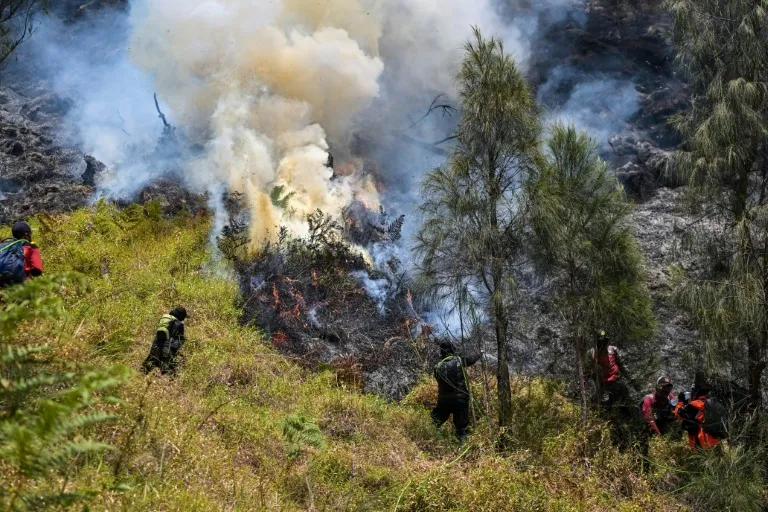
A significant wildfire is currently engulfing parts of Mount Bromo in East Java, Indonesia, a popular tourist attraction that has been temporarily closed to visitors. The blaze, which ignited on Monday, has already consumed at least 127 hectares (approximately 314 acres) of national park land, an area comparable to about 180 football fields. Firefighting efforts are being hampered by challenging terrain and wind conditions, according to officials.
Battling the Flames in Difficult Terrain
Local authorities have mobilized two water-bombing helicopters to combat the escalating wildfire. However, the challenging landscape of Mount Bromo, characterized by steep cliffs, is making it exceedingly difficult for ground crews to access and extinguish the flames. Bambang Setyo Antoko, a fire official, emphasized the critical role of wind conditions in the ongoing battle against the fire, stating, “We’re very dependent on wind conditions.”
The exact cause of the fire remains under investigation. However, officials noted that the park is exceptionally dry, a condition exacerbated by the developing El Niño phenomenon in Indonesia. This extreme dryness significantly increases the risk and intensity of wildfires.
El Niño’s Impact on Indonesia’s Wildfire Risk
The current wildfire at Mount Bromo serves as a stark reminder of the heightened wildfire risks associated with El Niño. This naturally occurring climate pattern influences global weather systems, typically leading to drier and hotter conditions across Southeast Asia, including Indonesia. The Indonesian Meteorology, Climatology, and Geophysics Agency (BMKG) has issued warnings that the upcoming dry season, predicted for 2026, is expected to be more severe and prolonged than usual. This forecast points to an elevated risk of both wildfires and drought conditions.
The impact of dry seasons and potential climate shifts is already evident. Between January and June of the current year, Indonesia experienced extensive land fires, with over 107,000 hectares (approximately 264,420 acres) burning. This figure is more than double the area affected by forest fires in the entirety of 2023, according to data from the Ministry of Forestry. These figures underscore a worrying trend of increasing land degradation due to fires.
Historical Context and Global Climate Trends
Mount Bromo has a history of experiencing fires. In 2023, a separate blaze erupted when a couple ignited a flare during a pre-wedding photoshoot, ultimately destroying over 500 hectares (approximately 1,235 acres) of land. This incident highlights how human activities, even unintentional ones, can have devastating consequences in dry conditions.
The current situation in Indonesia is also occurring against a backdrop of global climate trends. The last El Niño event contributed to 2023 and 2024 being recorded as the two hottest years globally on record. El Niño’s influence on weather patterns, including shifts in wind, air pressure, and rainfall, has far-reaching consequences. While it typically brings drier conditions to regions like India and Southeast Asia, its effects vary across the globe, sometimes leading to increased rainfall in other areas.
Understanding El Niño
El Niño is a complex, naturally occurring climate phenomenon characterized by the warming of sea surface temperatures in the central and eastern tropical Pacific Ocean. This warming disrupts normal atmospheric circulation patterns, leading to significant changes in weather worldwide. Key characteristics of El Niño include:
- Oceanic Changes: A sustained period of warmer-than-average sea surface temperatures in the equatorial Pacific.
- Atmospheric Shifts: Alterations in wind patterns, air pressure systems, and cloud formation.
- Global Weather Impacts: Diverse effects on precipitation and temperature across different continents. In some regions, it can cause droughts and heatwaves, while in others, it may lead to increased rainfall and flooding.
- Frequency: El Niño events typically occur every two to seven years and can last from several months to a couple of years.
The current El Niño event is contributing to the heightened risk of wildfires in Indonesia, underscoring the vulnerability of its ecosystems to climate variations. The ongoing efforts to contain the Mount Bromo wildfire are a critical priority, not only for preserving the natural beauty of the national park but also for mitigating the broader environmental and economic impacts of such events.
Conclusion
The wildfire at Mount Bromo is a critical environmental challenge for Indonesia, exacerbated by the prevailing El Niño conditions. The difficult terrain and dry vegetation present significant obstacles to firefighting efforts. As the nation grapples with this immediate crisis, the long-term implications of climate change and phenomena like El Niño on the frequency and intensity of natural disasters, particularly wildfires and droughts, remain a pressing concern. Authorities continue to monitor the situation closely, with the hope of bringing the blaze under control while ensuring the safety of personnel and the surrounding environment.
