

Niger’s presidential guard successfully repelled an attempted coup originating from within the armed forces, according to a security source. The incident involved heavy gunfire and disruptions in the capital, Niamey, overnight and into Saturday morning. State television’s signal was temporarily interrupted, adding to the tension.
Overnight Clashes Erupt in Niamey
Residents of Niamey reported hearing sustained gunfire and explosions throughout the night and early morning. The disturbances were concentrated in several areas, including the city center near the presidential palace and the vicinity of the airport, which houses a significant military base. The state television channel, Tele Sahel, went off the air for over an hour, resuming transmission around 10 a.m. local time. Access to the presidential palace and national television studios was reportedly blocked by soldiers.
The initial sounds of gunfire began around 1 a.m. and continued until dawn, with further bursts heard later in the morning. Eyewitnesses described the intensity and type of weaponry used as indicative of organized military action rather than attacks by jihadist groups typically operating in the region.
Armored vehicles were observed reinforcing areas near the airport, and videos circulating online depicted the deployment of military hardware. A local resident recounted an incident where a military vehicle was forced to turn back, suggesting significant disruption and heightened security measures.
Context: Niger’s Security Challenges
Niger has been under military rule for the past three years, led by a junta that has faced considerable challenges in combating persistent jihadist violence. This insurgency has plagued the West African nation for approximately a decade. However, intelligence sources indicated that Saturday’s events were not directly linked to jihadist factions but rather stemmed from a mutiny involving troops from various regional military bases who converged on the capital.
Discontent within certain military factions has been attributed to the leadership’s handling of the ongoing fight against jihadists, with concerns raised about the high number of casualties among frontline soldiers. In response to the unfolding events, the military issued a statement via social media urging calm and caution against the spread of unverified information, emphasizing that defense and security forces were mobilized to protect the nation.
Jihadist Activity in Niger
Niamey’s airport has been a target for jihadist groups earlier in the year. In January, the Islamic State in the Sahel (EIS) claimed responsibility for an assault, followed by a late June attack attributed to their rivals, the Group for the Support of Islam and Muslims (JNIM), an affiliate of Al-Qaeda in the Sahel. These groups not only target civilians and the military but also engage in a struggle for dominance within the Sahel region, including Niger.
Authorities reported that the January attack resulted in the deaths of twenty assailants and four soldiers, with four soldiers wounded. The head of Niger’s military regime, General Abdourahamane Tiani, who came to power following a coup in July 2023, had previously acknowledged a “flaw in the system” that allowed the January attack, which he stated aimed to cripple the army’s air capabilities. In the June incident, at least 11 soldiers and two civilians were killed, along with 22 attackers, according to the defense ministry. The army successfully repelled both assaults.
Regional Dynamics and Shifting Alliances
The EIS and JNIM are also active in neighboring Burkina Faso and Mali, countries that, like Niger, are currently governed by military juntas that came to power through coups. These three nations have recently withdrawn from the Economic Community of West African States (Ecowas) bloc. They have also distanced themselves from traditional Western partners, particularly France, in their counter-terrorism efforts, and have instead pursued closer ties with Russia.
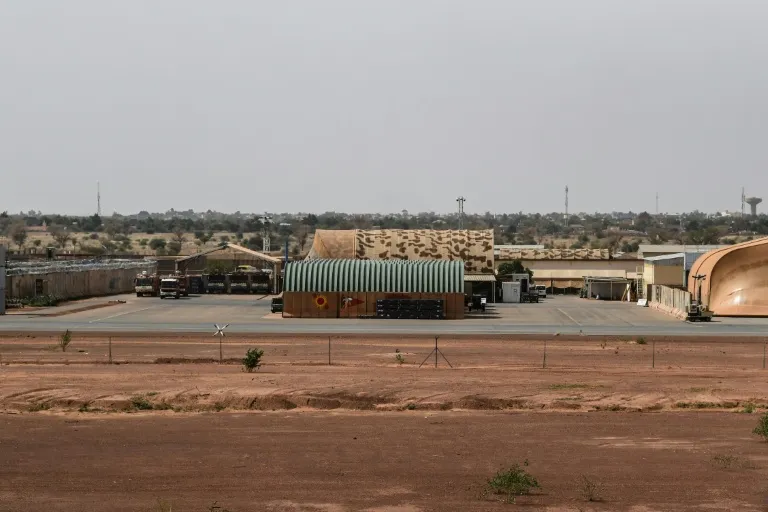
Air Force Base 101, situated within the Niamey international airport complex, is a significant location. It hosts the headquarters of Niger’s Russian Africa Corps partners and the command center for the unified force of the Alliance of Sahel States, an alliance comprising Niger, Burkina Faso, and Mali. This base is considered strategically sensitive. Notably, a substantial shipment of uranium concentrate was held at the base between December and January, awaiting export, with no subsequent movement of the material reported.
Conclusion
The attempted incursion at the presidential palace highlights the volatile security landscape in Niger. While the presidential guard managed to thwart the immediate threat, the incident underscores underlying tensions within the armed forces and the persistent challenges posed by regional instability and jihadist insurgencies. The situation remains fluid, with authorities working to restore full stability and address the root causes of the unrest.
