

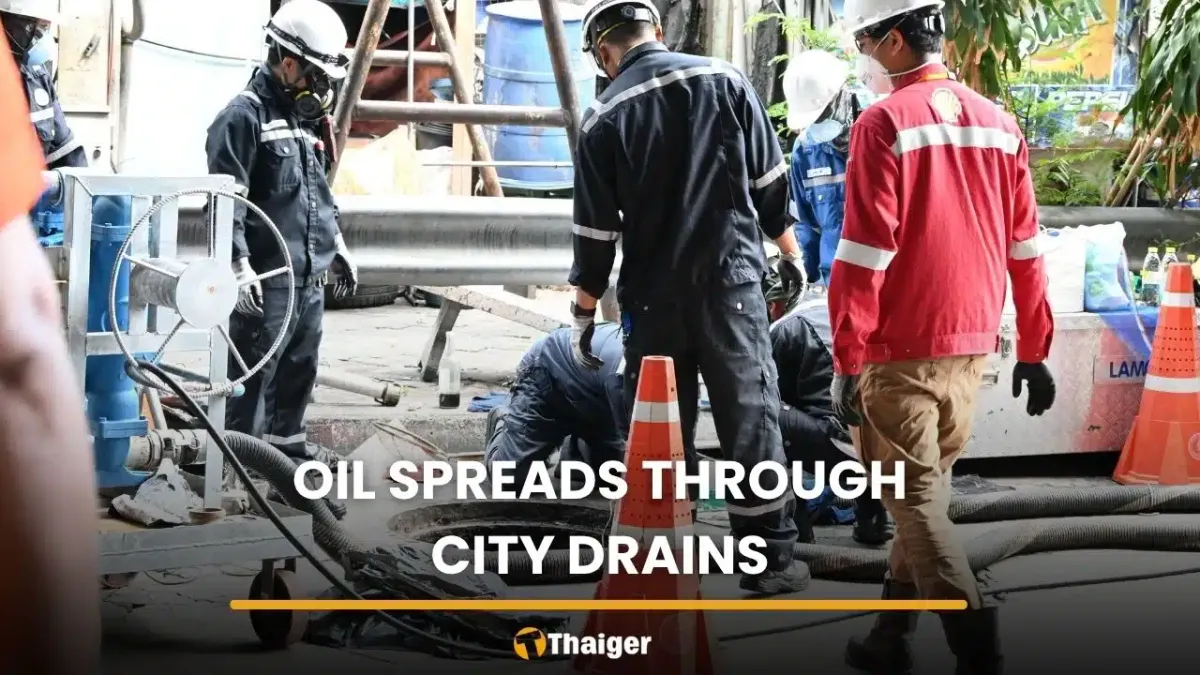
An oil leak in Bangkok has been contained, with authorities actively investigating its origin after residents reported a strong fuel odor and the discovery of oil within the city’s drainage system. Emergency crews responded swiftly to the incident, implementing containment measures and initiating safety monitoring in the affected vicinity.
Discovery and Initial Response
The contamination was first detected on September 7th, with residents near Rama III Road and Chuea Phloeng Road, close to the border of Khlong Toei and Yan Nawa districts, reporting a pervasive fuel smell. Subsequent inspections confirmed the presence of oil within the underground drainage network, prompting immediate action.
Bangkok Governor Chadchart Sittipunt visited the site on the evening of September 7th, accompanied by officials from relevant district offices, the Department of Drainage and Sewerage, and the Pollution Control Department. In response, crews deployed oil-absorbent booms within the drainage system to prevent further spread and began the process of removing the contaminated liquid.
Containment and Monitoring Efforts
To mitigate potential fire and health hazards associated with volatile organic compounds, air quality monitoring was established in the surrounding area. By the morning of September 8th, although oil was still present in parts of the underground network and the odor persisted, containment efforts were well underway. Officials reported that approximately 20,000 liters of an oil-water mixture had been pumped out, with an initial estimate suggesting around 4,000 liters of pure oil, pending laboratory confirmation.
The affected section was localized to about 50 meters of drainage pipe, covering an estimated 1,000 square meters. Sandbags were strategically placed to block both ends of the contaminated segment, and the recovered mixture was transported for separation and disposal. Authorities confirmed that the contamination had not reached any public waterways. The volume of oil remaining and the intensity of the odor reportedly diminished following the pumping and containment operations.
Investigating the Source
The primary focus of the ongoing investigation is to pinpoint the exact source of the oil leak. Several possibilities were initially considered, including accidental spills or deliberate illegal dumping. However, a leading hypothesis now centers on a potential leak from an underground fuel pipeline that runs near the affected drains.
Governor Chadchart indicated that two such pipelines, each approximately 2 meters deep and 14 inches in diameter, traverse the area. These pipelines, operational for over three decades, transport various petroleum products. While a pipeline rupture remains a strong possibility, officials emphasized that it is not yet definitively confirmed.
Evidence supporting the pipeline theory includes a reduction in the oil flow into the drains after pipeline pressure was lowered post-discovery. Engineers commenced excavation work around the suspected pipeline area on September 9th to conduct direct inspections and identify any potential damage.
Safety Precautions and Community Guidance
Continuous, round-the-clock monitoring of fuel vapors and the lower explosive limit (LEL) is being conducted. Current readings are within safe parameters, and there have been no indications necessitating the evacuation of nearby communities. Nevertheless, residents in the vicinity have been advised against smoking, lighting fires, or engaging in any activities that could generate sparks near the drains.
Individuals experiencing strong fuel odors within buildings are encouraged to enhance ventilation. Special precautions are recommended for vulnerable groups, including children, the elderly, and those with respiratory ailments. The Bangkok Metropolitan Administration, in collaboration with the Ministry of Energy, the Pollution Control Department, and petroleum experts, continues its diligent search for the leak’s origin while ensuring the safety and well-being of the surrounding communities.
Conclusion
While the immediate threat of the oil leak spreading has been contained, the investigation into its source is ongoing. Authorities are employing a multi-faceted approach, combining technical inspection of potential infrastructure failures with environmental monitoring and public safety advisories. The situation underscores the importance of robust infrastructure maintenance and rapid emergency response in urban environments.
