

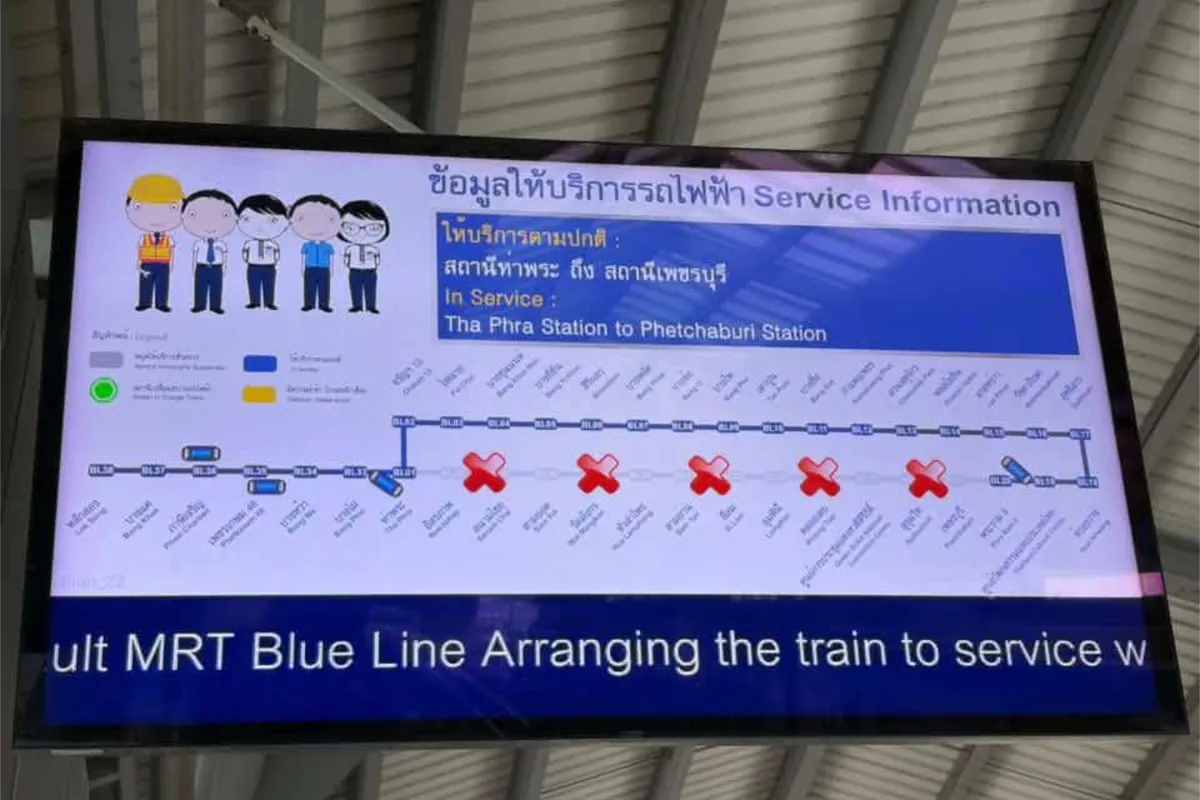
Commuters in Bangkok experienced significant disruptions on Saturday afternoon when a signaling system failure on the MRT Blue Line halted services for over two hours. The incident affected a substantial 12-station segment of the popular subway line, forcing passengers to seek alternative transportation and reroute their journeys. The Bangkok Expressway and Metro (BEM), the service operator, confirmed the issue and subsequent repair efforts.
Signaling System Failure Causes Widespread Delays
The problem was first identified at Hua Lamphong station, impacting services on the route heading towards Tha Phra and Lak Song. BEM issued an initial announcement at 2:25 PM, detailing the disruption. However, earlier online posts from the operator indicated a delay of approximately 30 minutes, with the first notification appearing around 1:20 PM. This discrepancy and the prolonged nature of the outage led to frustration among many passengers, who took to social media to inquire about service resumption times.
One passenger, commenting on a social media post at 3:15 PM, reported that the service remained unavailable. According to this commuter, station staff at Hua Lamphong indicated that repairs might take an additional hour and a half to complete. The extent of the service suspension was visually confirmed by screens displayed at Blue Line stations, which showed that operations were halted across 12 stations, stretching from Phetchaburi (BL21) to Itsaraphap (BL32).
Restoration and Alternative Travel Advice
After more than two hours of suspended service, BEM announced at 4:13 PM that the signaling system repairs were successfully completed, and normal operations were gradually resuming. During the period of disruption, BEM provided guidance for passengers needing to travel to key areas of Bangkok.
Recommendations for Inner Bangkok Travel
For those heading towards the city center, including popular districts like Sukhumvit and Silom, passengers were advised to transfer to the BTS Skytrain. This transfer could be made at either Mo Chit station or Bang Wa station, depending on the passenger’s original location and intended destination.
Airport Link Connectivity
Passengers aiming to reach the Airport Rail Link were directed to utilize the BTS Skytrain as well. The recommended transfer point for this connection was Phaya Thai station, a major transit hub that links the BTS and Airport Rail Link systems.
Shuttle Bus Services
To further assist commuters, two BMTA (Bangkok Metropolitan Transit Authority) shuttle buses were deployed. These buses operated a specific route connecting Rama IX station and Tha Phra station, offering an additional ground-level transportation option for those caught in the MRT disruption.
Understanding the MRT Blue Line Network
The MRT Blue Line is a crucial component of Bangkok’s public transportation network, forming a circular route that serves numerous densely populated areas and key commercial districts. Its extensive coverage includes major stations such as Hua Lamphong, Phetchaburi, and Itsaraphap, among others affected by the recent incident. The line’s strategic importance means that any disruption can have a significant ripple effect on daily commutes for thousands of residents and visitors.
The Blue Line’s design facilitates connections with other major transit lines, including the BTS Skytrain at several interchange stations like Mo Chit, Phaya Thai, and Asok (Sukhumvit). It also provides access to the Airport Rail Link via Phaya Thai. This interconnectedness is vital for the seamless flow of urban mobility, underscoring the impact of the signaling failure on the broader transportation ecosystem.
Importance of Signaling Systems in Urban Rail
Signaling systems are the backbone of any modern railway operation, ensuring the safe and efficient movement of trains. They are responsible for controlling train speeds, maintaining safe distances between trains, and managing track switches. A failure in such a critical system can have immediate and severe consequences, leading to service suspensions, delays, and potential safety risks if not managed properly.
Modern signaling systems often employ sophisticated technologies, including computer-based interlockings and communication-based train control (CBTC). Despite their advanced nature, these systems can be susceptible to various issues, ranging from hardware malfunctions and software glitches to external factors like power fluctuations or environmental conditions. Regular maintenance, rigorous testing, and robust contingency plans are essential to minimize the impact of such failures.
The incident on the MRT Blue Line highlights the reliance of urban populations on these complex technological infrastructures. While BEM’s prompt announcement and provision of alternative travel advice were crucial in mitigating the immediate impact, the event also underscores the ongoing need for investment in system reliability and redundancy to prevent future occurrences and ensure the consistent operation of vital public transport services.
Conclusion: Resilience and Future Preparedness
The resolution of the signaling system failure on the MRT Blue Line brought relief to stranded passengers, allowing normal travel patterns to resume. The incident served as a reminder of the complexities involved in managing large-scale urban transit systems and the critical role of reliable signaling technology. BEM’s response, including the provision of alternative travel options, aimed to minimize inconvenience. As Bangkok continues to expand its public transportation network, ensuring the resilience and redundancy of core systems like signaling will remain paramount for maintaining the efficiency and reliability that commuters depend on daily.
A full route map of the MRT Blue Line is available for reference.
