

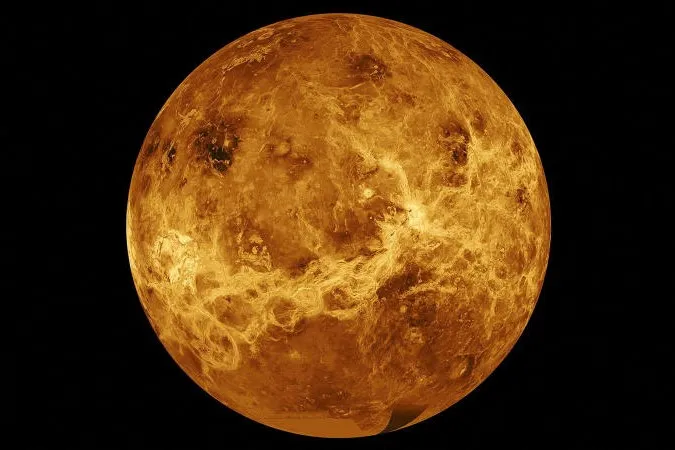
A groundbreaking theory suggests that Venus, often called Earth’s twin, may have once possessed a moon only to lose it through a process of ‘celestial cannibalism.’ Scientists propose that the planet’s exceptionally slow rotation would have caused any natural satellite to spiral inward and ultimately collide with Venus. This new hypothesis offers a fresh perspective on why Venus currently appears moonless, diverging from previous explanations that suggested the planet either never formed a moon or lost one through a catastrophic impact.
The Slow Spin of Venus and Lunar Demise
Astrophysicist Stephen Krane, the lead author of the study from the University of California, Riverside, explained that if Venus had a moon in its past, its slow rotation would have made it impossible to retain. “That moon would have crashed down on the planet in a relatively short time scale,” Krane stated. The research, published in The Astrophysical Journal, utilized computer models that simulated the gravitational interactions between Venus and hypothetical moons of varying sizes. These simulations consistently showed that any such moon would eventually fall back to its parent planet.
This presumed moon-swallowing event, according to Krane, likely occurred within the first billion years of Venus’s existence, a period when the solar system was still in its formative stages, approximately 4.5 billion years ago. Previous scientific thought posited that Venus either never formed a moon or that any existing moon was destroyed by a massive collision with another celestial body. However, the UC Riverside study highlights the critical role of a planet’s rotational speed in maintaining a stable orbit for its moon.
Earth’s Rapid Rotation vs. Venus’s Sluggish Spin
The study’s focus on Earth-moon dynamics revealed a stark contrast between our own planet and Venus. Earth completes a rotation on its axis every 24 hours, a pace more than 200 times faster than Venus, which takes a lengthy 243 Earth days to rotate once – a period longer than its orbital period around the sun. This rapid rotation of Earth plays a crucial role in the gradual recession of our moon.
The energy transferred from Earth’s swift spin is actively pushing the moon farther away. This phenomenon is precisely measured, with the moon receding from Earth at a rate of approximately 4 centimeters per year. This measurement is corroborated by laser reflectors placed on the lunar surface by Apollo 11 astronauts in 1969.
In contrast, Venus’s languid rotation would have had the opposite effect on any hypothetical moon. Instead of pushing a satellite away, the slow spin would have facilitated the gradual inward spiral of a moon due to tidal forces and other gravitational interactions. Over vast stretches of time, this process would inevitably lead to the moon’s collision with the planet.
Venus: A Planet of Extremes and Unanswered Questions
Venus, the third brightest object visible in the night sky after the sun and moon, is a subject of intense scientific interest. Its similarities to Earth in terms of rocky structure and size make it a valuable target for understanding our own planet’s history and potential future. However, Venus is also a world of extremes, enveloped in a dense, toxic atmosphere that has triggered a runaway greenhouse effect. Surface temperatures soar to a scorching 471°C (880°F), hot enough to melt lead.
While direct evidence of a Venusian moon remains elusive, Krane argues that it is improbable Venus, in its early history, avoided the kind of colossal impact event widely believed to have formed Earth’s moon. The early inner solar system was a chaotic environment, characterized by numerous large, rocky bodies colliding. Given its proximity to the sun, Venus may have experienced even more such impacts than Earth.
Future Missions to Unravel Venusian Mysteries
The quest to understand Venus and its potential past continues. NASA has two significant missions planned for launch in the late 2020s or early 2030s: DAVINCI+ (Deep Atmosphere Venus Investigation of Noble gases, Chemistry, and Imaging) and VERITAS (Venus Emissivity, Radio Science, InSAR, Topography, and Spectroscopy). These missions are designed to delve into the planet’s complex atmosphere and map its geological features, potentially offering further clues about its formation and evolution, and perhaps shedding light on the fate of any ancient Venusian moons.
The theory of celestial cannibalism provides a compelling, albeit speculative, explanation for Venus’s lack of a moon. It underscores the delicate balance of forces governing planetary systems and highlights how subtle differences, like rotational speed, can lead to vastly different outcomes for celestial bodies.
