

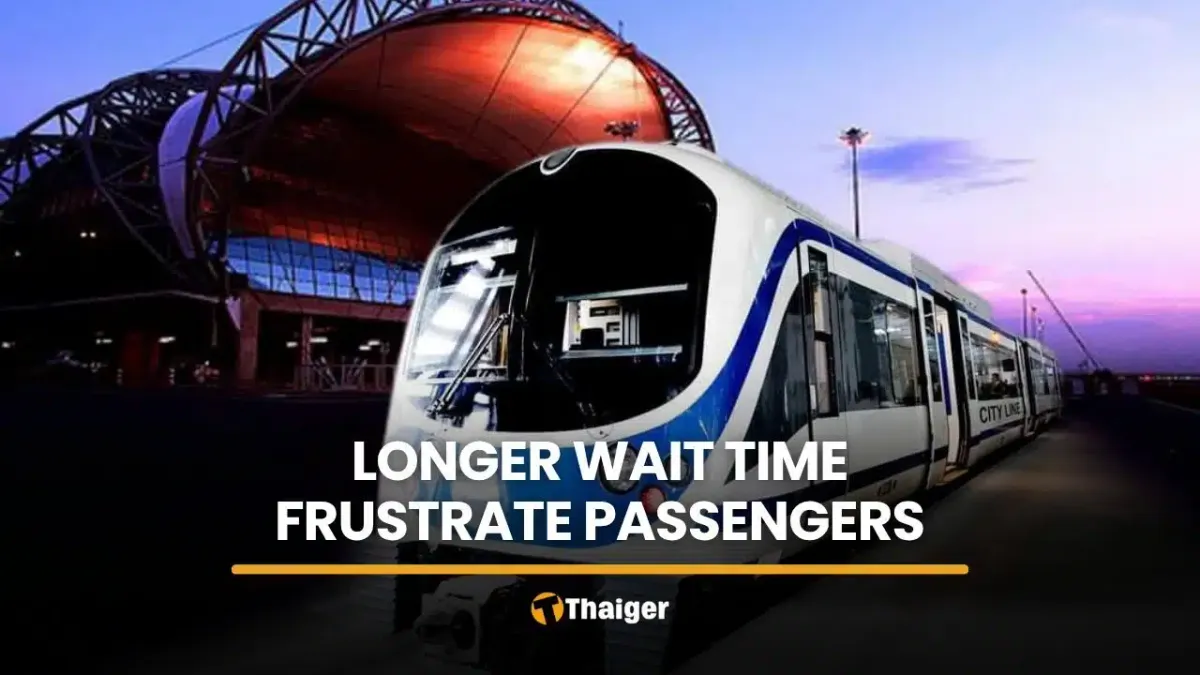
Passengers using Bangkok’s Airport Rail Link are experiencing significant disruptions and longer wait times due to a reduced train service. Currently, only five out of the line’s nine trains are operational, a situation attributed to unexpected wheel wear. The full fleet is not anticipated to be back in service until at least September 14.
Reduced Service Causes Passenger Frustration
The diminished capacity on the Airport Rail Link has led to considerable frustration among daily commuters and travelers. The issue came to light on September 8, when Deputy Prime Minister and Transport Minister Phiphat Ratchakitprakarn announced that daily inspections had revealed significant wheel wear on several trains. This discovery necessitated further checks and immediate repairs, leading to the temporary removal of four trains from service.
Minister Phiphat confirmed that five trains were actively running, but the State Railway of Thailand (SRT) Governor, Anan Phonimdang, provided a more detailed timeline. He stated that a sixth train was expected to rejoin the service on September 9, with the goal of having all nine trains operational by September 14. The lack of a clear, immediate explanation for the disruption initially fueled public criticism.
Operational Transition Amidst Service Issues
Adding to the complexity, the Airport Rail Link is on the cusp of a significant operational change. The current concession agreement with Asia Era One, a subsidiary of the CP Group responsible for operating the high-speed rail project connecting Don Mueang, Suvarnabhumi, and U-Tapao airports, is set to expire on September 30. The SRT had formally requested Asia Era One to extend its operations for an additional two to four months, allowing time for an SRT subsidiary to prepare for taking over the management of the Airport Rail Link.
On September 8, Minister Phiphat shared that Asia Era One had agreed in principle to continue operating the line for another four months, even expressing willingness to extend their service until the end of the year. However, the company presented several conditions that require further negotiation between Asia Era One and the SRT’s top officials, including the chairman and governor. These negotiations are crucial to determine which of the company’s stipulations can be accommodated.
SRT Prepared to Take Over Operations
Despite the ongoing negotiations, Minister Phiphat emphasized that services would continue uninterrupted from October 1. He assured the public that the SRT is prepared to manage the Airport Rail Link operations itself should an agreement with Asia Era One not be reached. The SRT subsidiary has prior experience operating the Airport Rail Link before the current private concession.
To facilitate a smooth transition, Minister Phiphat indicated that some experienced former staff, who are currently employed by the private operator, could be rehired by the SRT subsidiary. Additionally, new personnel would be recruited to meet operational demands. Governor Anan estimated that approximately 300 staff members would be needed for the SRT subsidiary to effectively manage the line. The proposed four-month extension for Asia Era One is intended to provide the SRT subsidiary with adequate time for personnel preparation and thorough equipment inspection before assuming full control.
The proposed extension and the detailed transition plan are scheduled to be presented to the SRT board for review on September 10.
Financial Considerations and Revenue Generation
The Airport Rail Link, despite its importance as a public transportation service, currently faces financial challenges. Minister Phiphat acknowledged that the line is incurring losses of approximately 30 million baht per month, accumulating to an annual deficit of around 360 million baht. These losses would need to be absorbed by the SRT if the line’s operation is taken over by the state railway.
In response to these financial pressures, the railway agency is actively exploring avenues to boost revenue. One proposed strategy involves leasing underutilized commercial spaces within Airport Rail Link stations to private businesses. This initiative aims to create new income streams and offset the operational losses, thereby improving the financial health of the service.
Conclusion
The current situation with the Airport Rail Link highlights a dual challenge: addressing immediate operational issues caused by train maintenance and navigating a complex transition of operational management. Passengers are advised to expect potential delays and plan their journeys accordingly. The SRT is working to resolve the train shortage and finalize arrangements for the line’s future operation, emphasizing its commitment to maintaining this vital public service while seeking sustainable financial solutions.
