

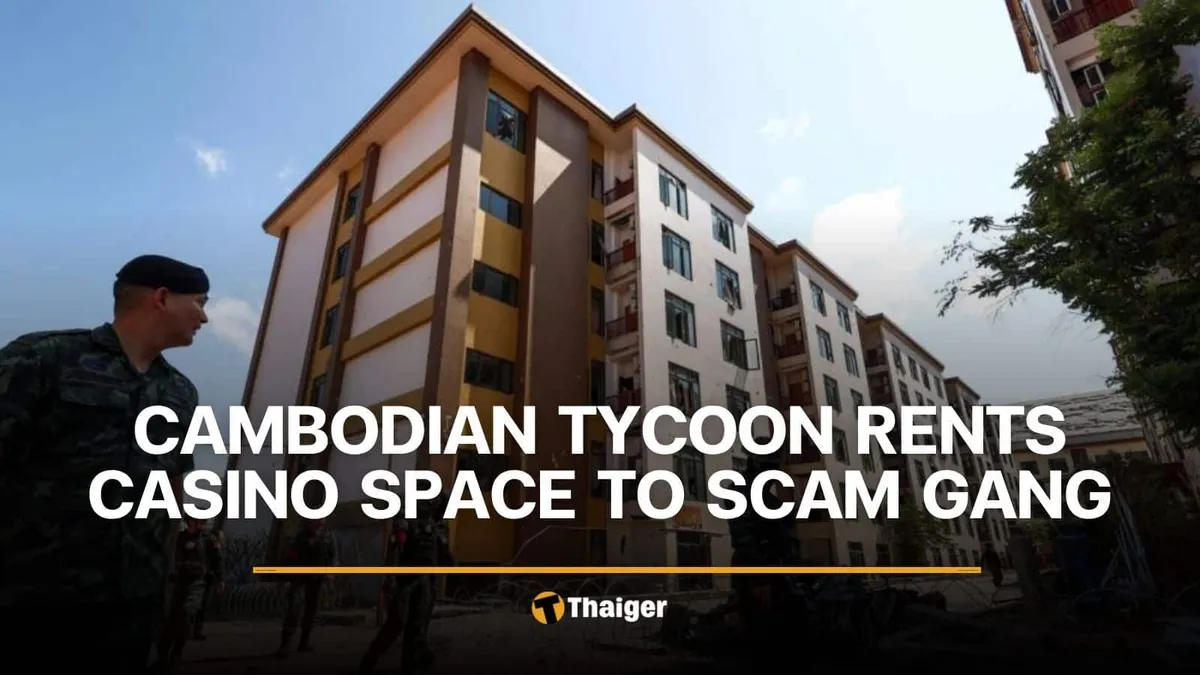
A sprawling casino complex situated on the Cambodia-Thailand border has been leased to a sophisticated Chinese-run operation involved in scams and human trafficking, according to an investigative report. Several spaces within the complex were reportedly outfitted to resemble official institutions like police stations and bank offices to facilitate deception of victims globally.
Casino Property Linked to Criminal Enterprise
The investigation identified the Lim Heng Group as the property owner. Records indicate that in March 2024, the company, which owns the Royal Hill casino located opposite Chong Chom in Thailand’s Surin province, rented out buildings on its grounds to the illicit operation. These leases were reportedly at rates significantly exceeding standard market values.
Representatives for Royal Hill and the Lim Heng Group did not respond to inquiries regarding these arrangements. However, a Cambodian human rights lawyer suggested that property owners who knowingly permit such activities on their land could face legal repercussions.
Financial Details of the Lease
Evidence reviewed by investigators revealed a lease agreement where a Chinese tenant committed to paying $200,000 per month for three buildings. This figure is more than eight times the approximate $25,000 that comparable properties in upscale areas of Phnom Penh typically command, highlighting the unusually high valuation and likely profitability of the criminal enterprise operating within.
Thai authorities confirmed that at least four buildings within the fenced compound were utilized for criminal activities. The site came under Thai security forces’ control following a border incident in December 2025, during which Royal Hill was allegedly used as a base for drone and sniper attacks. The Cambodian government has disputed these claims.
Allegations of Prior Knowledge and Legal Challenges
Reports suggest that the Lim Heng Group may have been alerted to potential human trafficking activities at the site as early as September 2024. This alleged awareness followed legal action taken by the group against two Cambodian media outlets that had published reports about foreigners being held captive within the casino premises. Despite maintaining the accuracy of their reporting, the outlets reportedly removed the content under legal pressure.
The Deputy National Police Chief overseeing the Thai investigation stated that Chinese criminal syndicates are orchestrating the fraudulent activities from within the Royal Hill complex.
The Human Cost of Scam Centers
The compound is estimated by Thai security officials to have once housed approximately 3,000 individuals. The experiences of those trapped within these centers are often harrowing. One woman, identified as Pornpen, recounted how she was lured by a job advertisement on Facebook in 2022, only to be forced into a scam ring. Her role involved impersonating police officers, under constant surveillance by armed guards.
In a separate case, a Thai national received a five-year prison sentence from a Thai court for his role as a low-level call center employee at Royal Hill. This sentencing underscores the legal consequences for individuals involved in these operations, even at subordinate levels.
Broader Context of Southeast Asian Scam Operations
The Lim Heng, who holds the Cambodian royal title of Oknha, a distinction akin to a duke, has also been noted for his financial contributions, including a $20,000 donation to the Cambodian military last year, according to a business association he is affiliated with. Analysts suggest that large-scale scam centers operating across Southeast Asia often require the complicity or protection of influential figures to function effectively. These operations are a significant financial drain, with estimates suggesting that Americans alone lost approximately $10 billion to such scams in 2024.
Escape and Legal Ramifications
Pornpen’s eventual escape from the compound provided a stark firsthand account of the conditions and coercion involved. Her testimony highlights the deceptive tactics used to recruit individuals and the subsequent control exerted over them. The presence of disguised offices, such as fake police stations and banks, served to further legitimize the scams in the eyes of unsuspecting victims, making them more susceptible to financial exploitation.
The involvement of international criminal organizations, particularly Chinese syndicates, in establishing and running these scam centers is a growing concern for regional law enforcement. The scale of these operations, often involving hundreds or thousands of individuals forced into fraudulent activities, presents a significant challenge to authorities on both sides of the Cambodia-Thailand border.
Conclusion
The leasing of casino property for illicit scam and human trafficking operations underscores a critical issue in border regions where oversight can be challenging. The case involving the Royal Hill casino and the Lim Heng Group brings to light the complex interplay between property ownership, alleged complicity, and the devastating impact of organized criminal enterprises on a global scale. Continued investigation and international cooperation are essential to dismantle these networks and protect potential victims.
