

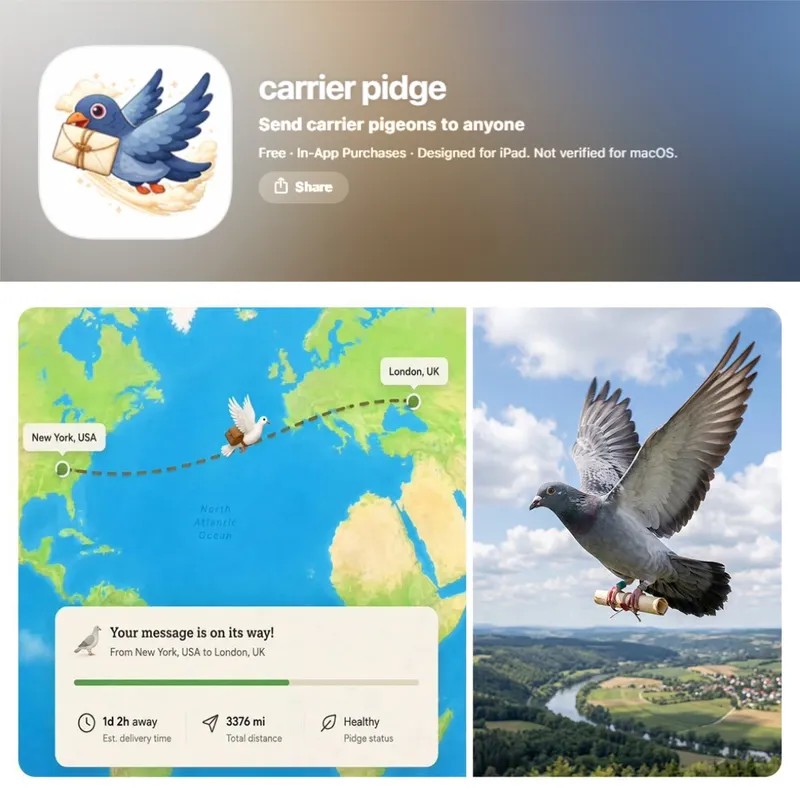
In a digital landscape dominated by instant messaging, a novel application named Carrier Pidge offers a deliberately slow and whimsical alternative. Developed by Noah Iarrobino, this app reimagines message delivery by employing digital birds that traverse distances at realistic speeds, introducing significant wait times for users, especially those communicating across continents. The core concept behind Carrier Pidge is to simulate a more tangible, albeit virtual, postal service.
How Carrier Pidge Works
The application leverages GPS coordinates to meticulously calculate the precise distance between the sender and the intended recipient. Once a message is composed and sent, a virtual pigeon embarks on its journey. These digital birds maintain a base speed of approximately 110 miles per hour (177 kilometers per hour). This speed is the primary determinant of how long it takes for a message to reach its destination and appear in the recipient’s inbox.
While communications between users in close proximity might arrive relatively quickly, exchanges spanning long distances demand considerable patience. For instance, Iarrobino notes that sending a single message from Los Angeles to New York can take as long as 22 hours to be delivered. This intentional delay transforms the act of sending and receiving messages into an experience that contrasts sharply with the immediacy of most modern communication tools.
Unpredictable Journeys and In-App Purchases
Adding a layer of comedic unpredictability, Carrier Pidge incorporates several elements that challenge the reliability of its avian couriers. There is a 0.2% chance that each digital pigeon might get lost or perish during its flight, resulting in the permanent deletion of the message it carries. This risk means that even after a lengthy wait, message delivery is not guaranteed, mirroring the uncertainties of traditional mail or even the occasional mishap with real-life pets.
Furthermore, the speed of these virtual birds is not constant. Their flight velocity can randomly fluctuate by as much as 25%, making delivery times inherently unpredictable. This variability adds another dimension of surprise, as a message that might have arrived within a few hours could potentially take much longer due to these random speed changes.
To enhance their messaging capabilities, users have the option to expand their virtual flock through in-app purchases. The cost for acquiring additional digital birds begins at $0.88 per bird. However, the app is designed so that messaging existing friends or contacts already within the user’s network does not necessitate further purchases. This model allows for a gradual expansion of one’s messaging capacity while keeping basic communication free for established connections.
Platform Availability
Carrier Pidge is currently accessible as a free download exclusively on the Apple App Store, making it available to users of iOS devices. At present, there has been no official timeline announced for the release of an Android version of the application. This means that users of Android smartphones and tablets cannot yet experience the unique messaging system offered by Carrier Pidge.
A Novel Approach to Digital Communication
The concept behind Carrier Pidge is a deliberate departure from the norm. In an era where technological advancements constantly push for faster, more efficient communication, this app embraces slowness and unpredictability. It invites users to reconsider their expectations of digital interaction, offering a playful commentary on the relentless pursuit of speed in our connected lives. By simulating the journey of a physical message, Carrier Pidge provides a unique and often humorous experience that stands out in the crowded app market.
The app’s design encourages a different kind of engagement, where anticipation and the possibility of loss become part of the communication process. This approach could appeal to users seeking a more mindful or novel way to connect, or simply those who appreciate a touch of digital whimsy. The developer’s decision to introduce elements of chance and delay transforms a mundane task into an engaging, albeit slow, adventure.
