

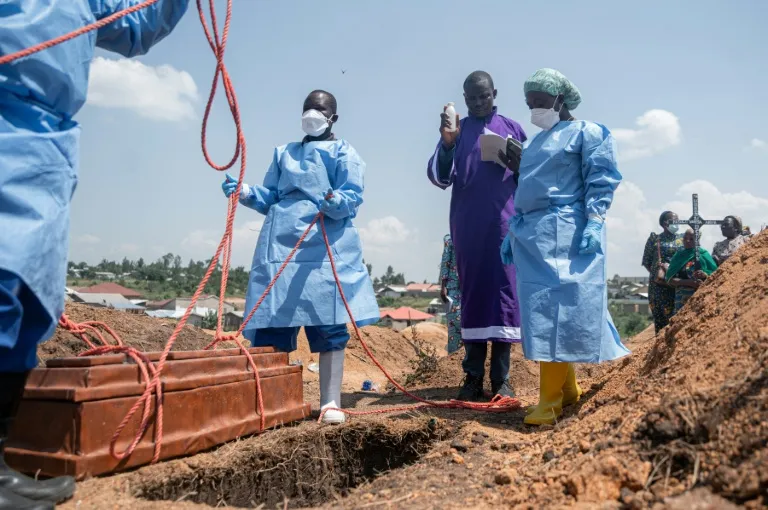
The Ebola outbreak in the Democratic Republic of Congo (DRC) is escalating rapidly, with officials describing its spread as “exponential.” This marks the country’s largest Ebola epidemic on record and is progressing at an unprecedented speed compared to previous outbreaks. The situation is particularly concerning in the eastern regions of the DRC, where insecurity and a weak health infrastructure present significant challenges to containment efforts.
Exponential Growth and Widespread Impact
Julien Harneis, speaking from Bunia, a city at the epicenter of the outbreak, informed reporters that over 2,500 people have died in the last three months. Alarmingly, half of these fatalities occurred within the most recent 20-day period, underscoring the accelerating nature of the epidemic. The virus’s reach has expanded significantly, now encompassing an area larger than France. Harneis emphasized that the epidemic is “spreading faster than the Ebola response,” highlighting a critical gap between the virus’s propagation and the efforts to control it.
The current outbreak, the 17th recorded in the DRC, is believed to have been active for several weeks before its official declaration on May 15. It has disproportionately affected regions in the north and east, areas characterized by a limited state presence, underdeveloped health systems, and decades of activity by numerous armed groups. This complex environment complicates the implementation of effective public health measures.
Alarming Rate and Response Challenges
The international medical humanitarian organization Doctors Without Borders (MSF) echoed these concerns, characterizing the outbreak’s spread as “alarming.” Javid Abdelmoneim, president of MSF, stated that the epidemic continues to advance “faster than the response can keep up.” This sentiment highlights the strain on resources and the difficulties faced by health workers on the ground.
Harneis underscored the urgent need to intensify the response. The current efforts have faced criticism for being slow and poorly organized, further exacerbated by a pervasive mistrust among local populations. This mistrust can stem from various factors, including historical grievances, the presence of armed groups, and perceived failures of past interventions.
Geographic Spread and Neighboring Concerns
Cases have been reported across six provinces within the DRC. The outbreak’s proximity to the border with South Sudan has raised particular concern, as has its spread into neighboring Uganda. Uganda experienced a limited number of cases and deaths related to Ebola, eventually declaring itself free of the virus last month. However, the potential for cross-border transmission remains a significant risk given the region’s interconnectedness.
Vaccine and Treatment Landscape
The specific strain of Ebola driving the current surge is the Bundibugyo virus. Currently, there is no approved vaccine or specific treatment for this strain, although research and clinical trials are in progress. The World Health Organization (WHO) announced that the DRC would receive 70,000 doses of the Ervebo vaccine. Ervebo has demonstrated effectiveness against the more common Zaire strain of Ebola.
WHO vaccine experts recently recommended a full-scale human trial for Ervebo to assess its potential for cross-protection against the Bundibugyo strain. Early data, including findings from animal studies, suggests that Ervebo might offer some level of protection against Bundibugyo. However, as WHO spokesman Christian Lindmeier clarified, “it is not yet known whether Ervebo is protective against the Bundibugyo virus in humans.” This uncertainty underscores the ongoing need for research and the careful deployment of available medical tools.
Operational Difficulties and Humanitarian Needs
Containing the virus, which transmits through contact with bodily fluids and causes hemorrhagic fever, is fraught with difficulties. Harneis pointed to the pervasive insecurity and the fragility of the health system in eastern DRC as major obstacles. He described the operating environment as “brutal,” citing undermined law and order and fragmented basic services, particularly in healthcare.
The human toll on healthcare workers has been substantial, with approximately 160 falling ill and 43 succumbing to the virus since the outbreak began. Frontline workers and ambulances have also been subjected to repeated attacks, further jeopardizing response efforts. Additional challenges include a barely functional banking system, which hinders the timely payment of wages to those involved in the outbreak response. Furthermore, international funding cuts have reportedly reduced the capacity of humanitarian organizations by one-third, stretching resources even thinner.
Call for Enhanced International Support
Harneis issued a strong appeal for increased international support. He stated that with additional staffing and resources deployed to the remote eastern regions of the DRC, transmission could be slowed and eventually halted within months. Conversely, he warned that without adequate support, the epidemic risks becoming more deadly, expanding its geographical reach, and potentially spreading to neighboring countries.
The situation demands a robust, coordinated, and well-resourced international response to protect vulnerable populations, support healthcare workers, and prevent further escalation of this devastating outbreak.
