

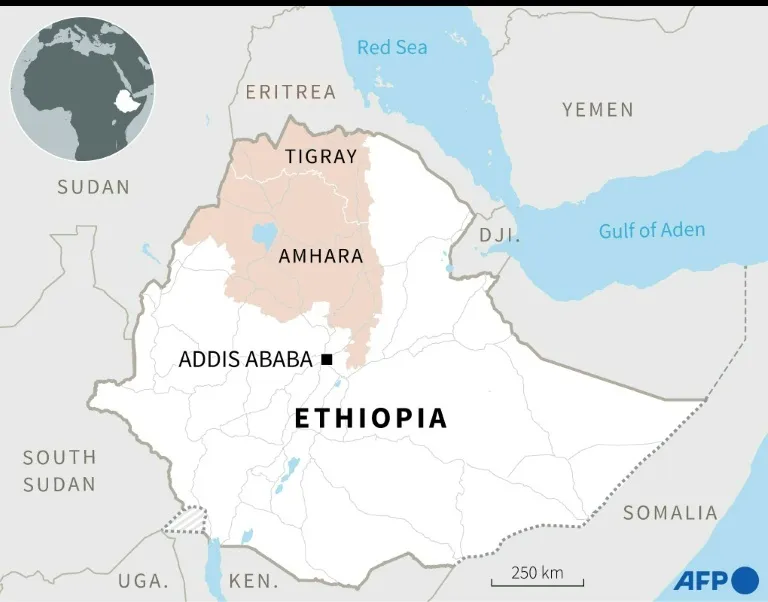
Tensions are escalating in Ethiopia’s northern Tigray region following accusations by the Tigray People’s Liberation Front (TPLF) that the Ethiopian federal army conducted drone strikes. The TPLF reported that the alleged attacks occurred in Merewa, southern Tigray, near the border with the Amhara region, resulting in casualties among Tigrayan fighters. This incident adds to a period of heightened friction, with both federal and Tigrayan forces reportedly amassing troops along regional borders, raising concerns about a potential resurgence of conflict.
Escalating Tensions and Accusations
Amanuel Assefa, vice chairman of the TPLF, stated that the Ethiopian government carried out a drone strike on Monday in Merewa. He reported that four Tigrayan fighters, including one woman, were wounded in the attack. A medical source at a hospital in Alimata confirmed that two of the injured fighters had undergone surgery. The TPLF issued a statement detailing that the strikes targeted their troops and caused human casualties, though further specifics were not immediately provided. The Ethiopian federal army has not yet responded to requests for comment on these allegations.
Amanuel also claimed that the strikes hit a high school, an assertion that could not be independently verified by news agencies at the time of reporting. These accusations come at a time of significant military buildup along the borders of the Tigray region, with both sides accusing the other of provoking a new war. This fragile situation exists less than four years after the conclusion of a devastating conflict that resulted in hundreds of thousands of deaths.
Background of Conflict and Peace Efforts
Tigray, a region with approximately six million inhabitants, is still recovering from a brutal two-year war that concluded in 2022. The conflict pitted TPLF forces against the federal army, with support from local militias and the Eritrean army. An estimated 600,000 lives were lost during this war, according to figures from the African Union (AU). A peace agreement was signed in November 2022, bringing an end to the widespread hostilities. However, several critical aspects of this agreement, including the return of displaced populations and the disarmament of TPLF forces, remain unimplemented.
The peace deal was further tested in late 2025 when direct clashes between Tigrayan and federal forces erupted for the first time since the agreement was signed. These renewed hostilities highlighted the persistent instability in the region. The African Union, which played a crucial role in mediating the peace deal and is headquartered in Addis Ababa, had not yet commented on the TPLF’s latest accusations regarding the drone strikes.
Geopolitical Dynamics and Regional Alliances
In recent months, federal authorities have voiced concerns about the TPLF allegedly strengthening ties with neighboring Eritrea. Relations between Ethiopia and Eritrea have historically been strained, marked by a border war between 1998 and 2000 that claimed tens of thousands of lives. Initially, Ethiopian Prime Minister Abiy Ahmed pursued a policy of rapprochement with Eritrea upon taking office, and the two nations collaborated against the TPLF during the 2020-2022 conflict.
However, disagreements arose following the peace accord, from which Eritrea was excluded. The peace agreement also stipulated the withdrawal of foreign troops, a point of contention given Eritrea’s involvement. Eritrea has reportedly accused Ethiopia of desiring access to its Red Sea port of Assab, a sensitive issue given Ethiopia’s landlocked status and Prime Minister Abiy’s past assertions about the need for maritime access through peaceful means.
Amidst these complex geopolitical currents, Amanuel Assefa indicated the TPLF’s willingness to form alliances with any group opposing the Ethiopian federal government, though he provided no specific details about potential partners. This statement suggests a strategic effort by the TPLF to broaden its support base in the face of federal pressure.
Internal Dynamics and Calls for Dialogue
Reports from organizations like Human Rights Watch and news agencies indicate that Tigrayan rebel authorities have been engaged in a campaign of forced recruitment over the past several months. This practice raises further concerns about the internal situation within the region.
In response to the escalating tensions, Dr. Tedros Adhanom Ghebreyesus, the Director-General of the World Health Organization and a native of the Tigray region, issued an appeal on social media. He urged both the federal government and all regional leaders to prioritize dialogue over armed conflict and to pursue genuine political solutions to the ongoing disputes. His call underscores the urgent need for de-escalation and a commitment to peaceful resolution.
The TPLF was the dominant political force in Ethiopia for nearly three decades before Prime Minister Abiy Ahmed came to power in 2018. Although his government has restricted the TPLF’s political activities nationally, the group maintains significant influence and its own military capacity within the Tigray region. In late April, the TPLF announced the reinstatement of a regional parliament, an action that had previously been deemed illegitimate by federal authorities, further complicating the political landscape.
Conclusion
The recent accusations of drone strikes by the Ethiopian army in Tigray, coupled with troop movements and ongoing political complexities, signal a precarious situation in Ethiopia’s north. The international community and regional bodies like the African Union are watching closely, with calls for dialogue and adherence to the 2022 peace agreement growing louder. The unimplemented aspects of the peace deal and the shifting regional alliances continue to fuel instability, making a peaceful resolution paramount for the well-being of the region and its people.
