

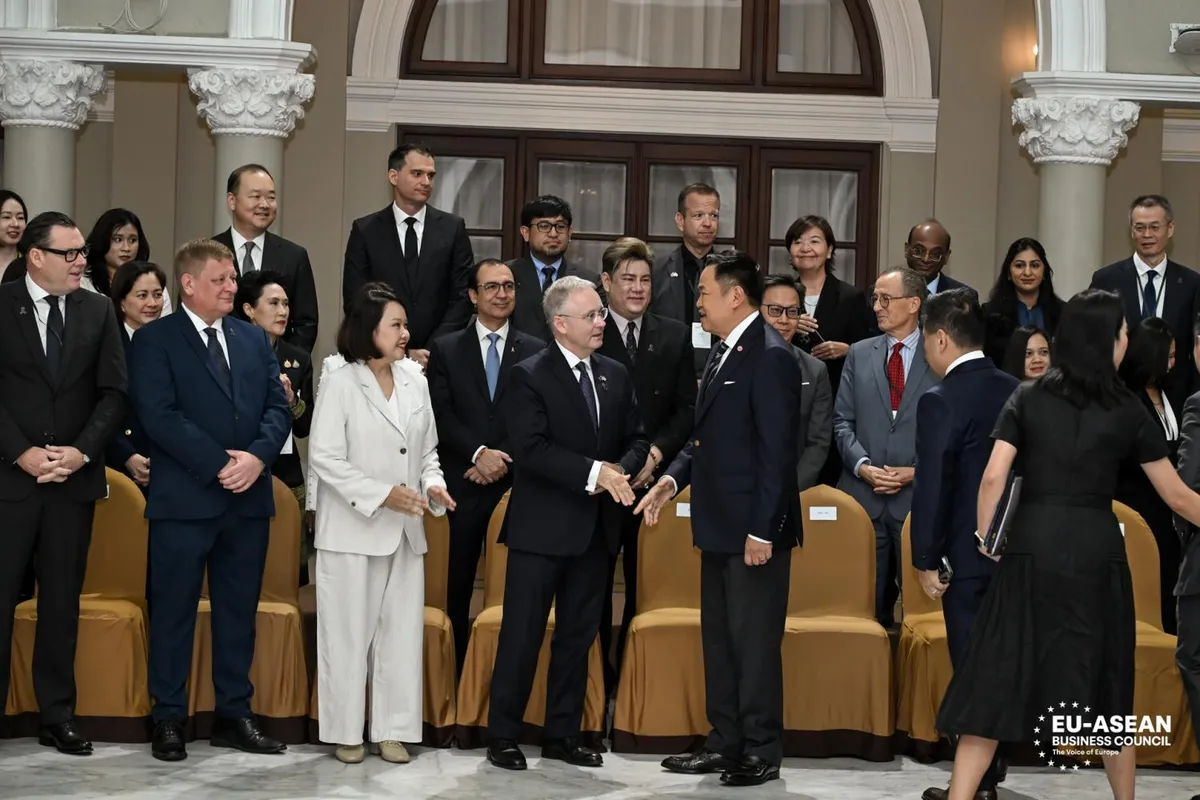
The European Union is keen to increase investment in Thailand, particularly in sectors like life sciences, biotechnology, low-carbon and high-tech manufacturing, financial services, and fast-moving consumer goods. However, realizing this potential hinges on Thailand implementing significant regulatory reforms to create a more attractive and predictable business environment for European companies.
Thailand’s Investment Appeal and Challenges
Noel Clehane, vice-chair of the EU-Asean Business Council (EU-ABC), highlighted Thailand’s strategic advantages for foreign investment. He described the country as an ideal geographic hub within the region, boasting a well-developed industrial ecosystem and a substantial domestic consumer market. Furthermore, Thailand serves as a gateway to the broader ASEAN market, which comprises nearly 700 million people.
The sentiment among European firms is largely positive, with a survey indicating that approximately 57% of European companies intend to expand their investments in Thailand. This outlook is supported by the findings of the 11th EU-Asean Business Sentiment Survey, published in 2025.
Despite these strengths, significant hurdles remain. Mr. Clehane pointed to the more than 7,600 ministerial regulations in Thailand, many of which are perceived as outdated, unnecessary, and inconsistent. These create a complex and often unpredictable operating landscape for foreign investors.
Foreign Business Act Barriers
A primary concern is the Foreign Business Act of 1999. This legislation imposes specific restrictions, particularly impacting service and high-tech industries. A key obstacle is the ownership cap, which limits foreign ownership to 49% in certain sectors. This effectively compels foreign companies to form joint ventures with local partners.
Mr. Clehane elaborated on the impact of these ownership restrictions: “This ownership cap is a major deterrent for companies with sensitive intellectual property [IP] such as those in the artificial intelligence [AI] or specialised service industries. Investors are often unwilling to surrender 51% of their operations because they fear losing control over their knowledge.” This fear of IP dilution is a significant deterrent for businesses operating in cutting-edge fields.
Beyond ownership limitations, European businesses have also expressed frustration with complicated licensing and permit processes. They are actively seeking a more predictable and transparent regulatory framework to facilitate smoother operations and investment decisions.
Proposed Reforms and Competitiveness
In response to these concerns, Mr. Clehane expressed support for Thailand’s proposed reforms. These include the introduction of an omnibus law, which aims to streamline regulations, and the removal of certain sectors from the restrictive lists within the Foreign Business Act. Such broader regulatory reforms are seen as crucial for enhancing Thailand’s attractiveness to investors.
Addressing Demographic and Digital Challenges
Thailand’s overall competitiveness is also a critical factor. In the 2026 IMD World Competitiveness Ranking, the country was positioned 26th out of 70 economies, ranking behind Singapore and Malaysia but ahead of Vietnam. To maintain and improve its standing, Thailand must confront long-term structural issues.
Mr. Clehane emphasized the need to address an ageing population and the critical requirement for digital upskilling. “Thailand must invest more in digital upskilling. While the country has highly educated people in industrial manufacturing, it has likely lagged behind some competitors in developing digital skills and the industries of the future, which are knowledge- and idea-based.” This focus on digital transformation and future-oriented skills is essential for sustained economic growth and competitiveness.
Thailand-EU Free Trade Agreement (FTA) Progress
Negotiations for a Free Trade Agreement (FTA) between Thailand and the EU, which resumed in 2023, have seen steady progress on less contentious issues. However, several complex topics remain on the table. These include market access for goods, particularly sensitive agricultural and industrial products; sanitary and phytosanitary measures; services and investment; government procurement; digital trade; intellectual property rights; and energy and raw materials.
The primary challenge for Thailand lies in securing greater access for its agricultural products to EU markets. Conversely, for the EU, the most significant hurdle is achieving greater access for investment in Thailand’s service sector.
Despite these complexities, Mr. Clehane expressed optimism, believing that both sides possess the political will to overcome these obstacles and arrive at mutually beneficial solutions. He anticipates that the negotiations could be agreed upon in principle by the end of this year or early 2027.
Bilateral Trade and Investment Landscape
The economic relationship between the EU and Thailand is substantial. In 2025, bilateral trade reached approximately 1.64 trillion baht. European companies have significant investments in Thailand, with stocks valued at over 953 billion baht. A modern FTA is expected to provide a stronger foundation for both trade and investment flows.
The EU has existing FTAs with Vietnam and Singapore. It finalized FTA negotiations with Indonesia in September 2025 and is actively engaged in negotiations with Thailand, the Philippines, and Malaysia. The bloc aims to conclude its FTA with the Philippines later this year and with Malaysia in 2027.
Conclusion
The EU’s interest in expanding investment in Thailand is clear, driven by the country’s strategic location and market potential. However, unlocking this investment requires Thailand to undertake comprehensive regulatory reforms, particularly concerning the Foreign Business Act and the simplification of bureaucratic processes. Addressing these issues, alongside investments in digital skills and managing demographic shifts, will be crucial for Thailand to enhance its competitiveness and fully capitalize on opportunities for deeper economic ties with the European Union.
