

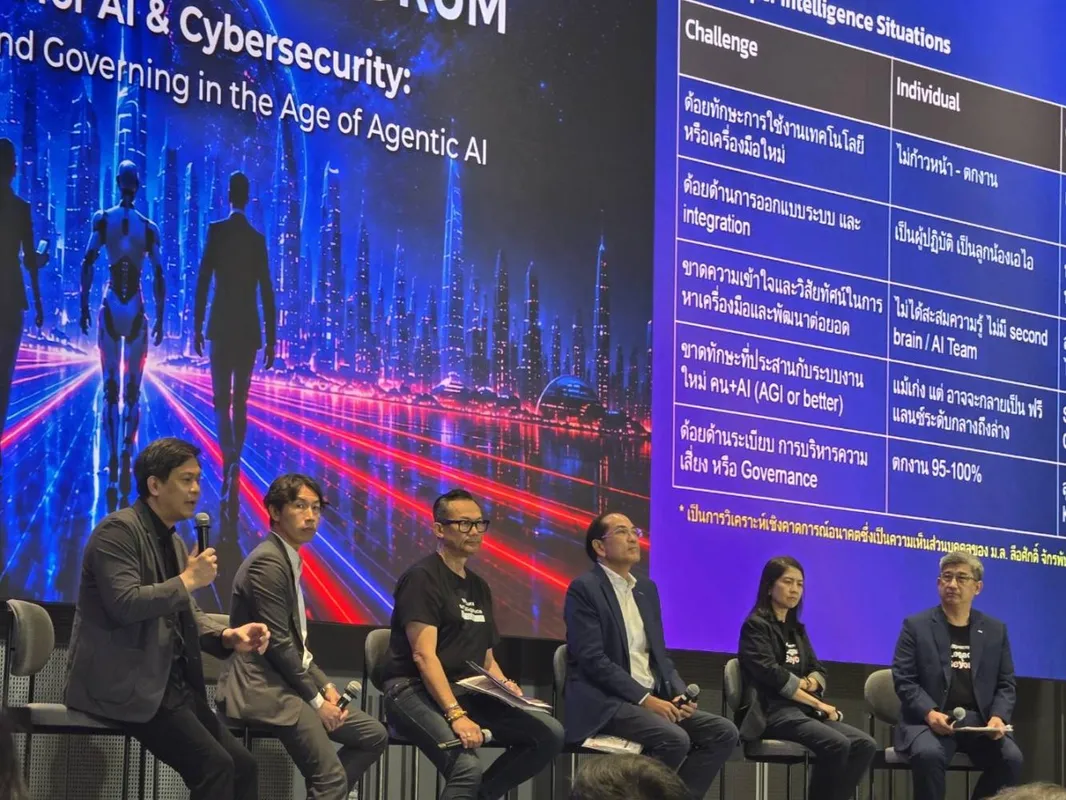
Artificial intelligence (AI) presents significant challenges and opportunities for the global workforce, with experts emphasizing the critical need for adaptation, robust security measures, and human oversight. Discussions at a recent digital workforce forum, organized by the National Electronics and Computer Technology Center (Nectec), highlighted potential job displacement, the evolving landscape of cybersecurity, and the essential role of human intelligence in navigating the AI era.
Navigating the AI-Driven Workforce Transformation
M.L. Luesak Chakrabandhu, president of the Association of Thailand Open Source Federation and director of the Digital Council of Thailand, issued a stark warning regarding the societal and workforce impacts of advancing AI technologies. He predicted that individuals who fail to acquire new technology and integration skills could face a 95-100% chance of job loss in a post-artificial general intelligence (AGI) era. Organizations that do not effectively integrate AI and design secure systems risk operational conflicts and reduced productivity, potentially leading to stagnant GDPs and inefficient supply chains for nations.
Despite the transformative power of AI, M.L. Luesak stressed that human accountability remains paramount. AI cannot bear legal responsibility or be held liable, meaning humans will continue to be the ultimate decision-makers, defining AI’s purpose as its creators and consumers. To address the evolving skill demands, he proposed a three-tier upskilling strategy:
- Humans Beyond the Loop: Executives and boards should focus on strategy, governance, and establishing guardrails for AI.
- Humans Over the Loop: Middle managers should orchestrate workflows and validate AI outputs.
- Humans In and On the Loop: All employees need to filter AI-generated information and ensure tasks align with organizational goals and safety.
Elevating Cybersecurity in the Age of AI
The discussion also delved into the critical intersection of AI and cybersecurity. Tatchapol Poshyyanonda, country director of Palo Alto Networks for Thailand and Vietnam, advocated for viewing security not as a mere business expense but as an enabler of potential. With malicious actors increasingly leveraging AI, defenders must adopt similar technologies to combat threats and drastically reduce incident response times from hours to minutes.
Poshyyanonda urged top executives to lead the charge by defining clear business priorities for AI and establishing frameworks for “Trust AI.” This involves ensuring data accuracy, employing appropriate models, and verifying results, rather than simply adopting new technologies without strategic consideration. Organizations are encouraged to implement a comprehensive five-stage AI governance framework, encompassing assessment, design, protection, monitoring, and continuous improvement.
The future cybersecurity professional will require a blend of technical and soft skills, including:
- AI and data literacy
- AI security knowledge
- AI agent management
- Threat analysis
- Critical thinking
- Ethics and governance
- Communication and collaboration
The Human Element in Digital Systems
Panita Pongpaibool, deputy executive director of Nectec, highlighted that humans remain the most significant vulnerability in any cybersecurity system. She emphasized the necessity of mandatory security awareness training for all employees, including phishing simulations. Crucially, top executives, not just IT departments, must take responsibility for data classification, as they possess the business context to understand the value of corporate data.
Nectec is also supporting small and medium-sized enterprises (SMEs) with an open-source cybersecurity monitoring system designed to provide high-quality security affordably.
Cultivating Natural Intelligence Against AI Threats
AVM Amorn Chomchoey, secretary general of the National Cyber Security Agency, underscored the importance of developing “natural intelligence”—specifically critical thinking and cognitive skills—to counteract AI-driven manipulation. Scammers are employing sophisticated AI for highly realistic fraud. While scams remain a significant issue in Thailand, recent daily financial losses have reportedly decreased to approximately 15-35 million baht.
Chomchoey stressed that cybersecurity must be integrated into AI systems from their inception. Users should exercise caution and verify digital interactions before granting “digital trust.” Furthermore, organizations must urgently establish clear guidelines and acceptable use policies for AI to ensure responsible and safe employee usage, preventing the exposure of sensitive data. He noted that budget constraints are not a valid excuse, as abundant free open-source tools and learning resources are available, albeit requiring dedicated effort.
Protecting Vulnerable Populations in the Digital Space
Santi Siritheerajesd, a child protection specialist with UNICEF Thailand, addressed the inherent risks of the internet, including exposure to inappropriate content, dangerous interactions like grooming, negative youth behavior, and data privacy issues. He warned that malicious actors are weaponizing AI, using tools like deepfakes for extortion and manipulating AI prompts to generate abusive content or bypass safety measures.
The consensus among experts is clear: while AI offers immense potential, proactive adaptation, stringent security protocols, and a strong emphasis on human oversight and critical thinking are essential to harness its benefits responsibly and mitigate its risks.
