

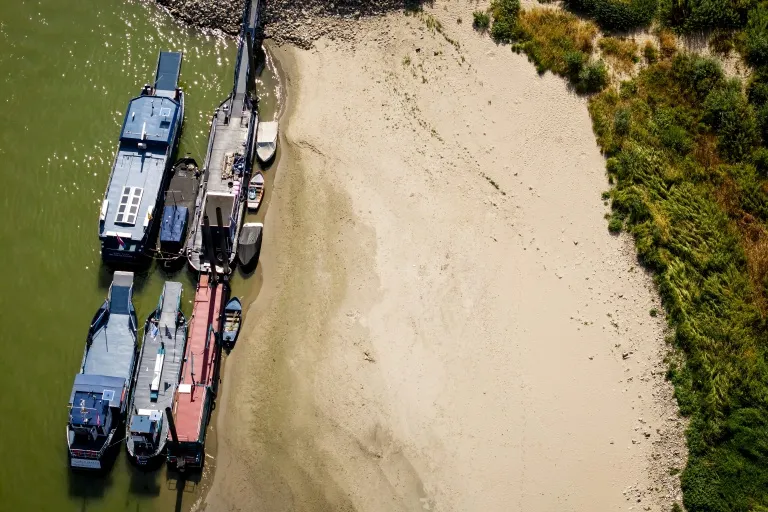
The Netherlands, a nation long celebrated for its mastery over water with intricate systems of dikes, dams, and canals, is confronting a profound challenge: how to manage water scarcity in an era of escalating climate change. A historic summer drought, fueled by prolonged dry spells, extreme heat, and intense evaporation, has left the country, much of which lies below sea level, grappling with a critical dilemma – retaining precious freshwater while still guarding against the threat of floods.
This unprecedented situation is starkly illustrated by the experiences of individuals like Leon Berkers, an entrepreneur who has frequented the Rhine River for decades. “This is the lowest, the craziest level it’s ever reached,” Berkers remarked, his restaurant boat listing heavily after becoming stranded on the riverbank. The diminished water levels have become a daily inconvenience, with his son, Linus, noting with a touch of humor, “We can’t even fill the coffee cups to the brim or they spill.”
The drought’s impact is particularly severe in the southern and eastern provinces, where the landscape has transformed into a parched expanse of straw-colored grass. The Rhine itself has recorded its lowest-ever water levels during this summer, underscoring the severity of the dry conditions.
Beyond the visible effects on the landscape, the shortage of fresh water and the creeping intrusion of saltwater into the river network—a process known as salinisation—are creating widespread problems across the nation. Marthe Wens, a researcher specializing in water and climate risks at the Vrije Universiteit Amsterdam’s Institute for Environmental Studies, drew a comparison to drier climates, stating, “It feels like we’re in the south of France.” She highlighted the immediate impact on nature, observing, “The trees already look like autumn.”
An equally concerning crisis is unfolding beneath the surface. As peat bogs dry out, they shrink, leading to subsidence that can cause significant structural damage to buildings. “Foundations are sometimes built on peat bogs: if these dry out, they shrink, and cracks can appear in buildings,” Wens explained, pointing to a less visible but equally damaging consequence of the prolonged dryness.
Recognizing the gravity of the situation, Rijkswaterstaat, the national water management agency, officially classified the conditions as an “actual water shortage” in mid-July. In response, the agency has implemented significant restrictions on irrigation. Furthermore, operational adjustments have been made to water locks, limiting their opening frequency to conserve freshwater resources and mitigate the influx of saltwater into the vital river systems.
The implications for transportation are substantial. Both inland shipping and, by extension, maritime transport have been severely impacted by the reduced water levels. “Not only are the carriers suffering, but also the industries that depend on the goods they transport,” Wens noted, emphasizing the ripple effect throughout the economy.
Rethinking Hydraulic Engineering for a Drier Future
The increasing frequency of extreme weather events, a direct consequence of climate change, necessitates a fundamental reevaluation of the Netherlands’ traditional water management strategies. For centuries, the nation’s engineering prowess has been focused on protecting against the perils of excess water.
“We have always designed our systems to protect us from flooding and to drain excess water into the sea,” explained Micha Werner, a professor specializing in drought resilience at IHE Delft, a leading global institution for water education. “But as we can see today with climate change, we are increasingly often faced with years of water shortage,” he added.
This shift demands a paradigm change in how water resources are managed. Werner stressed the urgent need for adaptation, stating, “We therefore truly have to change the way we manage water resources: instead of trying to get rid of water, we actually need to start trying to retain it within our hydraulic systems, and that really requires adaptation.” The focus must move from rapid drainage to strategic retention and conservation.
Adapting to the New Reality
For individuals like Leon Berkers, whose restaurant boat has been marooned for over a month, adaptation has meant immediate, practical solutions to cope with the immediate crisis. His efforts have been focused on improvising fixes to keep his vessel stable, preventing “pots and pans from flying around.”
Looking ahead, Berkers expressed a somber outlook, sighing as he prepared for another evening service, “I think we’ll be without water for at least another two months.” His sentiment reflects the broader uncertainty and the long road ahead for the Netherlands as it navigates this new era of water management, where resilience means not just defending against floods, but actively conserving and managing scarce freshwater resources.
The challenges posed by the current drought serve as a potent reminder that even a nation renowned for its water engineering must continuously adapt its strategies to the evolving realities of a changing climate. The future of Dutch water management lies in embracing a more nuanced approach, one that balances the age-old fight against floods with the pressing need to secure and retain water for survival and prosperity.
