

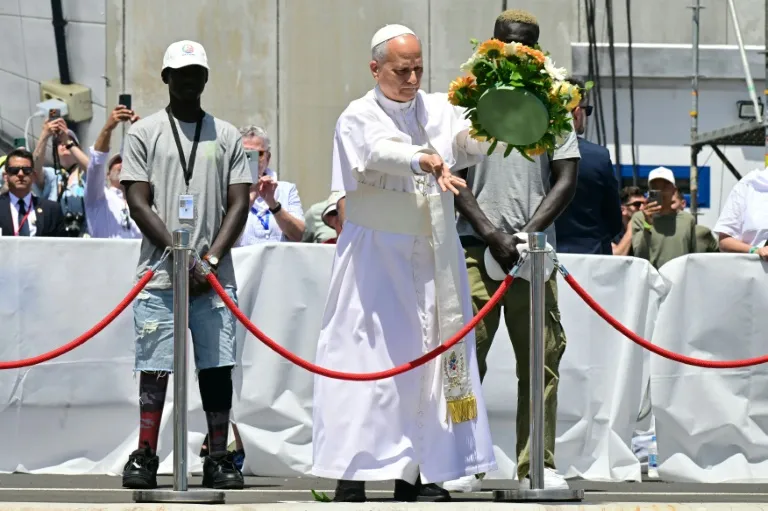
During a solemn ceremony at the port of Arguineguin on Gran Canaria, the pontiff cast a wreath into the sea, honoring the thousands who have perished attempting to reach the Atlantic archipelago. This poignant act marked the sixth day of a Spanish visit consistently focused on the precarious situation of migrants.
At Arguineguin, a key arrival point for many, the pontiff met with migrants and individuals dedicated to assisting them. He also blessed a cross crafted from the wreckage of migrant vessels, a stark reminder of perilous journeys. “Even today, monsters lurk in these seas: mafias that profit from despair, traffickers who enslave women and children, and those whose indifference allows the poor to be swallowed up by exploitation or forgetfulness,” the pontiff declared during the ceremony.
Tragic Toll on Deadly Migration Route
The route from Africa to the Canary Islands has become one of the world’s deadliest. According to the International Organization for Migration, nearly 1,200 people died or went missing on this passage last year alone. The pontiff criticized Europe’s approach, noting that governments have increasingly hardened their policies, often influenced by far-right pressures. He stated that the continent “cannot claim to uphold human dignity while growing accustomed to the Mediterranean and the Atlantic becoming unmarked graves.”
He emphasized that this tragedy must “appeal to the conscience” of both nations of origin and transit, where individuals flee poverty and conflict, only to fall victim to trafficking gangs. The audience heard a harrowing testimony from a Nigerian woman who narrowly escaped traffickers while attempting to reach Spain. She recounted the agonizing choice she faced: “I had to choose: live in suffering, or cross and risk it all. Die trying, or stay and not have anything.” Her ordeal included forced prostitution and the separation from her child.
The pontiff expressed a profound desire “to bow before” the dignity of migrants, acknowledging their humanity beyond mere statistics. “You are not just numbers or files. You are people who have left behind families and homes. You have dreams that no one has the right to despise,” he affirmed.
Record Arrivals and a Call for Humane Policies
In 2024, the Canary Islands witnessed a record number of arrivals, with over 46,000 people reaching the archipelago off the coast of northwestern Africa, often on overcrowded and unseaworthy boats. While numbers have since decreased, the scale of the challenge remains significant. This visit fulfills a long-standing wish of the pontiff’s predecessor, Francis, who had planned a trip to the islands before his passing.
The pontiff’s advocacy for migrants has drawn criticism from some quarters, but it has also resonated deeply with those directly affected. Mohamed Amjahdi, who arrived in the islands from Morocco at the age of 17, told reporters, “We really value this visit. It’s very important for us at such a critical moment.” He also highlighted the inclusive work of the Catholic Church, stating, “It doesn’t matter whether you’re Christian or not, whether you’re white or black — everyone receives the same support.”
Arguineguin was once infamously known as the “dock of shame” due to the surge in arrivals in 2020, when over 3,000 migrants found themselves sleeping in the open or under makeshift shelters. A banner proclaiming “dock of hope” was prominently displayed at the recent ceremony.
Earlier in his visit, addressing Spain’s parliament, the pontiff called for the establishment of “safe and legal pathways” for immigration and for migrants to receive “a respectful welcome and real opportunities for integration.” The current government in Spain has taken a notably different approach to many European nations, moving to regularize approximately 500,000 undocumented migrants.
The pontiff’s week-long visit to Spain, which has included stops in Madrid and Barcelona, is set to conclude on Friday on the island of Tenerife, where he is scheduled to visit a migrant center.
