

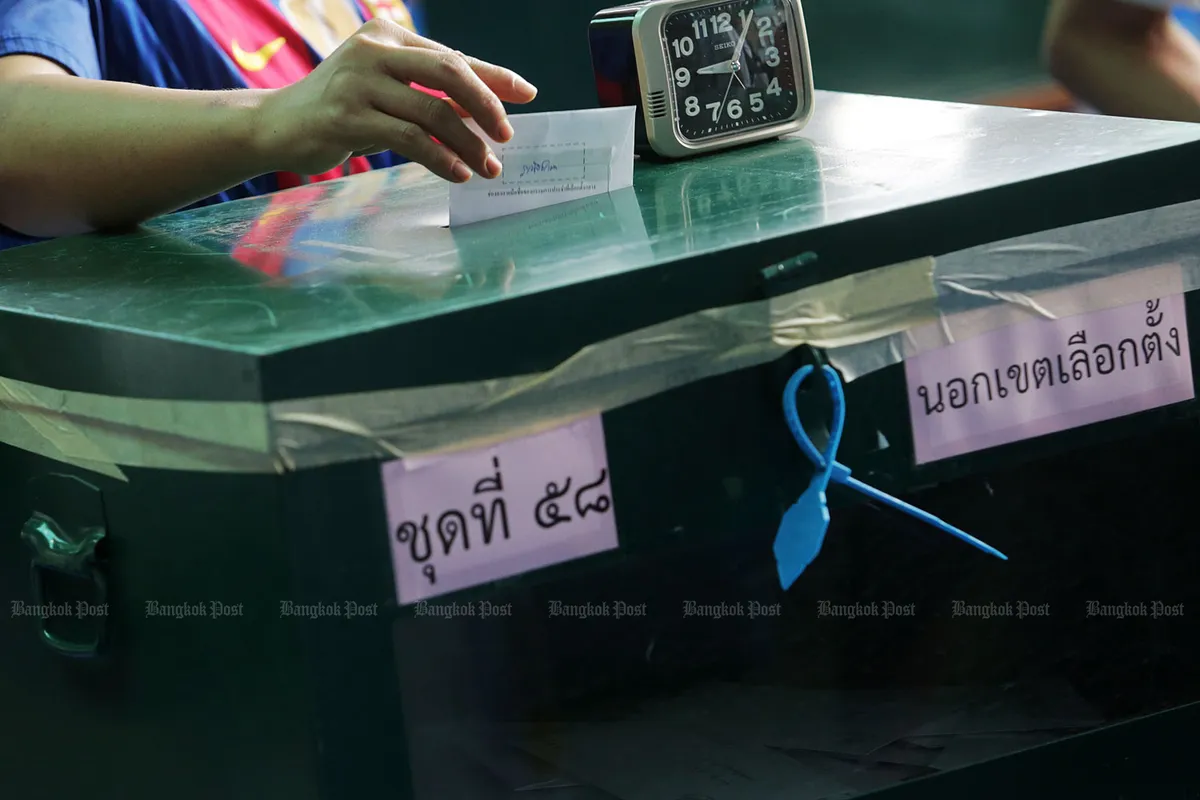
Political observers widely speculate that strategic voting could propel the PP party to secure the largest number of seats on the Bangkok Metropolitan Council (BMC). Projections indicate the party may win at least 20 of the 50 council seats, positioning them as the primary victors in the upcoming local elections.
Key Contenders Emerge in Crucial Local Race
Independent candidates running under the “Khon Tam Ngan” (Working People) banner and the Democrat Party are each anticipated to secure approximately 14 to 15 seats, according to political analysts. While the BMC election has garnered less public attention than the concurrent gubernatorial race, major political parties consider it a vital contest.
Control of the 50-member council, which represents Bangkok’s various districts, offers a significant grassroots network essential for future parliamentary campaigns. As Bangkok’s legislative body, the BMC is tasked with enacting local ordinances, overseeing the governor’s administration, and approving the capital’s substantial annual budget, which nears 100 billion baht. Consequently, all political factions view these council positions as strategically important.
Strategic Voting and Party Positioning
Stithorn Thananithichot, a political science lecturer at Chulalongkorn University, stated that the PP, having achieved a decisive victory in the capital during the February 28 general election, is in a strong position to win the most council seats. This outcome would see them outperforming independent candidates associated with the Working People group, who are seeking to align themselves with current Governor Chadchart Sittipunt as he pursues a second term.
Thananithichot suggested that many Bangkok voters are likely to engage in “strategic voting.” With opinion polls forecasting a comfortable re-election for Governor Chadchart, voters may opt for council candidates who can effectively scrutinize the governor’s actions, rather than supporting those from his political alignment. He noted that the PP benefits from a strong public perception of its ability to provide robust oversight, mirroring its role as a parliamentary opposition. The party’s complete sweep of all 33 Bangkok constituencies in the recent general election has bolstered urban voters’ confidence in its watchdog capabilities.
According to Thananithichot, the Democrats are expected to maintain their traditional strongholds and potentially expand their representation if they can effectively mobilize their voter base. However, he observed that the party has adopted a relatively understated campaign approach despite considerable on-the-ground efforts.
Pheu Thai’s Shifting Influence
A significant factor in the race is the redistribution of support once held by former councillors affiliated with the Pheu Thai Party. Unlike in prior elections, Pheu Thai has not fielded candidates under its own banner, leading many former councillors to join independent groups, including Working People and Pheu Thai Life.
Yuttaporn Issarachai, a political scientist at Sukhothai Thammathirat Open University, believes these former Pheu Thai networks will ultimately divide their votes among Working People candidates, the PP, and the Democrats. While the PP has set an ambitious target of winning 40 seats, or even all 50 districts, Issarachai considers such expectations unrealistic. He argues that voters approach local council elections differently from national contests, estimating the party will ultimately secure around 20 seats, an increase from their previous 14.
In his projection, the Democrats could secure second place with 14–15 seats, benefiting from their organizational strength and the renewed popularity associated with party leader Abhisit Vejjajiva. Working People candidates are expected to win a similar number of seats, largely due to their association with Governor Chadchart.
Governor Faces Scrutiny
However, the incumbent governor faces considerable pressure from critics regarding his administration’s ability to fulfill key campaign promises and alleged irregularities in policy implementation within the Bangkok Metropolitan Administration.
Voter Turnout as a Decisive Factor
Voter turnout is identified as a potentially decisive element. Thananithichot cautioned that if participation falls below 60%, established local political networks and incumbent councillors could gain a significant advantage, making a PP landslide less probable.
Meanwhile, Sakoltee Phattiyakul, a Democrat Party list Member of Parliament and director of the party’s Bangkok campaign operations, expressed strong confidence that Democrat candidates would win well over 10 seats. He cited robust support for Mr. Abhisit and favorable prospects in traditional Democrat strongholds, including the districts of Samphanthawong, Pomprap Sattruphai, Klong Toey, Huai Khwang, Bang Kholaem, Sathon, Yannawa, Ratchathewi, Klong San, Bangkok Noi, Bangkok Yai, Rat Burana, Thawi Watthana, Laksi, Wang Thonglang, Lat Phrao, Prawet, and Phra Khanong.
