

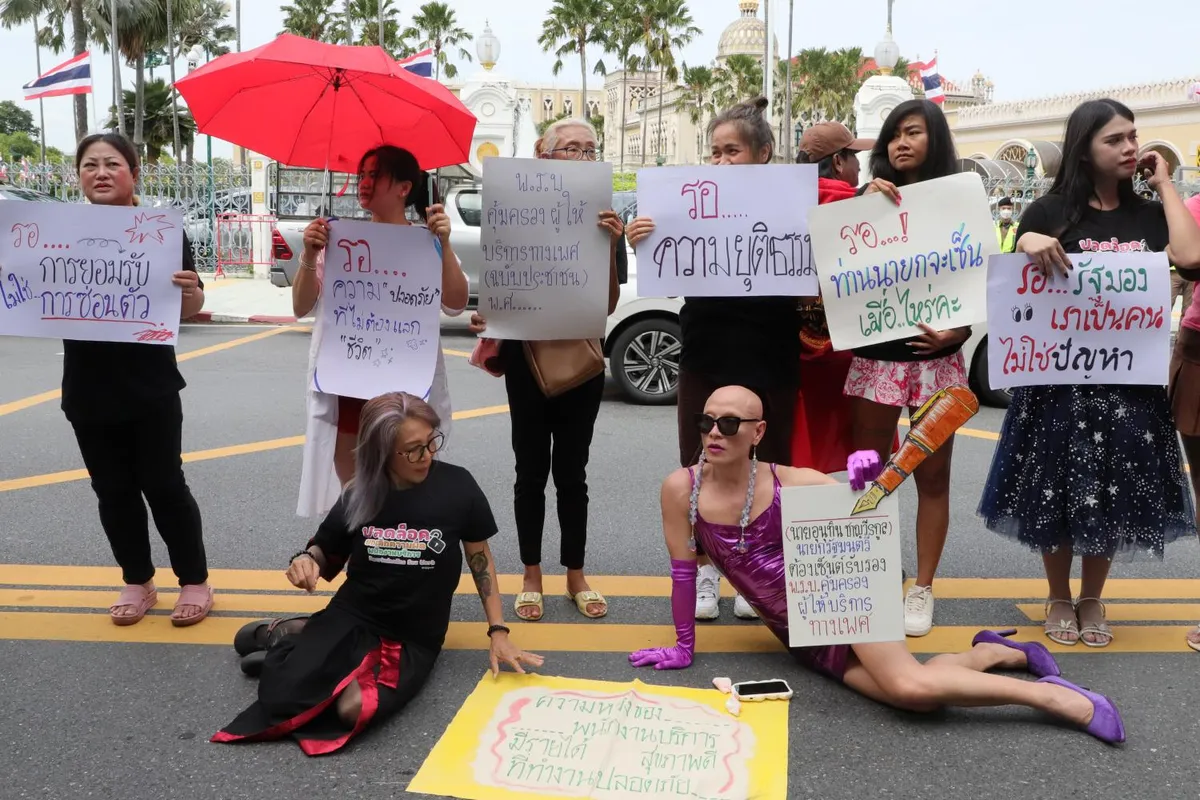
Sex workers, represented by the Empower Foundation, have intensified their campaign for legislative recognition, urging the Prime Minister to champion the long-awaited Sex Worker Protection Bill. A symbolic gathering outside the Office of the Public Sector Development Commission, near Government House, saw service workers from Udon Thani, Chiang Mai, and Bangkok united in their call for the bill’s advancement.
Push for Decriminalization and Basic Rights
The demonstration highlighted the critical juncture the Sex Worker Protection Bill now faces. Organizers presented over 10,000 signatures – specifically 10,293 – in a clear show of public backing for the draft legislation. However, the bill’s progress was recently stalled when it was classified as a “money bill” on July 10. This designation necessitates the Prime Minister’s endorsement before the bill can be formally presented to and debated by parliament, effectively placing the decision in the hands of the nation’s leader.
Chatchalawan Muangjan, a key figure from the Empower Foundation, expressed frustration over the perceived delay. She pointed out that the government’s current stance appeared to contradict its acknowledgement of observations made by the UN Committee on the Elimination of Discrimination against Women (CEDAW) on August 5. The CEDAW committee had strongly recommended that Thailand move towards decriminalizing sex work. Such a move, they argued, would be instrumental in ending arbitrary arrests, reducing societal stigma, and preventing human rights violations faced by sex workers. Furthermore, the committee advocated for the application of existing labor laws to ensure the protection of sex workers, aligning them with other professional groups.
A Decades-Long Struggle for Recognition
The Empower Foundation emphasized that the fight for recognition and rights for sex workers is not a new one. The organization stated that sex workers have been actively campaigning for legal and social acknowledgment for over four decades. Their primary objective is to secure fundamental labor rights, which include equitable access to social security benefits. Specifically, they are seeking inclusion under Section 33 of the Social Security Act, the same provisions available to all other employees in the country. This would grant them access to crucial benefits such as healthcare, unemployment support, and retirement funds, providing a much-needed safety net.
Direct Appeal to the Prime Minister
Ms. Chatchalawan reiterated the importance of the Prime Minister’s direct involvement in resolving the impasse. She stressed that the issue is of such significance that it warrants the highest level of political attention. The Empower Foundation is appealing to the Ministry of Social Development and Human Security to actively advocate for the decriminalization of sex work and to champion the passage of the protective legislation. This appeal underscores the belief that with strong governmental backing, particularly from the Prime Minister’s office, the bill can overcome its current obstacles and move towards becoming law.
Broader Implications of Decriminalization
The push for the Sex Worker Protection Bill is rooted in a broader vision of social justice and public health. Decriminalization is seen not merely as a legal change but as a fundamental step towards improving the lives and safety of a significant segment of the population. Advocates argue that by removing criminal penalties associated with sex work, individuals in the industry can operate with greater safety, access healthcare services without fear of reprisal, and report exploitation or violence to authorities more readily. This aligns with international best practices that suggest decriminalization can lead to better health outcomes and reduced vulnerability to trafficking and abuse.
The Path Forward: A Call for Action
The submission of thousands of signatures and the public demonstration serve as a powerful reminder of the persistent efforts of sex worker advocacy groups. The classification of the bill as a money bill, while a procedural hurdle, has inadvertently brought the matter to the forefront of national attention, placing the onus on the Prime Minister to make a decisive move. The coming weeks will be crucial in determining whether the government will heed the calls for reform and support the Sex Worker Protection Bill, thereby acknowledging the rights and needs of sex workers and aligning with international human rights standards.
The Empower Foundation and its supporters remain hopeful that the Prime Minister will recognize the urgency and importance of this legislation. Their continued advocacy aims to ensure that sex workers are no longer marginalized but are instead recognized as workers with fundamental rights, deserving of protection and social security under Thai law.
