

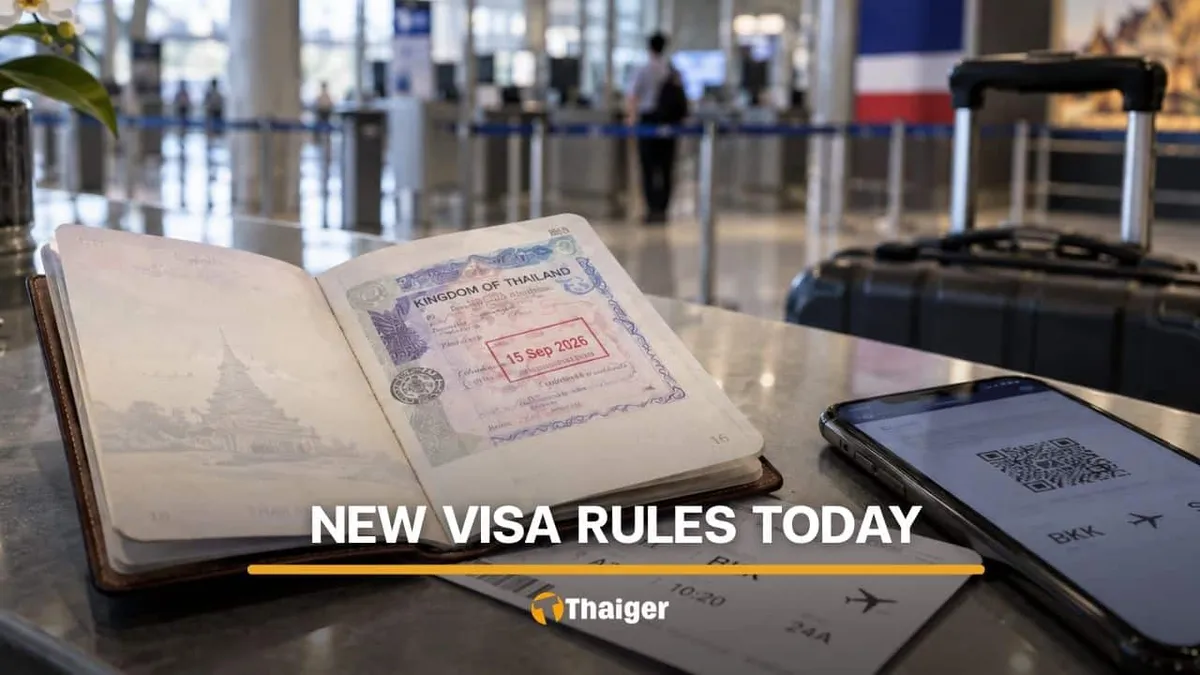
Thailand has implemented significant changes to its entry regulations for foreign visitors, effective September 15, 2026. These updated rules alter the duration of visa-exempt stays and modify the conditions for Visa on Arrival, impacting millions of tourists and expatriates. The core of the revision involves the discontinuation of the previous 60-day visa exemption previously available to citizens of 93 countries and territories.
Understanding the New Visa Exemptions and Requirements
Under the revised framework, Thailand now offers different visa exemption durations based on nationality. A broader group of 60 countries and territories will now be granted a 30-day visa exemption. Separately, citizens of Mauritius and Seychelles are eligible for a 15-day visa exemption. The Visa on Arrival (VOA) facility has also been narrowed, now exclusively available to travelers from Azerbaijan, Belarus, and Serbia, also for a maximum of 15 days.
These changes are officially stipulated by announcements from the Ministry of Interior, published in the Royal Gazette on August 31, 2026. It is crucial to note that the rules apply based on the date of entry into Thailand, not on when travel arrangements were made.
Visa Exemptions at a Glance (Effective September 15, 2026)
- 30-Day Visa Exemption: Available to citizens of 60 countries and territories. No pre-travel visa is required.
- 15-Day Visa Exemption: Granted to citizens of Mauritius and Seychelles. No pre-travel visa is required.
- Visa on Arrival (VOA): For citizens of Azerbaijan, Belarus, and Serbia. A 15-day stay is permitted, with application and payment required upon arrival.
- Bilateral Visa Exemptions: Certain nationalities benefit from specific agreements, offering stays of 14, 30, or 90 days, depending on the bilateral terms.
- Standard Visa: For all other eligible applicants, a visa must be obtained in advance, with the duration determined by the visa type.
It is important to distinguish between a visa exemption and a visa. A visa exemption grants permission to seek entry without prior visa application, whereas Visa on Arrival necessitates a formal application and fee payment at an eligible immigration checkpoint. In all cases, final admission into Thailand remains at the discretion of immigration officers.
Detailed Breakdown of Eligible Nationalities and Stays
30-Day Visa Exemption Countries
Passport holders from the following 60 countries and territories are eligible for a visa-exempt stay of up to 30 days:
Australia, Austria, Bahrain, Belgium, Bulgaria, Bhutan, Brunei Darussalam, Canada, Croatia, Cyprus, Czech Republic, Denmark, Estonia, Fiji, Finland, France, Georgia, Germany, Greece, Hungary, Iceland, India, Indonesia, Ireland, Israel, Italy, Japan, Jordan, Kuwait, Kyrgyzstan, Latvia, Liechtenstein, Lithuania, Luxembourg, Malaysia, Maldives, Malta, the Netherlands, New Zealand, Norway, Oman, the Philippines, Poland, Portugal, Qatar, Romania, Saudi Arabia, Singapore, Slovakia, Slovenia, South Africa, Spain, Sweden, Switzerland, Taiwan, Türkiye, Ukraine, the United Arab Emirates, the United Kingdom, and the United States.
15-Day Exemptions
Ordinary passport holders from Mauritius and Seychelles are permitted a 15-day visa-free stay. This is a distinct category from Visa on Arrival.
Visa on Arrival (VOA) – Three Nationalities
The list of countries eligible for Visa on Arrival has been significantly reduced to just three:
- Azerbaijan
- Belarus
- Serbia
Travelers from these nations can obtain a VOA for a stay of up to 15 days. They must be prepared to present a valid passport, accommodation details, proof of onward or return travel, and sufficient funds. The standard VOA fee is 2,000 baht.
Travelers from countries previously on the exemption or VOA lists but now removed, such as Uzbekistan and Armenia, must secure the appropriate visa before traveling to Thailand, unless another entry entitlement applies.
Bilateral Agreements: An Alternative Route
Thailand maintains several bilateral visa-waiver agreements that offer different permitted stay durations. These agreements operate independently of the general visa exemption schemes:
- 14 Days: Cambodia; Myanmar (arrivals at international airports only).
- 30 Days: China, Hong Kong, Kazakhstan, Laos, Macao, Mongolia, Russia, Timor-Leste, and Vietnam.
- 90 Days: Argentina, Brazil, Chile, Peru, and South Korea.
Travelers should verify the specific conditions of these bilateral agreements with the relevant Thai embassy or consulate, as terms can vary by nationality, passport type, and point of entry.
Entry Before September 15, 2026
The new regulations do not affect individuals who entered Thailand prior to September 15, 2026. Their permitted stay will be governed by the stamp in their passport at the time of entry. For instance, someone who entered on September 14, 2026, under the old 60-day exemption will retain their full permitted duration, irrespective of the new rules taking effect.
Extending a 30-Day Visa-Exempt Stay
Foreign nationals admitted under the 30-day visa exemption may apply for an extension of up to an additional 30 days at a Thai immigration office. This extension is subject to immigration approval and incurs a fee of 1,900 baht. Applicants typically need to complete form TM.7 and provide their passport, a recent photograph, copies of passport and entry pages, proof of address in Thailand, and any other documents requested by the local immigration office. It is advisable to confirm specific requirements with the immigration office beforehand. Those on a 15-day exemption or VOA should not assume similar extension possibilities; obtaining the correct visa in advance for longer stays is recommended.
Land Border Entry Restrictions
For travelers utilizing the 30-day or 15-day visa exemptions, entry via land border checkpoints is generally limited to a maximum of two times per calendar year. This restriction does not apply to nationals of Malaysia, Brunei Darussalam, Indonesia, and Singapore, or other nationalities as designated by the Ministry of Interior. Exceptions may also be granted by ministerial decree. This limit pertains specifically to visa-exempt entries by land and does not preclude immigration officers from scrutinizing repeated entries or refusing admission if they suspect misuse of tourist status.
Thailand Digital Arrival Card (TDAC) Remains Mandatory
The Thailand Digital Arrival Card (TDAC) continues to be a mandatory requirement for most non-Thai nationals entering the country by air, land, or sea, regardless of their visa status. A new TDAC must be submitted for each entry within three days prior to arrival, including the arrival date itself. Children must also be registered, though a parent or guardian can submit their information as part of a group. Transit passengers who do not pass through Thai immigration are exempt. The official website for TDAC submission is tdac.immigration.go.th, and there is no fee associated with its use. Travelers should be wary of unofficial sites that charge for this service.
Purpose of Travel: Tourism vs. Work
The revised visa exemptions are strictly for tourism purposes and do not authorize employment within Thailand or waive the need for a work permit. Individuals planning to work, study, retire, conduct business, or reside long-term in Thailand must obtain the appropriate visa category, such as a Non-Immigrant B (Business), ED (Education), or O (Other) visa, or explore options like the Destination Thailand Visa (DTV) or the Long-Term Resident (LTR) visa. Remote workers earning income from overseas may qualify for the DTV, while employment with a Thai entity requires a work visa and permit.
Essential Preparations for Travelers
Even with visa-free entry, travelers must be prepared with necessary documentation:
- A valid passport or travel document.
- A completed TDAC confirmation.
- A return or onward ticket, valid within the permitted stay duration.
- Accommodation details and address in Thailand.
- Evidence of sufficient funds, as immigration officers may request it. The required amount can vary by entry type (e.g., 10,000 baht per person or 20,000 baht per family for VOA).
- Documents clarifying the purpose of visit, especially for frequent travelers.
Airlines may also conduct document checks before boarding. Failure to present required documents could result in denied boarding.
Practical Scenarios Under the New Rules
- British Tourist (Arriving Sept 15, 2026): Eligible for up to 30 days visa-free, with a potential 30-day extension.
- British Tourist (Entered Sept 14, 2026): Retains the original 60-day permission stamped in their passport.
- Mauritian Tourist (Arriving Sept 15, 2026): Eligible for a 15-day visa exemption.
- Belarusian Tourist (Arriving Sept 15, 2026): May apply for Visa on Arrival for up to 15 days, subject to VOA requirements.
- Russian Tourist (Arriving Sept 15, 2026): Stay duration governed by the bilateral agreement (currently 30 days for ordinary passports).
- Digital Nomad (Planning 6 Months): A series of tourist exemptions is not advisable. The traveler should investigate long-term visa options like the DTV before departure.
Reasons Behind the Regulatory Changes
The Thai government’s decision to revise its entry system was influenced by several factors, including national security, tourism and economic considerations, reciprocity with other nations, streamlining of entry schemes, and the increased availability of Thailand’s e-Visa system. The aim is to create a more tailored entry framework that aligns with national interests and international relations.
Travelers are strongly advised to consult the official Thai e-Visa portal or the website of the relevant Royal Thai Embassy or Consulate-General for the most current and accurate information pertaining to their specific nationality and travel plans. For inquiries within Thailand, the Immigration Bureau can be reached at call centre 1178, which offers English-language service.
