

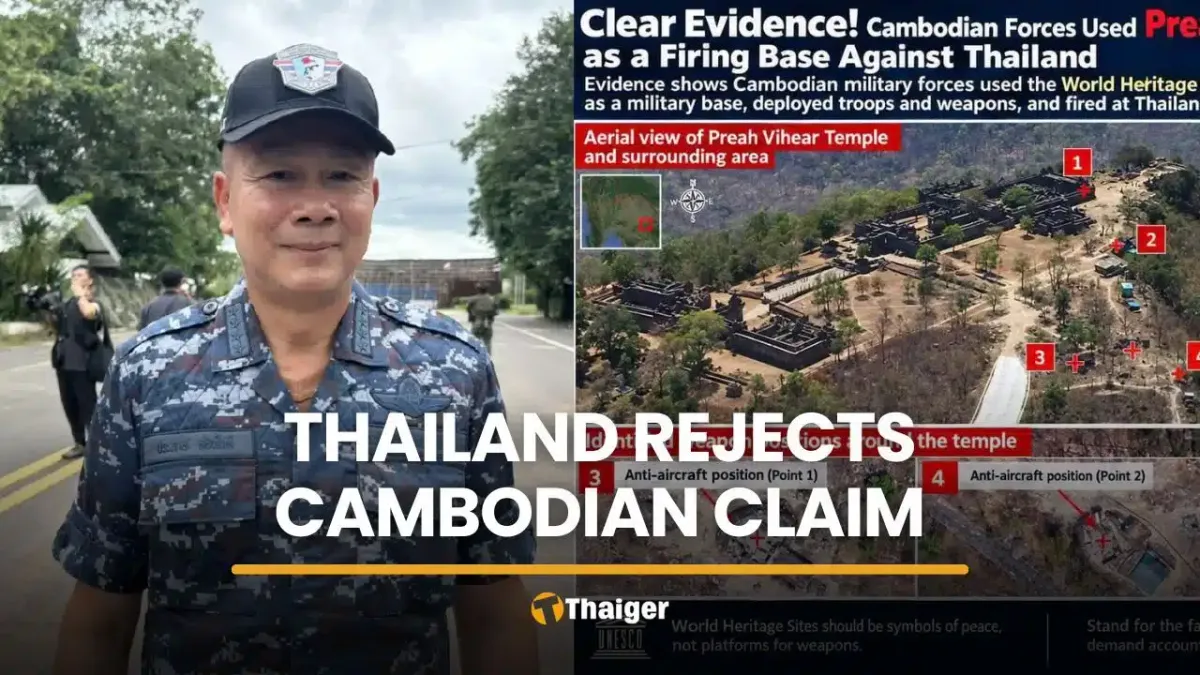
Thailand has officially rejected claims made by Cambodia that Thai forces have seized territory along their shared border. Air Chief Marshal Praphas Sonjaidee, director of the Thailand-Cambodia Joint Information Centre (JIC), stated on September 13 that the troop positions established after a ceasefire do not serve as a determination of the international boundary. He emphasized that any territorial disputes should be resolved through established bilateral mechanisms, specifically the Joint Boundary Commission (JBC).
Disputed Territory and Ceasefire Agreements
The Cambodian side had raised accusations regarding territory along the border. In response, Air Chief Marshal Praphas clarified the distinction between military actions during conflict and the subsequent demarcation of borders. He explained that if Cambodian forces encroached upon areas Thailand considers its own and used these locations for troop deployment or attacks, Thai forces were obligated to defend those areas and protect civilians. He stressed that any such defensive actions were necessary, proportionate, and conducted in accordance with international humanitarian law.
Praphas cautioned against interpreting the act of pushing opposing forces out of contested areas during hostilities as evidence of Thailand’s intent to invade Cambodia or claim its territory. He highlighted a joint statement signed on December 27, 2025, which established a ceasefire and mandated that both sides maintain their forces at the positions held at the cessation of fighting, without advancing further into each other’s territory.
The Role of the Joint Boundary Commission
Crucially, Praphas pointed out that this ceasefire agreement explicitly stated that the military positions held at the time of the ceasefire would not impact the ongoing process of surveying and demarcating the international boundary. This demarcation, he reiterated, must proceed through the JBC mechanism. A ceasefire, he explained, serves to end active combat but does not establish a new border. Therefore, the lines where troops are stationed should not be construed as new territorial boundaries.
He urged Cambodia to present its claims regarding disputed areas, including any supporting maps, evidence, and legal arguments, through the JBC. This, he stated, is the agreed-upon channel for resolving such matters between the two nations. Praphas added that Thailand expects to be held to the same standard, meaning its own troop positions should not be used as definitive proof of the border’s location.
Thailand’s Stance on Sovereignty and Resolution
Air Chief Marshal Praphas asserted that Thailand has no territorial ambitions, stating the country does not seek “even a square inch” of Cambodian territory. However, he underscored Thailand’s responsibility to defend areas and its citizens that fall under Thai sovereignty when they face a threat. Once the ceasefire was implemented, he affirmed that Thailand has respected the agreement and desires to return disputed sections of the border to the negotiation table.
His guiding principle for managing the situation was articulated as: “Defend when necessary, de-escalate when possible, and settle the boundary through agreed mechanisms.”
Call for International Understanding
Praphas also appealed to the international community to consider the complete timeline of events, the factual situation on the ground, and the signed agreements between Thailand and Cambodia. He urged observers not to take sides but to understand the complexities involved in resolving the dispute.
Ultimately, Thailand’s objective, as stated by Praphas, is to restore calm along the border, enable the resumption of normal life for the communities residing in border areas, and ensure that territorial disputes are settled through legal processes, negotiations, and bilateral mechanisms rather than through the use of force.
Background on Border Disputes
The Thailand-Cambodia border, stretching over 800 kilometers, has historically been a source of contention. Several sections remain undemarcated, leading to recurring disputes, particularly concerning resource-rich areas or strategically important locations. Past incidents have involved clashes between military forces and heightened diplomatic tensions. The Joint Boundary Commission (JBC) was established to address these issues, tasked with surveying, demarcating, and resolving border discrepancies based on historical treaties and modern agreements. However, the process has been slow and complex, often hampered by political sensitivities and differing interpretations of historical documents and maps.
Mechanisms for Dispute Resolution
The Joint Boundary Commission (JBC) is the primary official body responsible for resolving border issues between Thailand and Cambodia. It comprises representatives from both countries tasked with reviewing historical documents, conducting joint surveys, and proposing solutions for demarcation. The Joint Information Centre (JIC), directed by Air Chief Marshal Praphas Sonjaidee, serves as a communication channel to disseminate official information and clarify positions during periods of tension.
The emphasis on using these established mechanisms underscores a commitment to a peaceful and legal resolution, moving away from military posturing. International law and humanitarian principles are cited as guiding frameworks for any necessary defensive actions, ensuring proportionality and adherence to global standards.
Conclusion: Moving Towards Peaceful Resolution
Thailand’s firm rejection of Cambodian claims regarding seized territory, coupled with its clear articulation of adherence to agreed-upon resolution mechanisms, signals a commitment to diplomacy. The focus remains on the Joint Boundary Commission as the legitimate forum for addressing territorial claims. By distinguishing between defensive military actions during conflict and the permanent establishment of borders, Thailand seeks to de-escalate tensions and foster an environment conducive to negotiation. The call for a comprehensive understanding by the international community highlights the desire for a fair and fact-based resolution, prioritizing stability and the well-being of border communities.
