

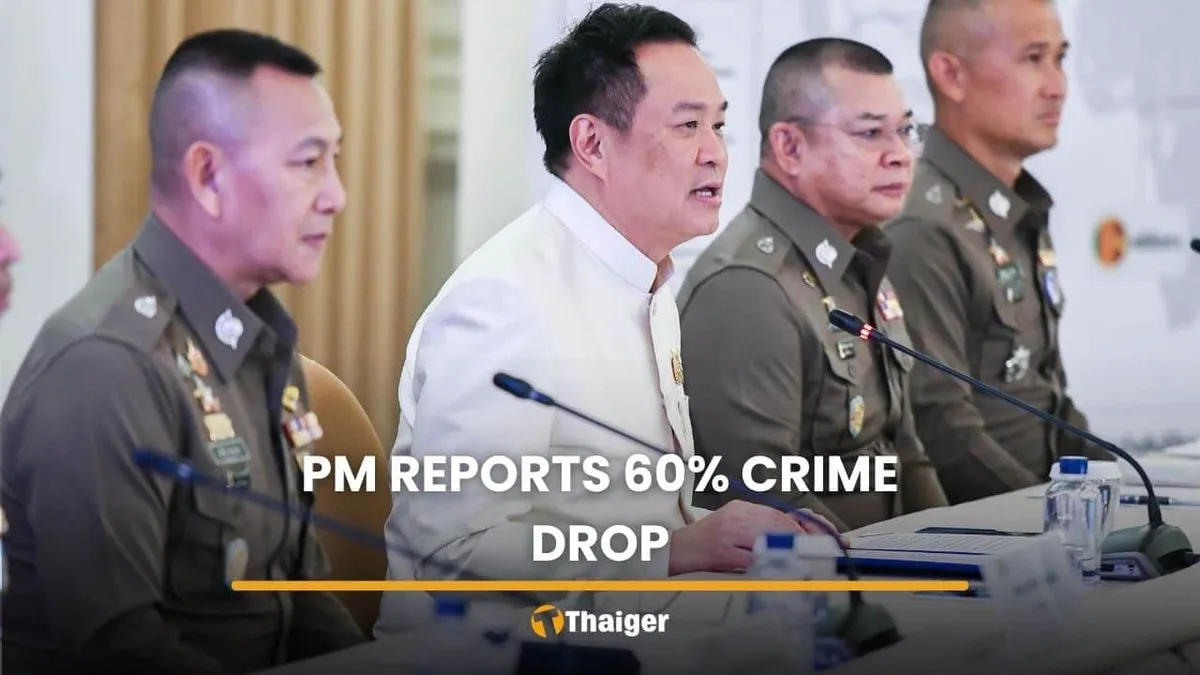
Cybercrime and Nominee Offenses Plummet 60% Following Government Crackdown
BANGKOK – A rigorous enforcement campaign targeting cybercrime, online scams, and foreign nominee businesses has resulted in a nearly 60% reduction in related offenses over the past three months, Prime Minister Anutin Charnvirakul announced on June 22. The announcement followed a briefing on the outcomes of a nine-month national crackdown, which ran from September 2025 to May 2026.
Prime Minister Charnvirakul emphasized that combating call-center gangs, online scam operations, and transnational nominee networks is a top government priority. To facilitate this, a dedicated steering committee was established to guide policy, monitor operations, and enhance inter-agency coordination.
“As a result, the number of cases fell sharply while the value of seized assets increased and fraud-related losses also declined across the board,” Prime Minister Charnvirakul stated, asserting that these figures represent tangible policy achievements. He specifically noted that during the intensified enforcement period from March to May 2026, offenses decreased by nearly 60%.
Focus on Nominee Networks and Foreign Involvement
A particular focus of the crackdown was on foreign nominee networks. These operations exploit legal loopholes by using Thai nationals as proxy shareholders to establish companies for illicit purposes. Prime Minister Charnvirakul indicated that law enforcement would conduct unannounced arrests, and foreign nationals implicated in these schemes would face deportation and be declared persona non grata.
He expressed his appreciation for the support of National Police Chief Police General Kittharath Punpetch and satisfaction with the performance of the police and other relevant agencies. The Prime Minister vowed that enforcement efforts would continue without abatement.
Royal Thai Police Operations and Seizures
Police General Kittharath detailed the Royal Thai Police’s strategic approach, including the establishment of two operation centers dedicated to combating online fraud and assisting victims. These centers facilitate intelligence sharing, expand investigations across criminal networks, and enable the recovery of assets and prosecution of offenders by coordinating with bodies such as the Ministry of Interior and the National Broadcasting and Telecommunications Commission.
Prior to launching targeted operations against nominee networks in key locations like Koh Phangan, Surat Thani, and Phuket, the Royal Thai Police gathered intelligence over an extended period. During the nine-month nationwide crackdown, authorities seized assets valued at 24 billion baht. Additionally, more than 300,000 suspicious phone numbers were blocked, and 122,840 fraudulent websites were shut down. Over 30,000 individuals linked to scam networks were apprehended.
Impact on Nominee Businesses and International Recognition
Operations specifically targeting foreign nominee businesses led to the recovery of 172 land plots. Sixty-five suspects were arrested in connection with these operations, and 1,450 companies were identified as potentially operating through illicit nominee arrangements.
Prime Minister Charnvirakul concluded by stating that the successful outcomes of Thailand’s crackdown on scam operations and cybercrime have garnered international recognition and contributed to restoring public confidence.
