

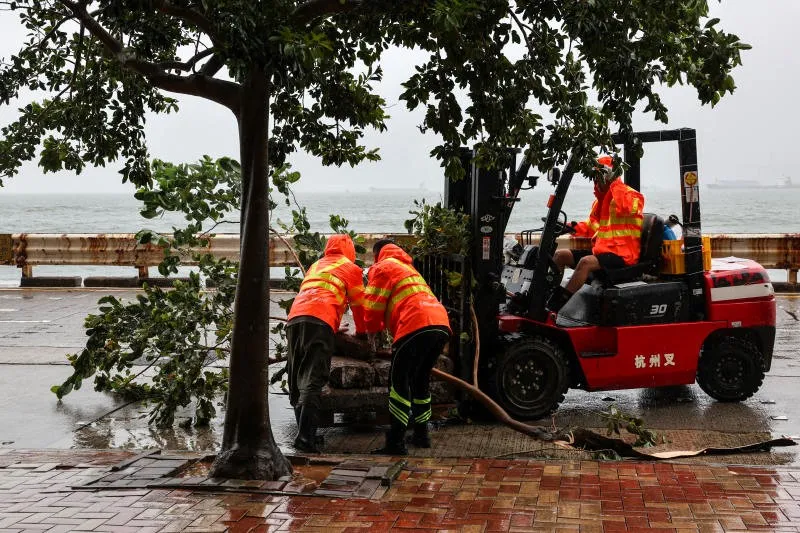
Southern China braced for the impact of Typhoon Noul, the most powerful storm to hit the region this year, prompting the evacuation of over 700,000 people and triggering the highest level of alert for flash floods in several provinces. The typhoon made landfall in Huidong county, Guangdong province, in the early hours of Sunday morning, bringing with it fierce winds and torrential rain.
Typhoon Noul’s Landfall and Impact
Typhoon Noul, the twelfth tropical cyclone of the year and the third to affect China in September, made landfall around 3:50 AM local time. Provincial officials confirmed the storm’s arrival, noting its significant force. The name ‘Noul’ itself, derived from Korean, signifies the ‘glow of sunrise or sunset,’ a poetic contrast to the destructive power it unleashed.
The immediate aftermath saw widespread evacuations, with Guangdong province being the most significantly affected. Authorities worked tirelessly to relocate more than 700,000 residents from vulnerable coastal areas to safer inland locations. This mass evacuation was a critical measure to prevent loss of life and minimize injuries as the typhoon’s full force bore down on the region.
Widespread Weather Warnings and Forecast
The National Meteorological Centre issued a stark warning, declaring the highest alert for flash floods across multiple provinces. The forecast indicated that extremely heavy to exceptional downpours were expected to lash certain areas, including the province of Fujian. Heavy to torrential rain was predicted to persist across much of southern China from Sunday through Monday morning.
As the typhoon moved inland, it was expected to continue bringing severe weather to neighboring provinces such as Jiangxi and Hunan. State broadcaster CCTV reported that the heavy rains were likely to continue their onslaught until Tuesday, underscoring the prolonged nature of the storm’s impact.
Hong Kong’s Experience with Typhoon Noul
While the mainland bore the brunt of the landfall, Hong Kong also experienced significant effects from Typhoon Noul. The Hong Kong Observatory reported that the storm, though weakening as it moved inland, still generated powerful southwesterly gales that pounded parts of the Asian financial hub. Authorities in Hong Kong initially raised the typhoon signal to level 8, indicating conditions were dangerous, but downgraded it to level 3 by the afternoon as the storm’s intensity lessened over land.
The storm had passed within approximately 80 kilometers of Hong Kong overnight, causing considerable disruption. Hong Kong International Airport experienced a 12-hour shutdown, leading to the cancellation and delay of numerous flights. Airport authorities announced that flight operations would gradually resume on Sunday afternoon, signaling a return to normalcy after the severe weather event.
Preparedness and Response Measures
The scale of the evacuations and the issuance of high-level flood alerts highlight the extensive preparedness measures undertaken by Chinese authorities. Relocating such a large number of people requires meticulous planning, including the establishment of temporary shelters, provision of essential supplies, and clear communication channels to ensure public safety. Emergency services were placed on high alert, ready to respond to any incidents arising from the typhoon, such as landslides, building collapses, or power outages.
The meteorological agencies closely monitored Noul’s trajectory and intensity, providing crucial data for decision-making. The coordinated response across different provincial and municipal levels, as well as the collaboration with meteorological observatories in neighboring regions like Hong Kong, demonstrated a unified approach to managing the crisis. The focus remained on protecting lives and mitigating the economic and infrastructural damage caused by the powerful typhoon.
Looking Ahead: Recovery and Future Preparedness
As Typhoon Noul moves further inland and weakens, the focus will shift towards assessing the damage and commencing recovery efforts. The extensive rainfall will likely lead to flooding in many areas, requiring ongoing monitoring and management of water levels in rivers and reservoirs. The long-term impact on agriculture, infrastructure, and local economies will need to be addressed in the coming weeks and months.
The event serves as a stark reminder of the increasing intensity and frequency of extreme weather events, likely exacerbated by climate change. Continuous investment in early warning systems, robust infrastructure, and effective evacuation strategies remains paramount for enhancing the resilience of coastal communities and other vulnerable regions against future typhoons and natural disasters. The experience with Typhoon Noul will undoubtedly inform future disaster preparedness and response protocols in China and the wider region.
