

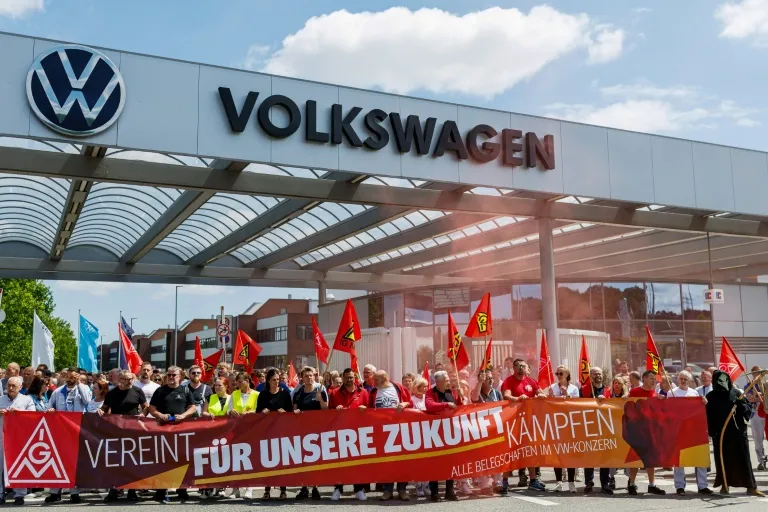
Volkswagen, the global automotive giant encompassing brands like Audi, Skoda, Seat, and Porsche, has announced a sweeping restructuring plan that includes significant job reductions, sending ripples of uncertainty through its workforce and the communities surrounding its factories. The company revealed plans to cut an additional 50,000 positions, adding to previously planned reductions, bringing the total workforce reduction to 100,000. This move marks what is being described as the largest restructuring program in the history of the global automotive industry, surpassing the 50,000 job cuts made by General Motors following its bankruptcy in 2009.
Investor Confidence Boosted by Cost-Cutting Measures
Financial markets reacted positively to the news, with investors viewing the extensive job cuts as a strategic move by Volkswagen to enhance its competitiveness against lower-cost Chinese automotive manufacturers. Following the announcement, Volkswagen’s shares saw a notable increase, opening nearly 10 percent higher and leading gains on Germany’s DAX index. Analysts from Deutsche Bank commented that the agreement demonstrated the company’s resolve in making necessary, albeit difficult, decisions to navigate the evolving market landscape.
Worker Concerns Over Plant Futures
While investors and analysts have focused on the financial implications, the impact on the company’s employees is a significant concern. For many workers, a career in automotive manufacturing is deeply intertwined with their identity and way of life. The agreement reached between management and unions has left the long-term future of four key German plants—located in Neckarsulm, Emden, Hannover, and Zwickau—undetermined. The current agreement only commits to exploring “alternative uses” for these facilities, leaving employees and local communities in a state of suspense.
Lars Bochmann, a 50-year-old employee who has dedicated his entire career to the Volkswagen plant in Zwickau, expressed profound disappointment with the outcome. “We at least expected people to speak plainly,” Bochmann stated. “That they wouldn’t just keep stringing people along, they’d be straight-forward and say whether the site has a future or not.” This sentiment highlights a desire for clear communication and definitive answers regarding job security and the operational future of their workplaces.
Economic Ripple Effects on Local Communities
The potential closure or significant alteration of these four Volkswagen plants carries substantial economic weight for the surrounding regions. These areas often host a complex ecosystem of businesses, from specialized automotive suppliers to local service providers like bars and cafes, all of which are dependent on the plant’s continued operation. The lack of clarity regarding the plants’ futures is expected to have a chilling effect on local economic activity.
Denny Pohl, a logistics worker at Radsystem, a wheel manufacturer, indicated that approximately 80% of his company’s revenue is directly linked to the Zwickau plant. “The plant is important for all Saxony, all Germany,” Pohl emphasized. He foresees a reluctance among businesses to invest in the interim. “Everyone’s going to say, ‘Right, I’m not going to invest anything for the time being, because I don’t know yet whether any more orders will come in’”, he explained. “In five years’ time it could all be over.” This sentiment underscores the precarious economic situation facing suppliers and related businesses.
Deep-Rooted Connections to Volkswagen
For many long-serving employees like Martin Lehmann, a 38-year-old who has worked at the Zwickau plant for years, Volkswagen represents more than just an employer; it is a deeply ingrained part of their personal history and local culture. Lehmann shared poignant childhood memories of spotting Volkswagens and trying to identify their manufacturing origins, illustrating the profound emotional and traditional ties many feel towards the brand and its production facilities.
“Those kinds of things I’ll never forget,” Lehmann said. “There’s so much passion, so much heart and soul and tradition bound up with these jobs.” He described the palpable sense of uncertainty permeating Zwickau, noticeable in conversations with local shopkeepers, hairdressers, and bakers. “If this factory were to close and we didn’t make cars here there’s no way you could make up for what we would lose,” he concluded. “Everything depends on the future of this plant.” The deep emotional and economic stakes highlight the human cost of such large-scale industrial restructuring.
Navigating the Future of Automotive Manufacturing
Volkswagen’s decision to implement such a drastic restructuring reflects the immense pressures facing the global automotive industry. The shift towards electric vehicles, increasing competition, and evolving consumer demands necessitate significant strategic adjustments. While the company aims to secure its long-term viability and competitiveness through these measures, the immediate consequences for its workforce and the communities reliant on its factories present a complex challenge that requires careful management and transparent communication moving forward.
