

Ukrainian President Volodymyr Zelensky arrived in Serbia on Saturday for crucial diplomatic talks with his counterpart, Aleksandar Vučić. The visit, which marks Zelensky’s first to Serbia since becoming president in 2019, occurs against a backdrop of intensified hostilities in Ukraine, including a recent barrage of attacks on Kyiv and its surrounding regions that resulted in civilian casualties.
Diplomatic Maneuvers Amidst Ongoing Conflict
The high-level meeting between Zelensky and Vučić at the presidential palace is intended to address a range of bilateral issues, including economic cooperation, Serbia’s European Union accession path, and security concerns. This diplomatic engagement comes at a critical juncture, with the full-scale Russian invasion of Ukraine now extending beyond its fourth year and both sides escalating long-range strikes. These actions have led to a growing number of civilian casualties, underscoring the urgent need for dialogue.
A senior Ukrainian official characterized Zelensky’s visit to Serbia, a traditional ally of Russia, as a significant diplomatic signal. Serbia, under Vučić’s leadership, has maintained close historical ties with Moscow and has notably refused to impose sanctions on Russia. This stance has drawn criticism from the European Union and has complicated Belgrade’s aspirations for EU membership.
Economic Ties and Sanctions Stance
The discussions are expected to focus on strengthening economic ties between Ukraine and Serbia. President Vučić reiterated his position on not imposing sanctions against Russia earlier in the week, a policy he has consistently maintained. Despite this, Serbia has provided non-military aid to Ukraine. This complex relationship is further highlighted by Moscow’s past accusations that Serbian firms have supplied munitions to Ukraine, allegations that Vučić has consistently denied.
Zelensky expressed his expectations for the talks on the social media platform X, stating, “We will discuss expanding economic ties between our countries, relations with the European Union, other areas that can benefit our nations, and security issues.” The leaders are also scheduled to hold a joint press conference following their discussions.
Escalating Attacks on Ukrainian Cities
The visit takes place in the shadow of recent deadly attacks on Ukraine’s capital. Overnight bombardments on Kyiv and the surrounding region claimed the lives of at least three people, including a child, and injured seven others. The head of the regional military administration, Tymur Tkachenko, reported via Telegram that the attacks in the Brovary district, northeast of Kyiv, caused significant damage. Falling debris from the strikes ignited fires in non-residential buildings and damaged homes and vehicles.
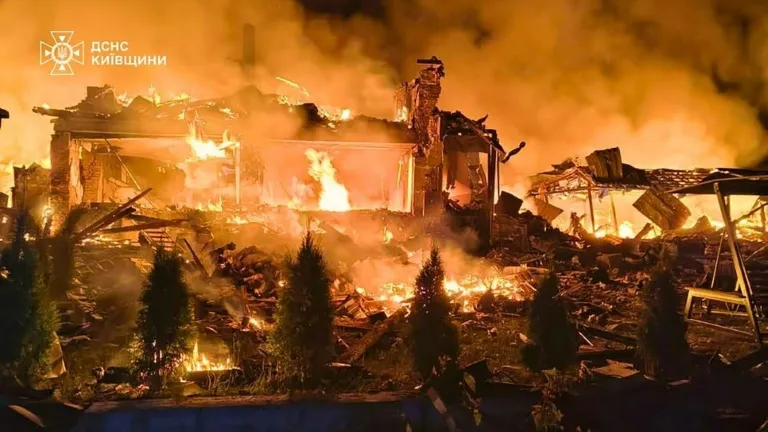
Ukraine’s state emergency service released images depicting a destroyed building engulfed in flames in the village of Pukhivka. The attack there reportedly obliterated a two-story house and two cars, also triggering a fire in a nearby warehouse. In the capital itself, an AFP correspondent reported hearing numerous explosions as Ukraine’s air force issued warnings about the potential use of ballistic missiles launched from the north.
Ukraine’s Defense and Drone Operations
In response to the sustained Russian offensive, Ukraine has been actively seeking enhanced air defense capabilities, particularly pleading for more U.S.-made Patriot interceptor systems to counter the increasingly difficult-to-intercept ballistic missiles frequently employed by Russia. Simultaneously, Kyiv has ramped up its own drone operations, launching a record number of unmanned aerial vehicles targeting Russian territory.
President Zelensky has undertaken extensive international travel since Russia’s full-scale invasion in 2022, seeking to rally global support for Ukraine. While Vučić has visited Ukraine for regional summits and met with Ukrainian leadership, he has refrained from signing any formal declarations of support for Ukraine in the ongoing war. Serbia’s reliance on affordable Russian gas and its unique geopolitical position continue to shape its foreign policy decisions, particularly concerning its relationship with Moscow and its EU integration trajectory.
Broader Geopolitical Context
Serbia’s refusal to join international sanctions against Russia places it in a distinct position among European nations. This policy is influenced by deep historical, cultural, and economic ties between Serbia and Russia. President Vučić has often emphasized Serbia’s commitment to its own national interests and its neutrality in the conflict, while also navigating the demands and expectations of the European Union.
The ongoing conflict continues to have profound humanitarian consequences, with civilian infrastructure and lives frequently impacted by the escalating military actions. The diplomatic efforts, such as President Zelensky’s visit to Serbia, represent attempts to manage complex international relations and seek pathways toward de-escalation, even as military operations intensify on the ground. The outcome of these discussions in Belgrade could have implications for regional stability and the broader European security landscape.
