

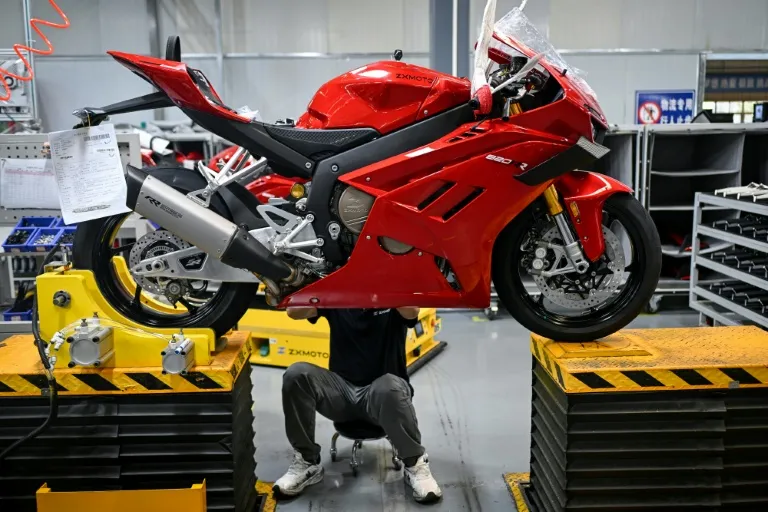
A recent victory at the Supersport World Championship has significantly boosted orders for ZXMoto’s motorcycles, providing crucial momentum for the young company as it vies for prominence in the highly competitive global motorbike market. Founded just two years ago, ZXMoto is already challenging established manufacturers like Europe’s Ducati and Japan’s Yamaha and Honda, offering comparable bikes at a substantially lower price point.
The company’s founder, Zhang, expressed his elation, stating, “You have this dream you’ve been thinking about for many years, and when it finally comes true… I was so happy.” Since the championship win in March, ZXMoto has doubled its workforce, and its factory operates around the clock to meet surging demand, yet customers still face waiting periods of several months.
Zhang, a former mechanic with a remarkable ability to assemble engines blindfolded, is resolute about the company’s future. “Chinese brands are very clear about where our future lies,” he asserted. “It has to be global.”
ZXMoto’s Competitive Edge: Performance and Price
The firm’s flagship model, the 820RR, boasts 133 horsepower and can accelerate from 0 to 100 kph in a mere 2.8 seconds. This high-performance machine retails for approximately 43,000 yuan ($6,370) in China, positioning it at least 30 percent cheaper than comparable foreign models. Riders like 28-year-old Yang, an owner of the 820RR, appreciate the value proposition. “Compared to imported ones like Kawasaki, it’s very good value,” Yang commented. “First off, we support domestic production, and second, if the product is truly good, we’ll choose it.”
ZXMoto’s sales figures reflect this growing appeal. The company sold 25,000 bikes in 2025 and projects reaching 100,000 units this year. Ambitious plans are in place to double that figure again by 2027, a target that aligns with the production scale of established manufacturers like BMW.
Navigating a Shifting Domestic Market
Despite its rapid growth, ZXMoto, like many Chinese manufacturers, faces challenges within its domestic market. The overall Chinese motorbike market has contracted, with sales falling 3.4 percent in 2025 and continuing to decline this year. This downturn is attributed to a growing consumer preference for automobiles and less regulated electric bikes. Furthermore, the market is characterized by intense competition and diminishing profit margins.
Zhang recalls a different era: “Twenty years ago, as long as you produced a motorcycle, even if it didn’t start, people would line up to give you money.” He contrasts this with the current reality: “Now… If you don’t get serious, you will be eliminated by the market.”
The Drive for Global Markets
The weakening domestic sales landscape is a significant driver for Chinese manufacturers to seek higher profit margins internationally, where consumers generally possess greater purchasing power. Last year, half of the 22 million motorcycles produced in China were exported, and the trend shows nearly all domestic brands actively pursuing overseas markets.
ZXMoto aims to export 40,000 bikes to Europe by 2027. Meanwhile, rival manufacturer Shineray finds significant success in international markets, with 90 percent of its lower-end models sold in South America, Southeast Asia, and Africa. Nie Jianwei, Shineray’s overseas marketing head, described the domestic situation as “very ‘juan’,” a Chinese term signifying extreme, often exhausting, competition. “We are constantly reducing the price of our products to make them more competitive,” he added.
Chongqing: A Hub of Motorcycle Innovation
Chongqing, often dubbed China’s “motorbike capital,” hosts over 50 manufacturers and hundreds of component suppliers. This concentration allows companies like ZXMoto to benefit from an integrated supply chain and a highly competitive industrial ecosystem that fosters rapid innovation and product development.
Bill Russo, an expert on China’s automotive industry, observed, “Companies like ZXMoto are emerging from one of the world’s most competitive industrial ecosystems, where rapid iteration, integrated supply chains, and relentless competition yield world-class products rapidly.”
The Road Ahead: Prestige, Heritage, and Global Expansion
Zhang believes that Chongqing’s lower production costs provide Chinese brands with a significant advantage over their Japanese and European counterparts. He suggests that established foreign manufacturers may have reached a technological plateau, limiting their pace of advancement. Russo likens the current state of China’s motorcycle industry to that of its passenger car sector a decade ago, when domestic giants like BYD and Geely began to challenge and eventually surpass foreign competitors through a combination of competitive pricing and technological innovation.
However, breaking into the motorcycle market presents unique challenges. “Motorcycles remain more emotionally driven purchases than cars,” Russo noted. “Heritage, racing history and brand prestige still matter much more, giving established Japanese and European manufacturers a stronger defensive position.” He cautioned that while the gap is narrowing, it will take time to close.
Despite these considerations, the momentum for Chinese brands is undeniable. ZXMoto anticipates that a majority of its production will be exported within the next five years. Russo predicts that Chinese brands will expand their global presence not solely through exports but also via local investments and strategic partnerships. With an 800-million-yuan factory slated to open in late 2027, ZXMoto is strategically positioning itself to become one of the world’s top ten motorcycle brands by 2034.
Drawing a parallel to the past, Zhang recalled the initial reception of Japanese products in Europe. “When Japanese products first entered Europe, there was the same reaction, there were many questions,” he said. “But as long as the products are good, one day people will accept and enjoy them.”
