

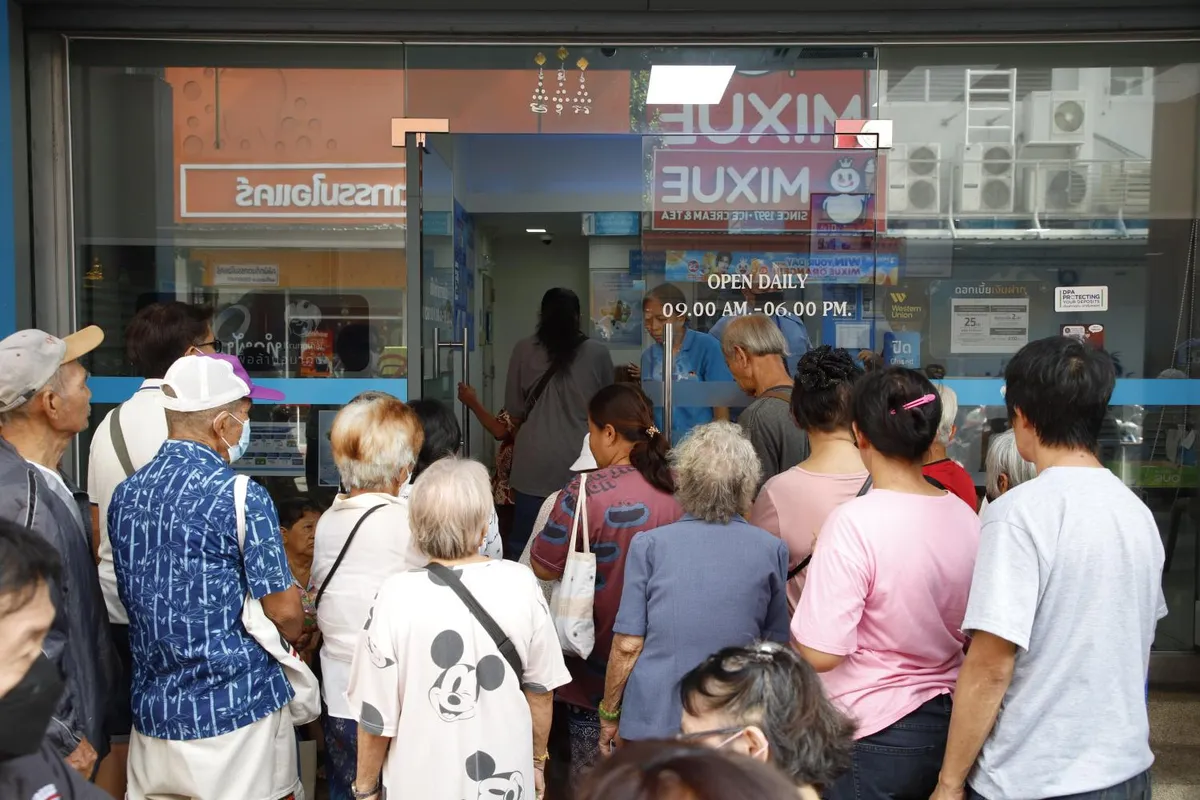
Rising Welfare Costs Strain National Budget
Public debt in Thailand is approaching the critical threshold of 70% of the nation’s Gross Domestic Product (GDP), driven significantly by escalating welfare expenditures. The government is actively working to construct a comprehensive social safety net designed to support all segments of society, with a particular focus on low-income and vulnerable populations. While the financial aid and benefits provided may be modest, they are crucial for those who depend on them for basic necessities.
State Welfare Card Revisions Spark Debate
Recent attempts to refine the eligibility criteria for the state welfare card have faced public scrutiny. An initial proposal aimed to exclude parents who claimed parental tax deductions on their income tax returns. However, this screening method was ultimately abandoned following widespread public outcry. The stated objective behind these revisions is to ensure that welfare benefits are genuinely channeled to those in need, rather than individuals who may technically qualify but are not experiencing genuine hardship.
These adjustments also underscore growing concerns within the Ministry of Finance regarding the increasing financial burden of the government’s welfare programs. A significant portion of the annual government spending budget is comprised of costs that are difficult to reduce, including welfare provisions for both public sector employees and the general public. This spending has seen a consistent upward trend, exacerbated by Thailand’s ongoing demographic shift towards an aging society.
Alongside debt servicing obligations and salaries for public sector employees, welfare spending represents an unstoppable rise. Collectively, these expenditures account for over half of the government’s annual budget. This proportion has climbed from 62% of total government spending in 2019 to 67% in 2023, before a slight decrease to 66% in 2024.
Breakdown of Welfare Spending
- Civil Servant Welfare: Spending on civil servant welfare has grown from 12.7% of total government expenditure in 2019 to 15.1% in 2024, equating to 542 billion baht. This includes medical benefits, gratuity and pension payments, and government contributions to the Government Pension Fund.
- Public Welfare: Welfare spending for the general public constituted 11.9% of the annual expenditure budget in 2019, rose to 13.1% in 2021, and settled at 12.2% in 2024, totaling 437 billion baht.
Public welfare expenditures encompass a range of support, including living allowances for the elderly, individuals with disabilities, and HIV/AIDS patients; child support subsidies; school lunch and supplementary nutrition programs; and government contributions to various social funds. These funds support initiatives such as the National Savings Fund, National Health Security Fund, Social Security Fund, Elderly Fund, and the Pracharat Welfare Fund, which manages the State Welfare Card program.
Healthcare Costs a Growing Concern
Thailand’s medium-term fiscal framework for 2027-2030 highlights mounting concerns over rising government obligations, particularly in healthcare. To address this, a committee has been established to review medical expenses within the public healthcare welfare system, seeking to identify cost-reduction measures and enhance spending efficiency. Healthcare expenditures are projected to continue their ascent as the population ages.
The National Health Security Fund, responsible for Thailand’s Universal Coverage Scheme (UCS), often referred to as the 30-baht scheme, received an allocation of 272 billion baht for fiscal year 2026. This translates to approximately 4,298 baht per beneficiary under the scheme.
This escalating financial burden is increasingly recognized as a fiscal risk. Credit rating agencies have advised the government to implement stricter fiscal discipline, particularly in light of the significant increase in public debt following the pandemic. In response, the Ministry of Finance has set a target to reduce the fiscal deficit to a maximum of 3% of GDP by 2029. For fiscal year 2026, the projected fiscal deficit remains at 4.4% of GDP.
Thailand’s Welfare System Landscape
Thailand’s welfare infrastructure includes several key mechanisms:
- Social Security Fund: A contributory system involving the government, employees, and employers, providing benefits for illness, work-related injuries, and lifelong pensions upon retirement.
- Civil Servant Healthcare Scheme: A government-funded health insurance program for civil servants, their parents, and up to three dependent children. Spending in this area has steadily increased, reaching 64 billion baht in the first half of fiscal year 2026.
- Universal Coverage Scheme (UCS): Launched in 2001, this scheme covers nearly 50 million people, approximately 70% of the population, providing nationwide universal healthcare access.
Historical data indicates that welfare-based healthcare programs predated the UCS, with initiatives for low-income citizens dating back to 1975. The state welfare card program, introduced in 2017, was a significant effort to establish formal criteria for identifying and supporting individuals classified as poor.
State Welfare Card: Eligibility and Challenges
Research indicates that among the 14 million welfare cards issued, only approximately 3 million reached genuinely impoverished individuals, while an estimated 2.7 million eligible poor did not receive a card. Some households in higher income brackets were also found to be beneficiaries.
The state welfare card is intended for low-income individuals with an annual income not exceeding 100,000 baht. Beneficiaries receive a monthly allowance of 300 baht for essential expenses, along with subsidies for cooking gas, electricity, water, and public transportation.
Revisions to Eligibility Criteria
According to Vinit Visessuvanapoom, director-general of the Fiscal Policy Office, the recent revisions aim to address two primary issues: reducing “leakage” by removing beneficiaries whose financial situations have improved, and proactively identifying truly disadvantaged individuals who may struggle to register independently. The Interior Ministry and the Ministry of Social Development and Human Security are planning field visits to ensure wider reach.
The updated eligibility criteria introduce several new ineligibility categories, including students under parental care, shareholders or company directors, individuals holding stock or bond accounts, and those paying life insurance premiums exceeding 12,000 baht annually.
The income threshold has shifted from average household income to individual income, requiring it not to exceed 100,000 baht per person annually. Financial asset criteria have also been adjusted to an individual basis, with personal deposits and lottery holdings limited to 100,000 baht per person.
Real estate restrictions remain, with limits on agricultural and residential land. Additionally, applicants must not own a motor vehicle, with exceptions for motorcycles under 300cc, three-wheeled vehicles, small public-hire vehicles, or agricultural vehicles. Credit card and loan balances must not exceed a combined total of 100,000 baht across all accounts.
The controversial criterion regarding parents claiming tax deductions for their children, which would disqualify parents from receiving the welfare card, has been removed. The Finance Ministry agreed to this change on June 11, and the full set of eligibility criteria is undergoing further review, with a final decision expected before July 17, the date for announcing eligible recipients.
