

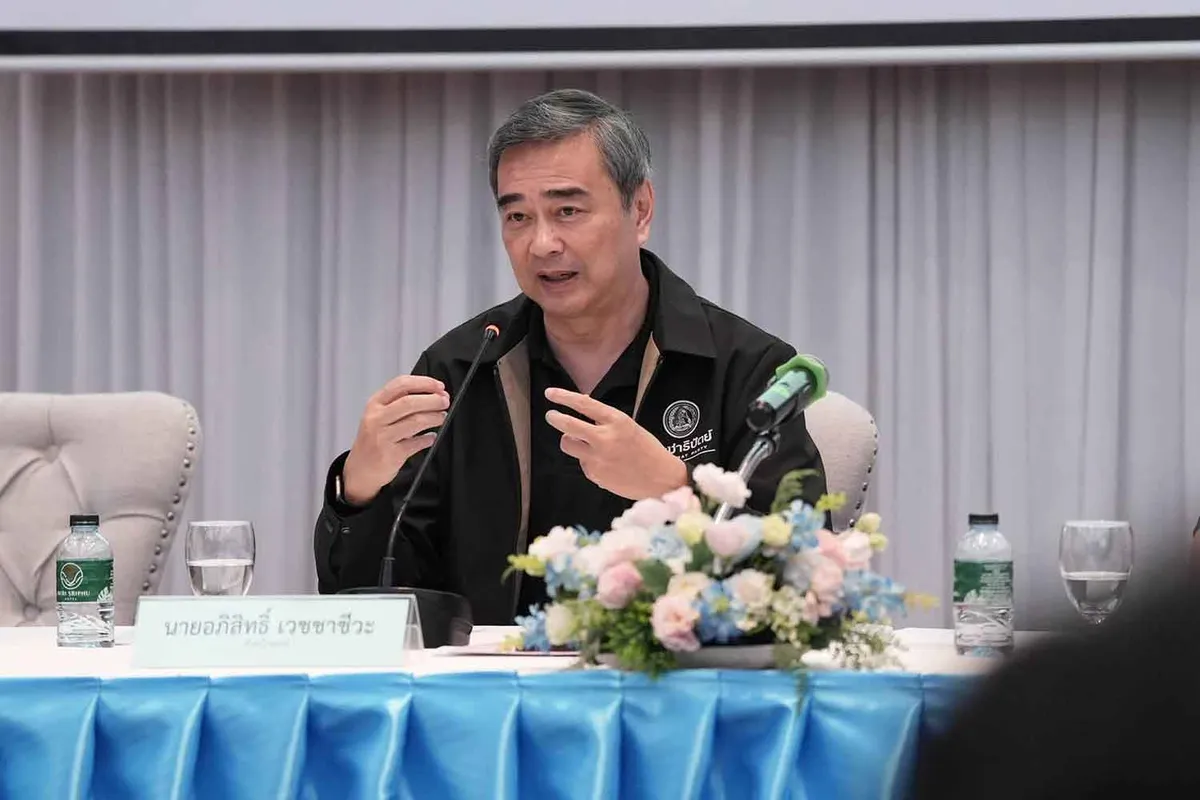
Democrat Party leader Abhisit Vejjajiva has put forward an alternative infrastructure development plan for Thailand’s southern region, dubbed “Southern Connect,” which he argues is a more economically sensible and beneficial approach than the government’s proposed Land Bridge project. Speaking at a party seminar in Songkhla’s Hat Yai district on Sunday, Vejjajiva detailed his proposal, emphasizing its potential to directly improve the lives of southern residents while requiring significantly less investment.
Critique of the Government’s Land Bridge Proposal
The government’s Land Bridge project aims to create a new shipping route connecting the Andaman Sea and the Gulf of Thailand, offering an alternative to the Strait of Malacca for international maritime traffic. However, Vejjajiva expressed significant doubts about its feasibility and economic viability. He pointed to existing feasibility studies that reportedly found the project to be uneconomical, primarily due to the anticipated need for multiple cargo transfers. This process, he explained, would likely increase costs and reduce the project’s attractiveness to global shipping companies.
Vejjajiva further elaborated that for the Land Bridge to become commercially viable, it might necessitate the development of large-scale industrial or petrochemical estates. This raises critical questions about whether the potential economic benefits would truly outweigh the substantial costs, particularly for the southern region. He also highlighted potential negative impacts, including the risk of affecting tourism, increased dangers associated with large vessel traffic, and the concentration of development along a specific Ranong–Chumphon corridor, potentially neglecting other areas.
The Southern Connect Alternative
In contrast to the massive investment required for the Land Bridge, Vejjajiva proposed the Southern Connect initiative. He questioned the allocation of approximately 1 trillion baht for a mega-project like the Land Bridge, suggesting that such substantial funds could be better utilized for infrastructure that directly benefits the local population. His vision for Southern Connect prioritizes infrastructure development with a more modest investment requirement.
Key components of the Southern Connect proposal include:
- Electrified Double-Track Rail: Developing a modern, electrified double-track railway system.
- Regional Connectivity: Linking this rail network with Malaysia and Singapore, facilitating seamless transport of goods and people.
- Local Goods Transport: Enhancing the movement of local products to major markets in Malaysia, Singapore, and Bangkok.
Vejjajiva asserted that this approach would not only be more cost-effective but also more practical in facilitating the transport of local goods, thereby stimulating regional economies more directly.
Leveraging Existing Infrastructure in Songkhla
Vejjajiva also pointed to the potential for developing a port in the Thepha district of Songkhla province. He suggested that establishing a connection between the Andaman Sea and the Gulf of Thailand via this location would require relatively minimal investment. This is largely because a degree of supporting infrastructure is already in place, potentially reducing the upfront capital needed compared to building entirely new facilities.
This strategy, according to Vejjajiva, offers a more pragmatic and targeted approach to enhancing southern Thailand’s connectivity and economic potential. By focusing on improving existing transport links and developing strategically located ports with less extensive new construction, Southern Connect aims to deliver tangible benefits to the region’s residents and businesses without the extensive risks and costs associated with the larger Land Bridge concept.
Conclusion: A Call for Pragmatic Development
Abhisit Vejjajiva’s Southern Connect proposal presents a clear counterpoint to the government’s ambitious Land Bridge project. By emphasizing direct benefits to the local population, prioritizing essential infrastructure like electrified rail, and suggesting a more cost-effective development strategy leveraging existing assets, Vejjajiva advocates for a more pragmatic and people-centric approach to developing Thailand’s southern economic corridor. The proposal invites a closer examination of the true needs and most effective investment strategies for the region’s long-term prosperity.
