

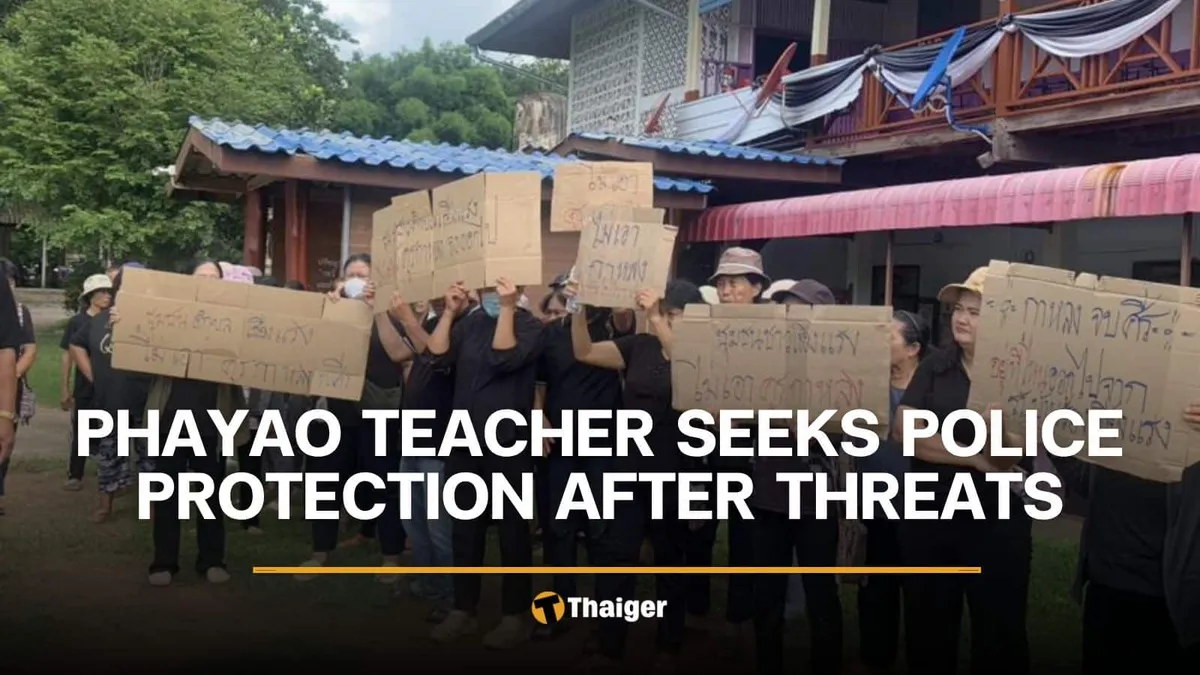
A seasoned teacher in Thailand’s Phayao province has formally requested police protection and assistance from the Ministry of Justice, citing threats and a public campaign for her dismissal. The teacher alleges the actions against her are a reprisal for her attempts to ensure the quality of school meals and her past whistleblowing activities.
Teacher’s Plea for Protection
Kalong Jobsri, a senior educator at Ban Rong Chiang Raeng School in Phu Sang district, traveled to Bangkok to seek aid from the Ministry of Justice’s Office of Witness Protection. Her appeal follows a public demonstration on July 3rd, where an estimated 40 to 50 villagers gathered outside the school. Protesters carried signs demanding her removal, with accusations that she was uncooperative with colleagues and was creating discord within the school community.
Ms. Jobsri stated that the opposition she faces is directly linked to her refusal to sign off on school lunch menus provided by a specific contractor. She expressed serious reservations about the suitability of the food for the students under her care. Furthermore, she has raised concerns about the school’s procurement procedures, suggesting they warrant a thorough investigation.
Adding a layer of complexity to the situation, Ms. Jobsri indicated that some individuals involved in the recent protest have prior connections to school administrators in Chiang Rai province. It was in Chiang Rai that she had previously voiced similar concerns regarding the management of lunch program funds.
Past Allegations and Retaliation
The current predicament appears to be part of a longer, more complex history. Ms. Jobsri reported that she has already filed a formal police report with the Phu Sang police station. This report details alleged damage to her reputation and expresses fears for her personal safety and property, particularly after local media outlets published the protest with what she described as inflammatory headlines.
Her request to the Witness Protection Office includes a plea for coordination with local law enforcement to conduct regular security checks at her residence and workplace. She also seeks monitoring from relevant authorities to ensure her safety while she continues to work in the area.
The roots of this conflict can be traced back to 2018. At that time, Ms. Jobsri was teaching in Wiang Kaen district, Chiang Rai province. She reported alleged financial improprieties concerning funds designated for underprivileged students, the school lunch program, and building repairs to the National Anti-Corruption Commission. Following these disclosures, a disciplinary panel was convened against her, and her salary increment was suspended.
Escalation and Transfer Requests
After formally requesting a transfer to escape the difficult professional environment in Chiang Rai, Ms. Jobsri was moved to Ban Rong Chiang Raeng School in Phayao. However, her troubles did not end there. Reports indicate that her vehicle was later vandalized, with its paint scratched and rocks thrown at it. This incident further prompted her to seek additional transfers, even requesting a move to Kamphaeng Phet province, where her husband resides.
The Importance of School Lunch Programs
School lunch programs are a critical component of student welfare and educational success. These programs are designed not only to provide essential nutrition, which can significantly impact a child’s ability to concentrate and learn, but also to ensure that all students, regardless of their socioeconomic background, have access to at least one balanced meal a day. The integrity of these programs relies heavily on transparent and ethical procurement processes, as well as the quality of the food provided.
Concerns raised by educators like Ms. Jobsri often stem from a deep commitment to student well-being. When teachers flag issues related to food quality, nutritional value, or adherence to safety standards, they are acting in their professional capacity to protect the children entrusted to their care. Such concerns, when valid, should be addressed through established channels without fear of reprisal.
Whistleblowing and Protection Mechanisms
The situation highlights the challenges faced by whistleblowers within educational institutions. Reporting potential corruption or mismanagement, especially when it involves significant public funds, can put individuals at personal and professional risk. The existence of witness protection programs and anti-retaliation policies is crucial to encourage reporting and uphold accountability.
Ms. Jobsri’s actions in seeking protection underscore the need for robust systems that safeguard those who speak out against wrongdoing. The Ministry of Justice’s Office of Witness Protection plays a vital role in assessing such threats and coordinating with local authorities to provide necessary security measures. The effectiveness of these measures is paramount in ensuring that educators can perform their duties without fear.
Conclusion
The case of Kalong Jobsri brings to light the sensitive intersection of school administration, community relations, and the protection of educators who raise legitimate concerns. Her request for police protection and the involvement of the Ministry of Justice signal the seriousness of the threats she perceives. As the situation unfolds, the focus remains on ensuring her safety and investigating the underlying issues related to the school’s lunch program procurement and past financial allegations.
