

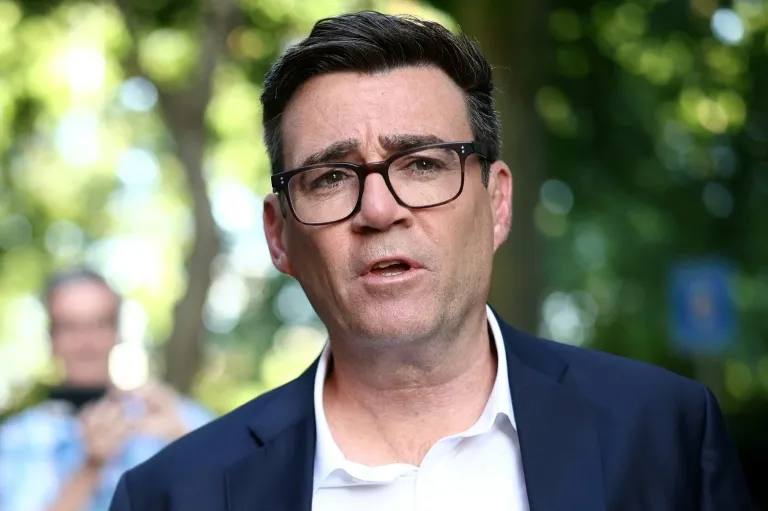
Andy Burnham, the former Mayor of Greater Manchester, is on the cusp of becoming the leader of the Labour Party and potentially the next Prime Minister of the United Kingdom. As the only Labour Member of Parliament to publicly declare his candidacy for the leadership following Keir Starmer’s recent resignation, Burnham’s path to the top appears increasingly clear. Nominations from fellow MPs have been steadily flowing in, suggesting he is set to be formally endorsed without a contest.
Burnham’s Ascendancy to Labour Leadership
The process for selecting a new Labour leader has seen a notable lack of competing candidates. This has paved the way for Burnham, 56, to be widely expected to be confirmed as the party’s new head at a special conference scheduled for July 17. If this occurs, he would then be positioned to take over as Prime Minister, succeeding Starmer at the iconic 10 Downing Street address just three days later.
The sentiment among some Labour parliamentarians is that Burnham is the clear choice. “There’s no one else,” one MP commented anonymously, indicating a strong belief in Burnham’s suitability for the role. This view is further solidified by the withdrawal of other potential contenders. Former armed forces minister Alistair Carns announced late Wednesday that he would not be running, stating that while he had hoped for a leadership contest to foster debate, the country’s current needs necessitate immediate action. Carns explicitly threw his support behind Burnham, emphasizing the urgency to “get on with the job.”
Meeting the Nomination Threshold
To become an official candidate, Burnham requires the support of 81 out of Labour’s 402 MPs. This threshold is anticipated to be easily met, underscoring his broad backing within the parliamentary party. His public statements have outlined an ambitious vision for the country, centered on a significant “rebalancing of power” and a commitment to placing decision-making authority “in the hands of the people and places who can use it best.” Burnham has also stressed the necessity of improving living standards for all citizens and acknowledged that achieving this requires fundamental changes to politics and the economy.
Background to the Leadership Vacancy
Keir Starmer’s resignation on June 22 came after months of mounting pressure concerning policy shifts and questions regarding his leadership judgment, ultimately leading to a loss of confidence from Labour MPs. Starmer’s departure followed closely on the heels of Burnham’s return to Parliament. Burnham, who previously served as an MP from 2001 to 2017, won a by-election, enabling him to re-enter the House of Commons and signal his widely anticipated leadership bid. On the same day Starmer announced his resignation, Burnham was sworn back in as an MP.
Signs of Support and Public Standing
The level of support for Burnham within the party was visibly demonstrated when approximately 200 Labour MPs gathered for a group photograph in Westminster, widely interpreted as a signal of their expectation that he will assume leadership. Further bolstering his position, former health minister Wes Streeting announced his decision to withdraw his own leadership aspirations and endorse Burnham. Surveys indicate that Burnham is Labour’s most popular politician, often seen as occupying a slightly more left-leaning position than the centrist Starmer. Many within the party believe Burnham represents their best opportunity to regain public support, particularly from the anti-immigrant Reform UK party led by Nigel Farage, ahead of the next general election, expected around 2029. Reform UK has held a lead in national opinion polls for over a year, though this gap has recently narrowed.
Burnham’s Policy Stance and Potential Challenges
In terms of policy, Andy Burnham has signaled a commitment to fiscal responsibility, vowing to maintain the government’s current borrowing limits and reduce the nation’s welfare expenditure. He has also proposed the establishment of a “No. 10 North,” a concept aimed at coordinating devolution efforts and decentralizing power, drawing a parallel to the Prime Minister’s office at 10 Downing Street. This initiative reflects his broader agenda to empower regions outside of London.
Despite the apparent consensus, some concerns have been raised regarding the short timeframe Burnham might have to prepare for government if he takes leadership in July. One anonymous MP expressed support but noted the challenge: “He’s going to have very little time to get ready for government.” Another, also speaking anonymously, suggested that the party was making the right choice by “rolling the dice” on Burnham, adding that “he couldn’t be worse than Starmer.” This sentiment, coupled with the hope that Burnham will provide a “breath of fresh air,” highlights the anticipation surrounding his potential leadership and its impact on the Labour Party and the nation.
Conclusion: A New Chapter for Labour?
With the nomination process largely concluded and key figures rallying behind him, Andy Burnham appears poised to take the helm of the Labour Party. His ascent signifies a potential shift in direction for Labour, with a focus on devolution and a renewed effort to connect with voters across the country. The coming weeks will be critical as Burnham prepares to potentially lead the party into its next major electoral challenge, aiming to offer a distinct alternative to the current government and address the pressing issues facing the United Kingdom.
