

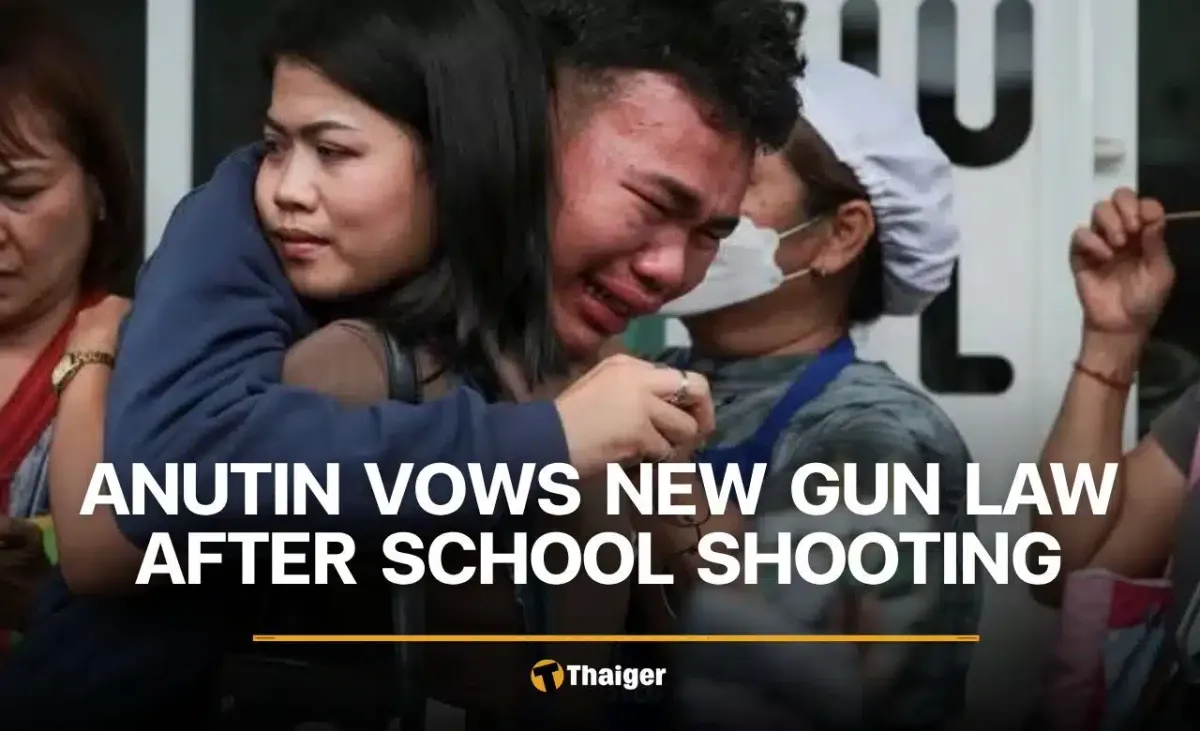
Following a tragic school shooting that claimed eight lives in Nonthaburi, Prime Minister Anutin Charnvirakul announced on Friday, August 7, 2026, that the government intends to introduce a new firearms control law. The proposed legislation aims to significantly restrict the carrying of guns in public spaces, with initial plans suggesting only on-duty government officials would be permitted to do so. This announcement comes just hours after the fatal incident at Debsirin Nonthaburi School in the Bang Kruai district, on the outskirts of Bangkok.
Tragic Incident at Debsirin Nonthaburi School
The violence erupted when a Thai teenager fatally shot his grandparents before proceeding to the school. There, he killed at least five additional individuals before taking his own life. The exact sequence of events and the motive behind the attack are still under investigation.
Thailand’s Persistent Gun Violence Problem
Thailand has long grappled with a high rate of civilian gun ownership, reportedly the highest in Southeast Asia. According to a 2017 estimate by the Small Arms Survey, approximately 10.3 million firearms were in civilian possession. This figure equates to roughly 15 guns per 100 residents. Of these, just over 6 million were officially registered, leaving an estimated 4 million firearms unaccounted for in the civilian domain.
This issue is not isolated to the recent tragedy. The nation has experienced several high-profile mass shootings in recent years, underscoring a recurring pattern of gun violence. Notable incidents include:
- October 2023: A shooting at a busy shopping mall in Bangkok resulted in significant casualties.
- 2022: A devastating killing spree in the northeastern region of the country claimed 36 lives, including 22 children.
Critique of Past and Present Gun Control Measures
The government’s commitment to stricter gun control is not new. Following the 2023 Bangkok mall shooting, Anutin Charnvirakul, who was then the interior minister, implemented several gun control measures. These included a temporary suspension of new firearm licenses, enhanced restrictions on firearm imports, and a prohibition on individuals under the age of 20 from using shooting ranges. Longer-term proposals were also discussed, such as requiring mental health certificates for gun ownership and establishing defined validity periods for certain licenses.
However, according to Piyaporn Tunneekul, an associate professor at Nakhon Pathom Rajabhat University, many of these proposed reforms have yet to materialize or be fully implemented. She highlighted critical shortcomings in the current licensing system:
- There is no mandatory mental health screening for gun license applicants.
- The system permits individuals as young as 20 years old to own firearms.
- There is no requirement for periodic re-assessment of license holders.
Professor Tunneekul suggested that the existing framework focuses on inadequate criteria for gun ownership. “We only look at things like: Do you have money? Do you have a necessary reason to protect your property? Do you want it for self-defence? But in other countries, authorities say those are not good reasons,” she explained, referencing reports from Bangkok Post.
The Need for Intervention and ‘Red-Flag’ Laws
Tunneekul advocated for the adoption of interventionist measures, similar to those employed in other countries. She specifically pointed to the effectiveness of “red-flag” laws, which empower authorities to remove firearms from individuals deemed a risk to themselves or others. “We need intervention, a process like other countries have,” she stated. “So these events repeat, but the state does nothing.” This perspective underscores a perceived gap in the current legal and regulatory framework, which may fail to proactively identify and mitigate potential threats associated with firearm possession.
Future Directions for Firearms Regulation
The Prime Minister’s recent vow to introduce a new law specifically targeting the public carrying of firearms suggests a potential shift in focus. While details remain scarce, the intention to limit this privilege to active government officials indicates a move towards significantly tighter public safety measures. Whether this new legislation will also address the broader issues of gun ownership, registration, and mental health assessments remains to be seen. The government faces the challenge of not only enacting new laws but also ensuring their effective implementation and enforcement to prevent future tragedies.
The recurring nature of mass shootings in Thailand highlights the urgent need for comprehensive and effective gun control policies. Experts and the public alike will be watching closely to see if the proposed legislation marks a substantive departure from previous, less effective reforms and truly addresses the root causes of gun violence in the country.
If you or someone you know is experiencing emotional distress, please reach out for help. Contact the Samaritans of Thailand at 02 713 6791 (English) or 02 713 6793 (Thai), or the Thai Mental Health Hotline at 1323 (Thai). Connecting with friends or relatives during difficult times is also encouraged.
