

Drone Crashes into Romanian Apartment Building, Injuring Civilians
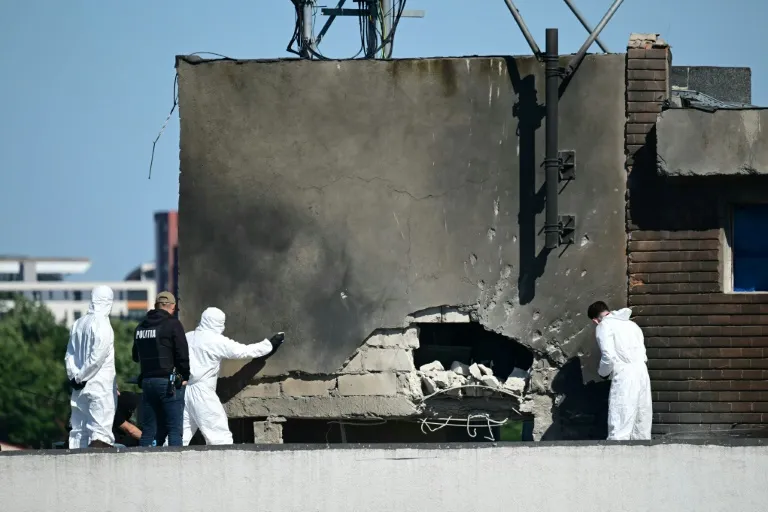
A drone, believed to be of Russian origin, crashed into an apartment building in the Romanian city of Galati on the night of May 28-29, marking the first instance of a residential structure being hit outside of Ukraine since the full-scale invasion began in 2022. The incident, which occurred near the border with Ukraine, resulted in a fire and sent two individuals to the hospital with injuries.
The drone impacted the roof of the building in the city center. Officials confirmed that a 14-year-old boy and a 53-year-old woman sustained injuries. This event follows numerous detected drone incursions into Romanian airspace since the commencement of the Russian offensive.
Romanian Defense Ministry Details Drone Incursion
The Romanian Ministry of National Defence stated that the Russian Federation resumed drone attacks on civilian and infrastructure targets in Ukraine during the night of May 28-29. “One of these drones entered Romanian airspace, was tracked by radar as far as the southern part of the city of Galati, and crashed onto the roof of an apartment building, with the impact triggering a fire,” the ministry reported.
In response to the detected drones, two F-16 fighter jets were immediately scrambled. This incident is part of a pattern of escalating Russian strikes targeting Ukraine, including severe attacks over the preceding weekend.
Why the Drone Was Not Intercepted
A defense official explained that Romanian forces did not have sufficient time to intercept the drone, citing “no realistic opportunities to engage it safely.” General Gheorghe Maxim of the Joint Forces Command stated at a press conference that the available engagement window was “extremely short,” lasting only about four minutes.
President Nicusor Dan of Romania further clarified that the decision not to engage was based on the absence of conditions that would ensure the drone’s destruction without posing a significant risk to the civilian population.
International Condemnation and Romanian Response
In the wake of the incident, Romania summoned the Russian ambassador and convened a national defense council meeting to address what was described as “the most serious incident to have affected our national territory” since Russia’s invasion of Ukraine. Romania’s defense ministry characterized the event as a “serious and irresponsible escalation on the part of the Russian Federation” and has formally requested accelerated measures to transfer anti-drone capabilities to the country.
High-ranking officials from allied nations expressed strong disapproval. EU chief Ursula von der Leyen stated that Russia’s “war of aggression” had “crossed yet another line” and pledged to bolster deterrence on the EU’s Eastern border. German Foreign Minister Johann Wadephul condemned “Russia’s reckless behaviour,” while his French counterpart, Jean-Noel Barrot, labeled it “an irresponsible act.” Britain’s Yvette Cooper strongly criticized the “violation” of NATO airspace.
The US ambassador to NATO, Matthew Whitaker, also denounced the “reckless incursion,” reaffirming solidarity with the NATO ally. Maia Sandu, the president of Moldova, a country situated between Romania and Ukraine that has also experienced drone incursions and debris, declared Russia a “danger to all.”
NATO’s Stance and Future Actions
NATO has condemned Russia’s “recklessness” and pledged “absolute solidarity” with Romania. NATO Secretary General Mark Rutte emphasized on social media, following a call with the Romanian president, that “Russia’s reckless behaviour is a danger to us all” and affirmed NATO’s readiness to “defend every inch of Allied territory.”
NATO member states bordering Ukraine or Russia, including Romania, Latvia, Estonia, and Poland, are facing increasing exposure to drone incursions from both sides of the conflict. The incident has prompted discussions about potential additional defensive measures.
NATO’s supreme headquarters confirmed that the alliance’s top commander, US General Alexus Grynkewich, discussed the incident with Romania’s military chief. Both leaders agreed to maintain close communication as the investigation proceeds and further defensive strategies are considered. At this time, there is no indication that Bucharest will initiate emergency consultations under NATO’s Article Four, which allows members to seek consultations when their territorial integrity, political independence, or security is threatened. This would fall short of triggering Article Five, the mutual defense clause, which has been invoked only once in the alliance’s history.
