

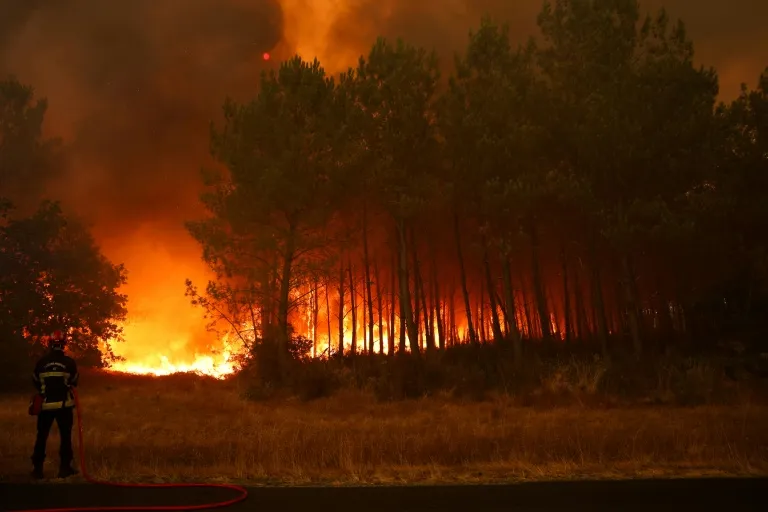
Thousands of people have been forced to evacuate their homes and holiday accommodations as devastating wildfires rage across southern Europe, exacerbated by a severe heatwave. France, Italy, and Spain are grappling with intense blazes, which have tragically claimed the lives of at least three firefighters. Temperatures have soared above 40 degrees Celsius (104 degrees Fahrenheit) in some regions, creating tinderbox conditions that fuel the rapid spread of flames.
Sicily Engulfed by Dozens of Fires
The Italian island of Sicily has been particularly hard-hit, with approximately 6,000 firefighters, forest guards, and civil protection officials engaged in a desperate battle against dozens of fires that have persisted for days. Despite the deployment of water-bombing aircraft, the infernos continue to spread across the Mediterranean island. The situation in Sicily has been described as “serious” by a spokesperson for Italy’s Civil Protection Agency, who noted that the fires are being intensified by extremely high temperatures and parched soil.
Tragically, one firefighter succumbed to his injuries after falling ill while actively fighting the flames, according to Italian Interior Minister Matteo Piantedosi. In the neighboring Calabria region, over 160 fires have been reported. Local civil protection authorities suspect deliberate arson by “malicious individuals” in some instances, with disturbing reports emerging of rags soaked in flammable liquid being tied to stray cats’ tails in an attempt to spread the fire.
France Evacuates Thousands Near Bordeaux
In southwestern France, more than 10,000 tourists and residents were evacuated from campsites and holiday homes near Bordeaux on Thursday. A wildfire has been consuming a pine forest along the coast in Le Porge, burning through an estimated 2,000 hectares (approximately 5,000 acres) – an area roughly three times the size of Gibraltar – since Wednesday. Officials confirmed that two firefighters lost their lives on Tuesday while battling a separate blaze that ignited near Bordeaux airport.
French Interior Minister Laurent Nunez met with the families of the deceased firefighters, as labor unions voiced concerns about the exhaustion and resource limitations faced by emergency crews. Firefighter Captain Wilfried Schneider described the intensity of the Le Porge fire as “rare,” noting the dense, closely packed pine stands that allow flames to spread rapidly. Residents like Julie Leonard, a local in her thirties, witnessed the alarming spread of a “big black cloud of smoke” across the sky. Bernard Roche, a 75-year-old resident, recounted his decision to leave his home due to the oppressive heat and dry conditions, stating, “In the forest, it’s been particularly dry these last few days.” While the mayor of Le Porge suggested a forest maintenance machine might have inadvertently started the fire, this has not yet been officially confirmed. Around 700 residents were also evacuated from their homes as a precautionary measure in Le Porge, with over 3,000 campers being relocated.
Spain Manages Toledo Fire, Battles Larger Guadalajara Blaze
Across the border in Spain, emergency services reported positive progress on Thursday in containing a significant wildfire south of Madrid, near the city of Toledo. This development allowed the majority of residents from threatened communities to return to their homes. The fire, which ignited on Wednesday approximately 75 kilometers (45 miles) from the Spanish capital, had prompted authorities to order evacuations in several districts as flames neared residential areas. Residents in El Encinar del Alberche, within the municipality of Villa del Prado, were still advised to stay away from their properties. Firefighters described their overnight efforts as “very positive,” though the blaze had not been fully stabilized, and several local roads remained closed.
However, a much larger and more challenging wildfire continues to burn in Guadalajara province, about 100 kilometers (62 miles) north of Madrid. Hundreds of firefighters are still engaged in combating this extensive blaze, which has already consumed approximately 32,000 hectares since igniting last Thursday. Data from the European Forest Fire Information System indicates that Spain has already experienced its worst wildfire season in recent history, with over 393,000 hectares lost to flames by 2025.
Climate Change and Extreme Weather
These devastating wildfires occur against a backdrop of increasingly severe heatwaves across southern Europe. Scientists have long warned that human-induced climate change, primarily driven by the burning of fossil fuels, is making extreme weather events like wildfires and heatwaves more frequent, longer-lasting, and more intense. The current crisis underscores the urgent need for global action to mitigate climate change and adapt to its escalating impacts.
Conclusion
The ongoing wildfires in France, Italy, and Spain highlight the severe threat posed by extreme heat and dry conditions, amplified by climate change. As emergency services continue their heroic efforts, thousands remain displaced, and the environmental and human toll mounts. The events serve as a stark reminder of the interconnectedness of climate, weather, and disaster, emphasizing the critical importance of addressing the root causes of climate change while bolstering resilience against its inevitable consequences.
