

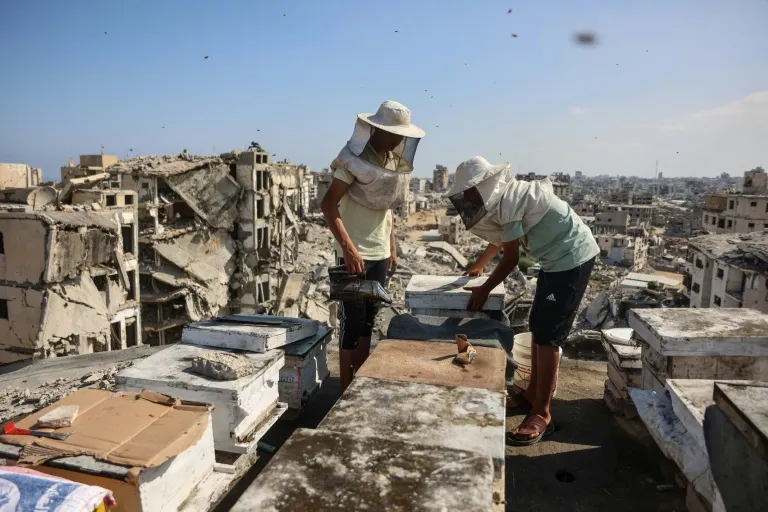
In the heart of a war-torn urban landscape, a Gaza beekeeper is striving to revive his livelihood, placing his remaining hives on a rooftop overlooking the ruins. Amidst the shattered remnants of buildings, rows of beehives now stand as a symbol of resilience, a stark contrast to the surrounding destruction.
A Fragile Restart for Gaza’s Beekeeping Sector
Amidst the sounds of buzzing bees, a veteran beekeeper, identified as Al-Dabba, along with his sons, meticulously tends to his apiary. Dressed in protective netted hats and using metal bee smokers, they carefully examine the frames of honeycomb. The scene, set against the backdrop of a devastated urban neighborhood, is an unusual one for beekeeping, but Al-Dabba had few alternatives after the devastating conflict.
Al-Dabba, who leads the Beekeepers Cooperative in the Gaza Strip, explained the profound impact of the war that began in October 2023. He stated that the conflict virtually obliterated the Palestinian territory’s established beekeeping culture. “We had more than 40,000 beehives and more than 450 beekeepers” before the war, he shared from his rooftop location in Gaza City’s Tel al-Hawa neighborhood. “The situation was good, with more than 1,000 families making a living through the beekeeping sector.”
The war’s onset brought widespread destruction. “The war came and destroyed the beekeeping sector by more than 95 percent because most beekeepers were near the border areas,” Al-Dabba elaborated. He personally lost approximately 400 hives that were situated on agricultural lands east of Gaza City. Faced with this immense loss, he was compelled to move his remaining 35 hives to the roof of a residential building, acknowledging that this location is far from ideal.
Challenges of Urban Beekeeping
The natural habitat for bees is typically a safe and suitable agricultural environment. However, Al-Dabba noted, “today the bees are suffering just as we are.” He explained the impossibility of returning his bees to their former locations, as those areas have been destroyed and are now under the control of the Israeli military. “We cannot approach or enter,” he stated. The beekeeper drew a poignant parallel: “Just as we are displaced in the streets, the bees are also displaced on the rooftops.”
Context of the Conflict and Humanitarian Crisis
The ongoing war in Gaza was initiated by Hamas’s attack on Israel on October 7, 2023, which led to the deaths of 1,221 people, according to an AFP tally based on official Israeli figures. In response, Israel launched a military campaign in Gaza. The territory’s health ministry, which operates under Hamas authority and whose figures are considered reliable by the United Nations, reports that more than 73,300 people have been killed in Gaza.
Despite a ceasefire that has been in effect, violence has persisted in the densely populated territory. The Israeli military continues to target individuals they identify as militants. Israel has stated that it now controls over 60 percent of the Gaza Strip, an increase from approximately half when the ceasefire began. The humanitarian situation remains critical, with hundreds of thousands of residents living in tents. The entry of goods into the territory is strictly controlled by Israel.
Struggles with Essential Supplies
The scarcity of resources presents a significant hurdle for Al-Dabba’s efforts. “We lack essential supplies because importing beekeeping equipment from the other side is not permitted,” he explained. He has sought assistance from external organizations and ministries in both Gaza and the occupied West Bank.
Finding Hope in Adaptation
Despite the immense suffering and the considerable challenges of relocating his hives to an unfamiliar urban environment, Al-Dabba finds a measure of hope in observing the bees’ ability to adapt. “The bees now come and go and feel settled,” he remarked. This observation fuels his aspiration for a broader return to normalcy and peace.
“So we hope that hope, goodness and living in peace and security will come, like in other countries,” Al-Dabba concluded, expressing a universal desire for a future free from conflict and filled with the promise of a stable life.
