

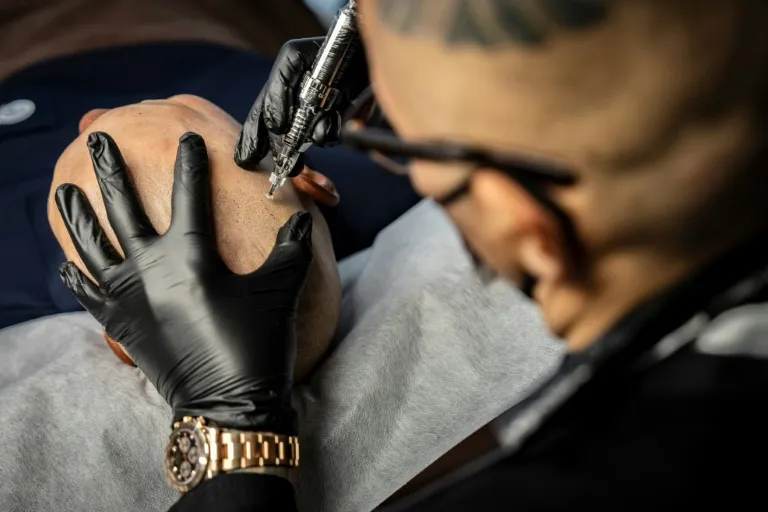
In Japan, the practice of permanent makeup, including scalp micropigmentation (SMP), finds itself in a legal and professional quandary. While globally recognized as an aesthetic service, Japanese authorities increasingly view it as a medical procedure, potentially subjecting practitioners without medical licenses to criminal prosecution. This stance places artists like Remy, a 44-year-old cosmetic tattooist from Okinawa, in a precarious position, caught between their artistic craft and stringent medical regulations.
The Art vs. Medicine Debate
Industry professionals argue that cosmetic tattooing, which encompasses creating the illusion of fuller eyebrows, defining lips, and replicating hair on the scalp, is fundamentally an artistic endeavor. They contend that the skills required are akin to those of tattoo artists and hairstylists, emphasizing aesthetic talent and precision rather than medical intervention. Remy, who specializes in SMP, expressed his bewilderment at the classification, stating, “It’s a complete mystery to me why they keep saying this constitutes a medical practice.” He highlighted that SMP is minimally invasive, often painless, and demands sophisticated aesthetic judgment.
For clients like Hatanaka, a 28-year-old marine sports instructor, SMP has been life-changing. Suffering from alopecia, or hair loss, he experienced significant despair and social withdrawal. “I didn’t even want to go outside,” Hatanaka shared. The procedure, which mimics a closely cropped haircut, restored his confidence, enabling him to engage more freely with others. “I’m more confident in myself now,” he added.
Legal Precedents and Ministry Warnings
A significant legal development occurred in 2020 when Japan’s Supreme Court ruled that traditional decorative tattooing was not a medical act. This decision was a relief for many artists operating without clinical training. However, the ruling did not extend to SMP. A health ministry official explained that SMP has a “documented history of doctors’ involvement,” and due to the use of needles, it is considered a practice with inherent risks if not performed with medical expertise.
The ministry has issued repeated warnings, including a notice in December, indicating that unlicensed practitioners could face criminal complaints, effectively signaling potential arrests. According to healthcare law expert Akihiro Saotome, these notices have likely created a “significant chilling effect” on businesses in this sector. Despite these warnings, many cosmetically unlicensed tattoo artists continue to operate openly. They recently gathered at a convention hosted by Remy’s SMP brand, Scalp Ink, in Okinawa, where dozens of specialists from various countries showcased their skills.
International Perspectives and Client Concerns
At the Okinawa convention, practitioners argued that permanent makeup is even less invasive than traditional tattooing, as it penetrates the skin less deeply. They stressed that both practices adhere to similar hygiene standards and involve inserting pigment into the skin using needles. Tatsuki Miyahira, an Okinawa-based tattooist who also performs SMP without a medical license, asserted, “I’m doing nothing I should be ashamed of.” He expressed readiness to demonstrate his safety protocols if inspected and believes that official recognition of SMP as an art form would further validate his work.
Japan and South Korea were historically among the few nations penalizing permanent makeup performed by non-medical personnel. However, Seoul enacted a law last year decriminalizing the practice. “Why is it only Japan that still can’t do this?” questioned Michiko Shinmasu, a 50-year-old hairstylist who also offers eyebrow tattooing. The lack of legal clarity leaves her clients feeling uncertain, often asking, “this is grey-zone, right?”
Historical Context and the Path Forward
Some observers suggest that Japan’s complex historical relationship with tattoos—once associated with criminals and later with yakuza gangsters—contributes to official skepticism towards related practices like SMP. Tattoos remain restricted in many public spaces, and while body art is gaining popularity, it is less prevalent than in Western countries. Yasuaki Sameshima, a 41-year-old SMP business operator, noted, “But tattoos of a different kind existed before. I think their negative image is spilling over and shaping the way SMP is perceived today.”
While advocating for his profession’s artistic merit, Remy acknowledges the potential risks of infection if procedures are performed improperly. He is a proponent of a regulated system for training and accreditation for all tattoo artists, whether they specialize in cosmetic applications or traditional body art. Remy founded the Japan Tattoo Hygiene Association, aiming to establish a standardized training program that could eventually become mandatory for tattoo parlors. “Every country has some kind of licence specifically for doing tattoos, but Japan hasn’t created that,” he stated. “I believe that’s the best way to protect clients and to ensure that tattoos are done under proper hygiene management.” This initiative reflects a broader desire within the industry to professionalize and gain clearer legal standing, ensuring both client safety and artistic recognition.
