

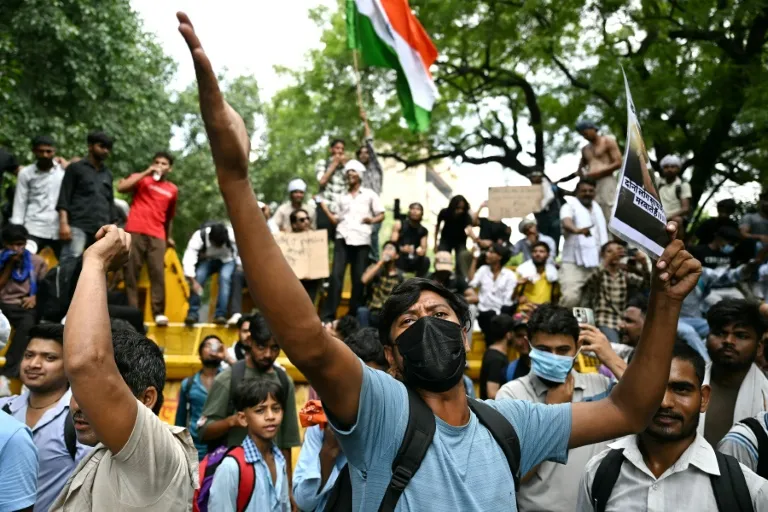
Prime Minister Narendra Modi has pledged swift and severe punishment for individuals involved in the recent examination paper leak scandals plaguing India’s education system. His commitment comes as thousands of young people, galvanized by the social media-driven ‘Cockroach Janta Party’ (CJP) movement, took to the streets of New Delhi, leading to significant clashes with law enforcement. The Prime Minister emphasized the paramount importance of safeguarding the nation’s youth, stating, “Nothing is more important than the welfare and future of our youth.” He announced plans to establish fast-track courts to expedite legal proceedings against those found responsible for leaking examination papers, adding, “Those who try to harm the future of our youth will not be spared.”
Escalating Protests and Government Response
The protests, largely comprised of students, have intensified demands for the resignation of the Education Minister. The demonstrations gained considerable momentum on Monday when police deployed tear gas and batons to disperse large crowds attempting to march towards Parliament on the inaugural day of the monsoon session. In response, protesters reportedly hurled stones, marking one of the most substantial street rallies in the capital in recent years. Official reports indicate that at least 178 individuals, including security personnel, sustained injuries during the confrontations.
The Rise of the Cockroach Janta Party (CJP)
The CJP movement, which boasts millions of followers across social media platforms, initially emerged in May. Its origins are reportedly linked to a satirical response to remarks made by Chief Justice Surya Kant, who, during a court hearing, allegedly compared young people to “cockroaches” and “parasites.” Since its inception, the CJP has expanded its scope beyond this initial catalyst, addressing broader concerns such as rising unemployment, limited opportunities for young people, and what the movement perceives as an increasingly authoritarian governance style under Prime Minister Modi.
A Significant Challenge to the Modi Administration
These widespread protests represent one of the most significant challenges to Prime Minister Modi’s administration since his re-election for a third term in 2024. On Wednesday, the demonstrations extended beyond the designated protest site at Jantar Mantar, leading to late-night confrontations with the police. Ashutosh Ranka, a spokesperson for the CJP, described the events on social media, stating that “Delhi Police cracked down heavily on protesters outside Jantar Mantar.” He further alleged that internet services were suspended and that individuals were “brutally” assaulted. Conversely, the Delhi Police asserted that protesters initiated the violence by attacking officers with stones and plastic bottles, resulting in “serious injuries.”
Opposition Involvement and National Reach
Opposition parties have lent their support to the protest movement, leveraging the situation to disrupt parliamentary proceedings and demand an apology from Prime Minister Modi regarding the police actions on Monday. Rahul Gandhi of the Congress Party publicly criticized the Prime Minister on X (formerly Twitter), asserting, “You are the one who has harmed the future of our youth the most. You allowed and encouraged the total capture and destruction of our education system — and protected every person responsible for it.” The unrest is not confined to the capital; smaller demonstrations have been organized in major cities across India, including Mumbai, Bengaluru, and Patna.
International Solidarity and Erosion of Trust
The movement has also garnered attention beyond India’s borders. In neighboring Bangladesh, students announced plans for a “torch rally” to express solidarity with the Delhi protesters. This echoes the significant youth-led protests in Bangladesh in 2024 that ultimately led to the ouster of the government under Sheikh Hasina. The series of exam irregularities in India has severely eroded public confidence in the integrity of the national testing system. Notably, a leak involving the medical entrance examination question paper necessitated a re-test for over two million candidates. Furthermore, a separate controversy surrounding the online marking of examinations taken by nearly two million high school students has further fueled public anger and distrust.
Conclusion: Demands for Accountability
The escalating situation underscores a deep-seated public concern over the fairness and security of India’s examination processes. Prime Minister Modi’s promise of swift justice through fast-track courts aims to address these anxieties, while the CJP and opposition parties continue to press for broader accountability and reforms. The widespread nature of the protests, coupled with international expressions of solidarity, highlights the significant impact these scandals are having on national discourse and the future of India’s youth.
