

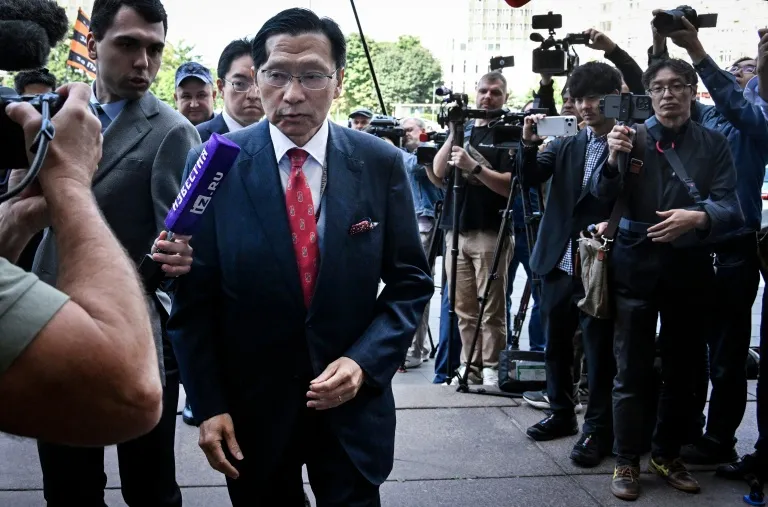
Russia has summoned Japan’s ambassador, Akira Muto, to its Foreign Ministry to protest recent statements by Japanese officials regarding a long-standing territorial dispute over a group of islands. Moscow asserted that its sovereignty over the islands, known as the Southern Kurils in Russia and the Northern Territories in Japan, is “unshakable.” The diplomatic exchange follows a visit by Russian President Vladimir Putin to the islands last week, the first by a Russian president since 2010.
Deepening Tensions Over the Kuril Islands
The territorial dispute centers on four islands seized by the Soviet Union in the final days of World War II, leading to the expulsion of their Japanese inhabitants. This historical context continues to strain bilateral relations between Japan and Russia.
Following President Putin’s recent trip to the islands, Japan summoned the Russian ambassador to Tokyo to express its protest. In response, Russia summoned Ambassador Muto to its Foreign Ministry. During the meeting, Russian officials reiterated their firm stance on the islands’ status, stating that Russia’s sovereignty and jurisdiction are absolute. The Russian Foreign Ministry further characterized Japan’s claims as “anti-Russian” and lodged a “strong protest.” Russian Foreign Minister Sergei Lavrov commented that Tokyo had “crossed the line of decency” with its remarks.
Japan’s Position on the Disputed Territories
Japanese Prime Minister Sanae Takaichi has maintained that the islands are an “inherent part of Japan’s territory, both historically and under international law.” This position underscores Japan’s long-held claim to the islands, rooted in historical and legal arguments.
Ambassador Muto’s Initial Hesitation
Reports from Japanese public broadcaster NHK indicated that Ambassador Muto initially did not immediately respond to the summons. This hesitation was reportedly due to concerns that Russian officials would dominate the discussion. After internal deliberations, Tokyo decided to accept the summons, according to unnamed sources cited by NHK.
Broader Geopolitical Context and Ukraine Conflict
The current diplomatic friction occurs against the backdrop of significantly worsened relations between Japan and Russia since the full-scale invasion of Ukraine began in 2022. Japan has aligned itself with other G7 nations by imposing sanctions on Russia and providing aid to Ukraine.
Notably, Ukraine, along with the United States, recognizes Japanese sovereignty over the disputed islands, adding another layer to the complex geopolitical landscape.
Putin’s Visit: A Strategic Signal?
Analysts suggest that President Putin’s visit to the Kuril Islands may have been intended as a strategic message to Japan. The visit could be interpreted as a warning against deepening its support for Ukraine, potentially including the direct supply of advanced military hardware like Patriot missiles, and against fostering closer cooperation with NATO.
Japan’s Defense Aid to Ukraine
Currently, Japan’s assistance to Ukraine is limited to non-lethal defense aid. While Japan has relaxed its restrictions on defense exports in recent years, it remains prohibited from directly supplying lethal military equipment to countries engaged in conflict, such as Ukraine. This policy reflects Japan’s post-war constitution and its commitment to a pacifist foreign policy, although recent adjustments indicate a growing willingness to contribute more significantly to regional and global security.
Historical Background of the Dispute
The territorial dispute over the Kuril Islands dates back to the end of World War II. In August 1945, the Soviet Union occupied the islands, which had been under Japanese administration. The subsequent expulsion of the Japanese population and the establishment of Soviet control marked the beginning of a protracted territorial disagreement that has persisted for decades. Japan has consistently sought the return of the islands, citing historical and legal claims, while Russia maintains its sovereignty based on the post-war settlement.
The Significance of the Southern Kurils
The islands hold strategic importance for Russia due to their location, providing access to the Pacific Ocean. For Japan, they represent a significant historical grievance and a matter of national pride. The unresolved status of these islands has been a major impediment to the signing of a formal peace treaty between the two nations, even decades after the end of World War II.
Future Implications for Japan-Russia Relations
The recent diplomatic clash highlights the fragility of Japan-Russia relations and the enduring impact of the Ukraine conflict on their bilateral ties. Russia’s assertive stance, coupled with its linkage of the islands dispute to Japan’s support for Ukraine, signals a potential escalation in diplomatic pressure. Japan’s commitment to international law and its alliances, particularly with the United States and G7 partners, will likely shape its response to these developments. The ongoing dispute over the Kuril Islands remains a complex issue with significant implications for regional stability and the broader geopolitical order.
