

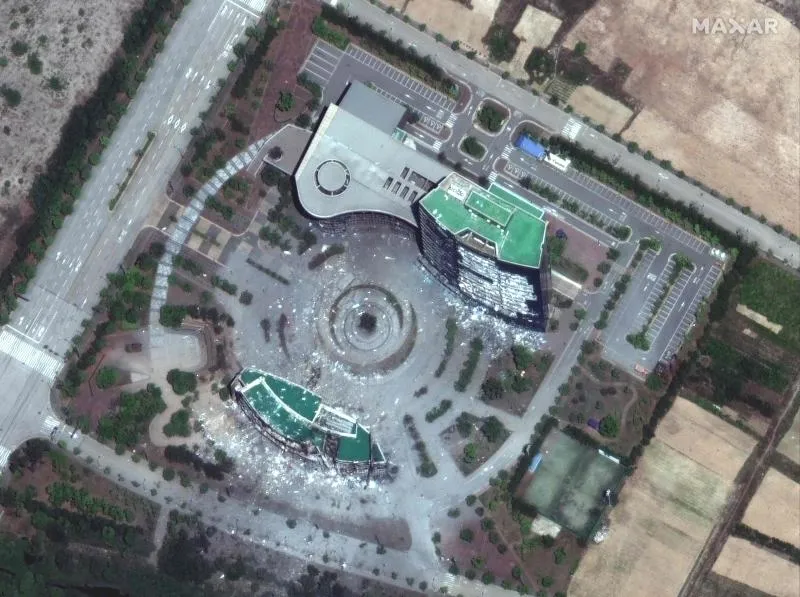
A South Korean court has ordered North Korea to pay approximately 44.6 billion won (about $32 million USD) in damages for the demolition of an inter-Korean liaison office in 2020. The Seoul Central District Court ruled in favor of the South Korean government, which had filed the lawsuit seeking compensation for the destruction of the building located in the border town of Kaesong. The court also mandated that North Korea cover all litigation expenses.
Background of the Lawsuit
The previous administration in South Korea initiated legal proceedings in June 2023. Officials stated at the time that North Korea’s destruction of the liaison office was unequivocally illegal. The lawsuit was filed to prevent the statute of limitations from expiring on the damages claim. The statute was set to expire later that year, making the legal action necessary to preserve the claim.
The Demolition Incident
On June 16, 2020, North Korea detonated the liaison office building situated within the Kaesong industrial complex. Pyongyang cited the scattering of propaganda leaflets across the border by a group of North Korean defectors as the reason for its action. Immediately following the explosion, the South Korean government declared that North Korea bore full responsibility for all ensuing consequences.
Purpose of the Liaison Office
The Kaesong liaison office was established as a tangible outcome of the 2018 Panmunjom Declaration. Its primary function was to serve as a continuous communication and consultation channel between the two Koreas, facilitating dialogue and cooperation. The office was intended to be a permanent fixture for inter-Korean relations.
Calculating Damages
South Korea calculated the total damages at 44.7 billion won. This figure encompassed compensation for the destroyed liaison office building itself, as well as for a nearby inter-Korean economic cooperation support center. This adjacent facility was also damaged and rendered unusable by the blast, significantly impacting joint economic initiatives.
Enforcement Challenges and Current Tensions
Despite the court’s ruling, practical enforcement of the damages award presents significant challenges. Reports indicate that North Korea is unlikely to voluntarily comply with the court’s decision. Furthermore, South Korea currently possesses no readily available legal mechanisms to compel Pyongyang to pay any awarded damages. This situation underscores the complex and often intractable nature of inter-Korean relations.
The court’s decision comes at a time of heightened tensions between the two nations. These increased tensions persist even amidst efforts by the current South Korean President, Lee Jae Myung, to foster improved relations since assuming office last year. North Korean leader Kim Jong Un has largely rebuffed these overtures, abandoning the North’s long-standing reunification policy and publicly designating South Korea as its principal adversary.
Official Reactions and Future Outlook
South Korea’s Unification Ministry acknowledged the court’s ruling, stating that it respects the decision and will review the necessary follow-up actions. The ministry also expressed hope for the resumption of inter-Korean dialogue as a means to resolve bilateral issues through mutual cooperation. The court and North Korea’s embassy in Beijing did not immediately provide comments when contacted.
The ruling highlights the legal ramifications of North Korea’s actions and the South Korean government’s commitment to seeking accountability through established legal channels, even when direct enforcement is difficult. The future of inter-Korean relations remains uncertain, with diplomatic efforts facing significant hurdles due to Pyongyang’s increasingly hostile stance.
