

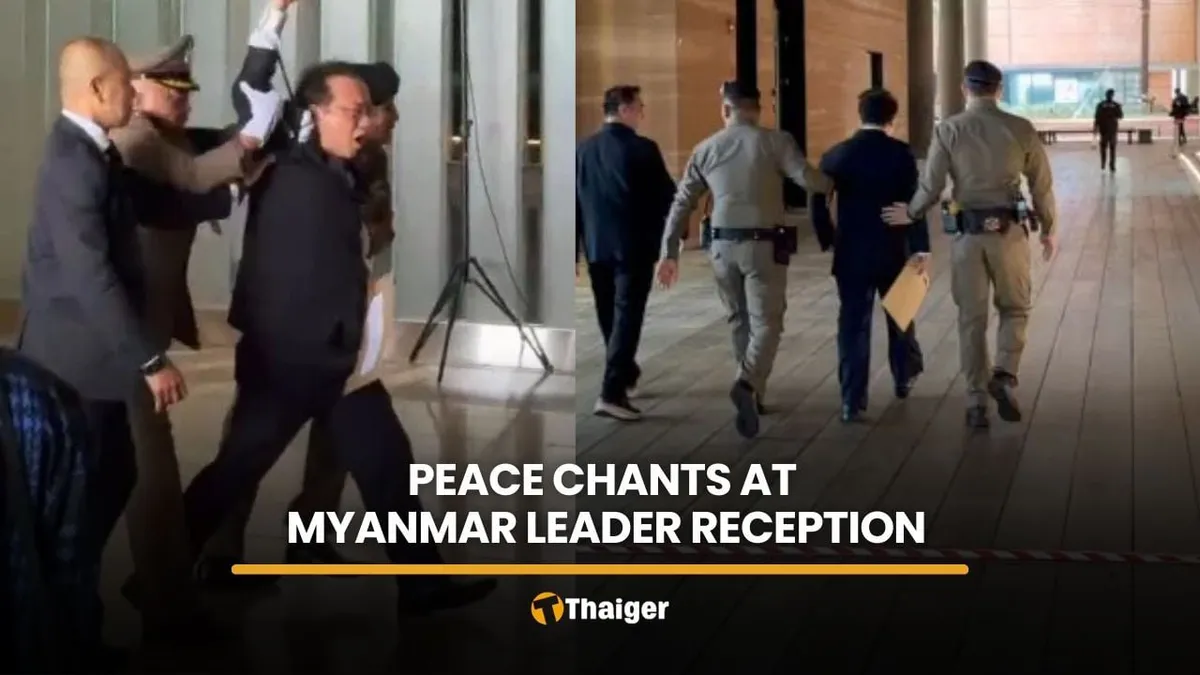
A Member of Parliament in Thailand was escorted from a government reception on August 7 after vocally calling for peace and humanity as Myanmar’s Senior General Min Aung Hlaing arrived. The incident occurred at the Parliament building as the Senate President was preparing to formally receive Min Aung Hlaing, who was visiting Thailand as a state guest.
Incident at Parliament Reception
The parliamentarian, identified as Anusorn Tamajai from the People’s Party, was present outside the reception room prior to the official welcoming ceremony. Reports indicate that Anusorn Tamajai intended to submit a letter to Min Aung Hlaing via the Senate President. This correspondence was reportedly focused on urging prompt action to address cross-border issues and advocating for support towards reinstating democracy in Myanmar.
As Min Aung Hlaing and his delegation entered the reception area around 10:50 AM, Anusorn Tamajai began repeatedly calling out, “For peace, for humanity.” Despite his continued appeals, parliamentary police intervened and led him away from the venue, allowing the welcoming proceedings to continue uninterrupted.
Broader Protests Against Myanmar Leader’s Visit
Anusorn Tamajai’s actions coincided with separate demonstrations held the previous day, August 6. A coalition including the Bright Future group and migrant workers organized a protest outside the United Nations office in Bangkok. Their objective was to voice opposition to the Thai government’s engagement with Myanmar’s military leadership.
Concerns Raised by Protesters
Organizers from the Bright Future group stated that Thailand’s interaction with the current administration in Myanmar could potentially damage the nation’s international standing on human rights. They also expressed concern that such engagement might embolden the military regime to exert further pressure on migrant workers who have sought refuge in Thailand after fleeing Myanmar.
The protesters highlighted several critical issues during their demonstration:
- The Thai government’s policy towards engaging with Myanmar’s military leadership.
- The potential for the current regime to extend its influence and pressure onto migrant populations in Thailand.
- Concerns regarding the management and rights of migrant workers.
- Allegations of transnational criminal activities.
- Environmental issues, specifically pollution linked to rare-earth mining operations within Myanmar.
Context of Min Aung Hlaing’s Visit
Senior General Min Aung Hlaing, the commander-in-chief of Myanmar’s armed forces, led the delegation to Thailand. His visit occurred amidst ongoing political instability and a humanitarian crisis in Myanmar, following the military coup in February 2021. The international community, including many neighboring nations, has been grappling with how to engage with the military-appointed government while also upholding principles of democracy and human rights.
Thailand, sharing a lengthy border with Myanmar, has historically maintained a policy of engagement with its neighbor, often emphasizing practical cooperation on issues such as border security and economic development. However, this approach has drawn criticism from human rights advocates and civil society groups who argue that it legitimizes the current regime and overlooks the severe human rights violations occurring within Myanmar.
Human Rights and Democracy Concerns
The core of the protests and Anusorn Tamajai’s public appeal centers on the desire for peace and the restoration of democratic governance in Myanmar. Since the 2021 coup, Myanmar has experienced widespread civil unrest, a violent crackdown on dissent, and a deteriorating economic and humanitarian situation. International bodies and human rights organizations have documented numerous instances of alleged atrocities committed by the military junta.
Critics argue that official receptions for leaders like Min Aung Hlaing, without clear conditions or demands for democratic reform and accountability, can be interpreted as tacit approval of the military’s actions. The Thai government, however, often frames such interactions as necessary for maintaining regional stability and addressing practical, cross-border concerns.
Conclusion
The ejection of the Thai MP from the reception underscores the deep divisions and strong sentiments surrounding Myanmar’s political situation, both within Thailand and among international observers. While the government pursued diplomatic engagement, activists and some political figures continued to voice dissent, advocating for peace, humanity, and the return of democratic rule in Myanmar. The incident highlights the complex challenges faced by regional governments in navigating relations with Myanmar’s military leadership while balancing international human rights standards and domestic political considerations.
