

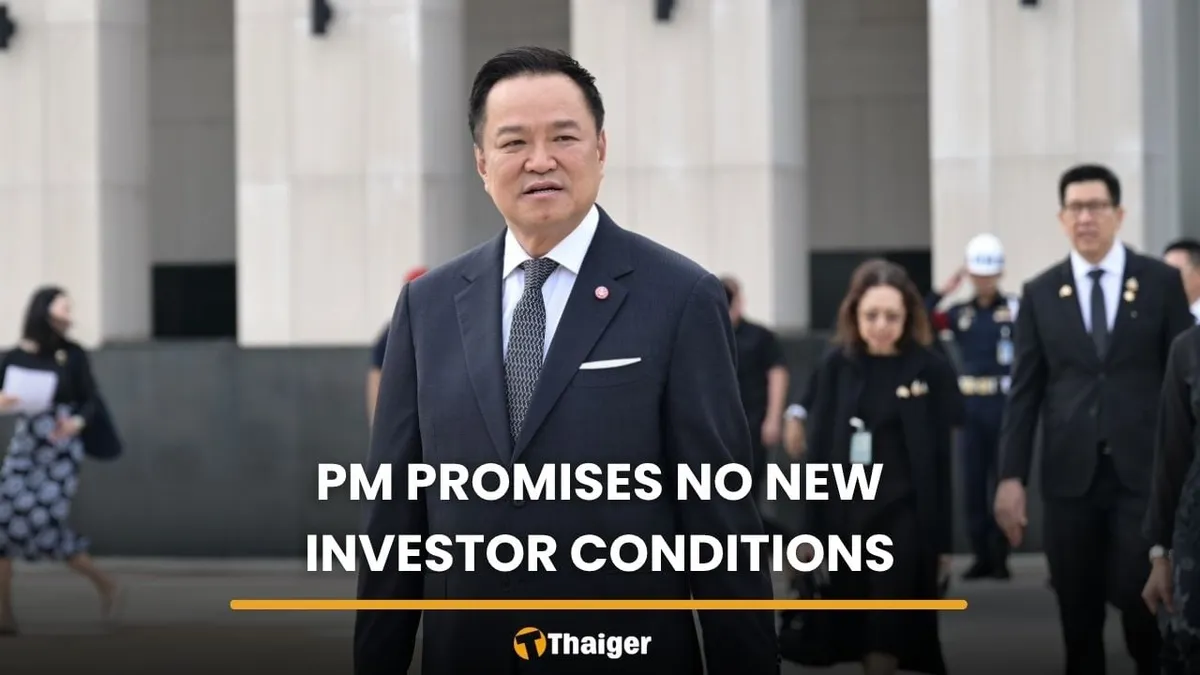
Thailand’s government has moved to reassure Japanese automakers that their established production base in the country remains secure, even as Thailand actively seeks new investment in electric vehicle (EV) manufacturing. Prime Minister Anutin Charnvirakul stated on August 21 that existing investors would not face new conditions as the nation courts EV companies.
Speaking to reporters during an official trip to Australia and New Zealand, where he also holds the portfolio of Interior Minister, Anutin emphasized the government’s commitment to supporting its long-standing industrial partners. He revealed that he had tasked Deputy Prime Minister and Finance Minister Ekniti Nitithanprapas with reviewing how investors from various nations are supported, ensuring that the current automotive industry is not disadvantaged by the push for new EV players.
Protecting Established Investors Amidst EV Transition
The Prime Minister’s assurances come at a critical juncture, with reports indicating that Toyota Thailand has raised questions regarding the government’s EV incentives. This situation is further complicated by neighboring Indonesia’s efforts to persuade the Japanese automaker to relocate its primary production facility from Thailand to its territory.
Anutin reiterated the government’s core policy: maintaining an open approach and adapting conditions to foster a more flexible business environment. He highlighted the strong, long-standing relationship between Thailand and Japan, emphasizing the goal of preserving Japan’s significant manufacturing presence in the Kingdom. “Japanese investors have been in the country so long that they are barely distinguishable from local businesses,” Anutin remarked, underscoring their deep integration into the Thai economy.
To alleviate any concerns among these established partners, Thailand is prepared to ease existing restrictions. The government aims to prevent any perception that these long-term investors are being neglected as the country pivots towards new technologies. Anutin explicitly rejected a strategy of making concessions only when investors are needed, only to impose new conditions once they are firmly established.
Economic Performance and Future Outlook
The Prime Minister pointed to Thailand’s robust foreign direct investment (FDI) figures as evidence of the country’s economic stability and attractiveness. He stated that FDI surpassed 1 trillion baht last year under the current administration, with the first half of this year already attracting 530 billion baht. These figures, he asserted, demonstrate a lack of production base relocation and no slowdown attributable to perceptions of Thailand’s unpreparedness.
Regarding the nascent EV sector, Anutin acknowledged that early-stage production still relies on imported components. However, he expressed confidence that a domestic supply chain for critical elements such as batteries, computer systems, and other components will naturally develop as production scales up and local sourcing becomes a necessity. This organic growth is expected to anchor more of the EV value chain within Thailand.
Addressing Competitor Influence
The government’s proactive communication is seen as a strategic move to counter regional competition for automotive investment. Indonesia’s reported attempts to lure Toyota’s main production hub underscore the intense rivalry for foreign capital in the automotive sector, particularly in the burgeoning EV market. By offering assurances and maintaining a flexible regulatory environment, Thailand aims to solidify its position as a preferred manufacturing destination.
Attracting New Technology Investment
Beyond reassuring existing investors, Thailand is actively pursuing new technological advancements. Recent reports indicate that the government is engaging with Chinese tech giants, with plans for significant investments totaling approximately 70 billion baht. This dual approach—safeguarding established industries while aggressively pursuing new growth sectors—is central to Thailand’s economic strategy.
In conclusion, Thailand’s message to Japanese automakers is clear: the nation values its long-standing industrial partnerships and is committed to ensuring their continued success. The government’s strategy involves balancing the transition to electric vehicles with the stability of its existing automotive sector, aiming for sustained growth and a robust manufacturing ecosystem.
