

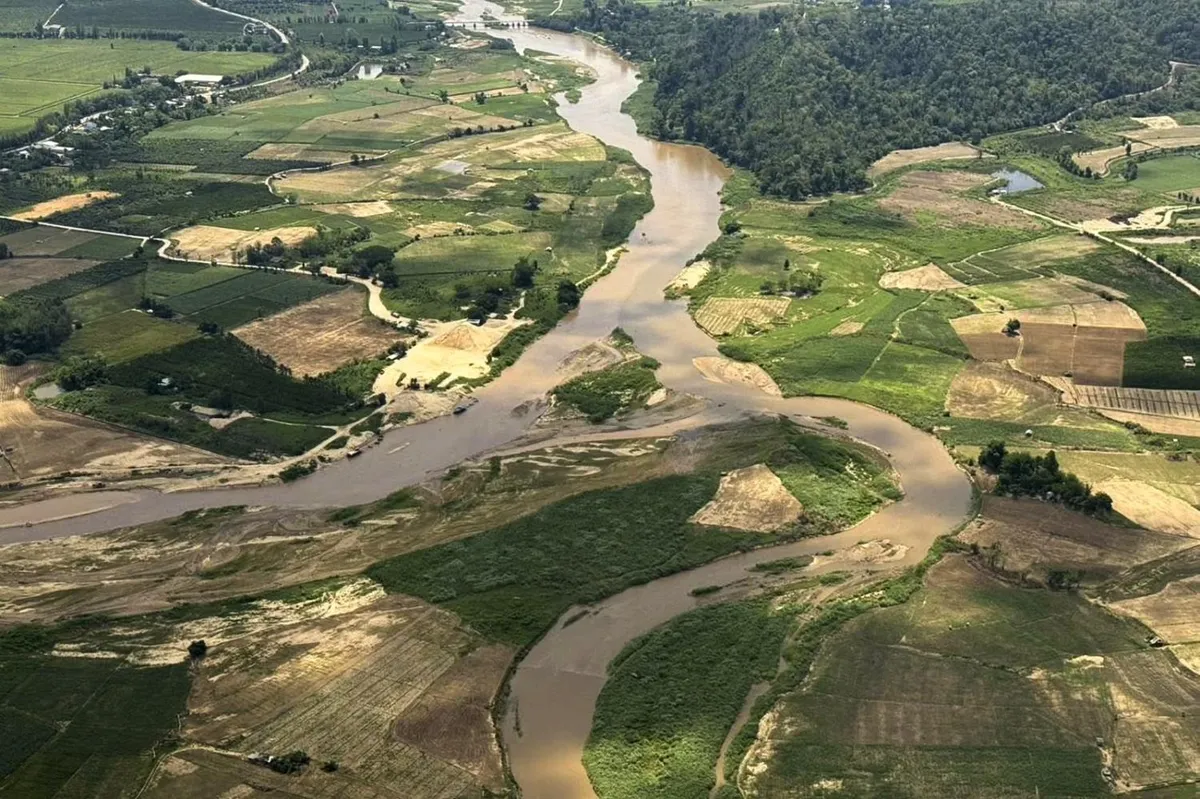
Thailand is facing growing concerns over its water security, a critical issue exacerbated by increasing pollution and ambitious development plans. Reports of industrial pollution, transboundary contamination, and local opposition to new projects highlight the complex challenges in ensuring a safe and sufficient water supply for the nation.
Rising Water Pollution Challenges
Ensuring the quality of water supplies is proving to be as significant a challenge as managing its quantity, according to Thanet Sombon, a spokesman for the Department of Royal Irrigation. Water pollution poses a direct threat to the department’s mission of providing adequate year-round water for households, agriculture, and industry.
Recent incidents underscore the severity of the pollution problem:
- A Thai-owned waste management facility in Saraburi province is alleged to be discharging heavy metals into local canals.
- In Chiang Rai province, transboundary water pollution has been linked to unregulated mining activities in a neighboring country.
- Local communities in Kanchanaburi province have protested the construction of a Chinese-owned mining plant, citing fears of potential pollution.
These cases illustrate the diverse sources of pollution, from domestic industrial activities to cross-border environmental negligence.
National Water Management and Development Goals
The Department of Royal Irrigation has outlined an ambitious plan to enhance the country’s water infrastructure. The department aims to expand the total irrigated area to 38.89 million rai by 2037, increasing the national water storage capacity to over 86.229 billion cubic meters. Currently, irrigation systems cover 35.91 million rai with a storage capacity of approximately 83.849 billion cubic meters, representing about 60% of the country’s total potential irrigated land. The remaining 40% is slated for development after 2037.
Eastern Economic Corridor (EEC) Initiatives
To support industrial growth, particularly within the Eastern Economic Corridor (EEC), 16 irrigation projects are currently in progress. These projects are scheduled for completion by 2037 with an allocated budget of 48 billion baht. They are expected to boost the available water volume by 542 million cubic meters.
Further investments are planned to increase water storage in key reservoirs. A budget will be allocated to six projects aimed at augmenting water levels in the Pra Sae reservoir in Rayong province and the Bang Pra reservoir in Chon Buri province. These initiatives are projected to add an additional 155 million cubic meters of water.
Controversial Projects and Regional Connectivity
A significant portion of the national water budget, 28 billion baht, is designated for the controversial Klong Wang Tanod reservoir construction project in Chantaburi province. This dam is expected to contribute 55 million cubic meters of water to the Pra Sae reservoir, integrating with other water networks in the eastern region.
Additionally, 12 billion baht will fund seven projects to enhance water storage capacity in two reservoirs in Chachoengsao province and two more in Chon Buri province. These projects, along with efforts to increase storage in canals, are anticipated to collectively add over 296.60 million cubic meters of storage. Some of these funds will also be directed towards increasing water storage capacity in Klong Bang Pai in Chon Buri.
Concerns Over Industrial Water Demand
The EEC is positioned as a hub for industrial development, including significant investment in AI data centers. However, this growth raises concerns among local populations regarding the substantial water and energy demands of such facilities. While environmental impact assessments (EIA/EHIA) are required for new investments, questions remain about their effectiveness in mitigating long-term water security risks.
Expert Perspectives on Water Security
Dr. Sitang Pilailar, a lecturer from the Department of Water Resources Engineering at Kasetsart University, emphasizes that water security has not yet been elevated to a national agenda item, despite its profound impact on public health and livelihoods. She observes that current government water policy predominantly focuses on sourcing natural water, often overlooking water quality. This neglect is particularly problematic as industrial activities increasingly contribute to water pollution through the discharge of untreated wastewater into natural water bodies.
“When water is not safe, neither food nor people are safe. We are now at the point where all stakeholders must take action to deal with polluted water. Strong law enforcement must be taken to plants that discharge untreated water into the rivers or canals,” Dr. Sitang stated. She advocates for local administrative organizations to play a more active role in regulating factories within their jurisdictions to control emissions and protect the environment.
Pianporn Deetes, executive director of the advocacy group Rivers and Rights, views transboundary river contamination as a critical national and regional security issue, directly impacting water and food security, public health, and regional stability. She highlights that the contamination of vital river systems incurs not only ecological damage but also substantial economic losses, erosion of public trust, and long-term health consequences.
Ms. Deetes stressed the urgency of the situation, stating, “Delayed or inadequate action only compounds those costs. That is why this crisis must be treated as a national priority and a regional diplomatic priority.” She expressed cautious optimism, noting that Thailand possesses the necessary legal frameworks, diplomatic channels, scientific expertise, and international partnerships to address these challenges. “What people expect is not confrontation with neighboring countries or China, but principled leadership that puts the public interest first,” she concluded.
Conclusion: A Call for Integrated Action
Thailand’s pursuit of economic development must be balanced with robust measures to protect its water resources. Addressing pollution through stricter enforcement, empowering local authorities, and fostering regional cooperation are crucial steps. Elevating water security to a national priority, as advocated by experts, is essential to safeguard public health, economic stability, and the nation’s future.
