

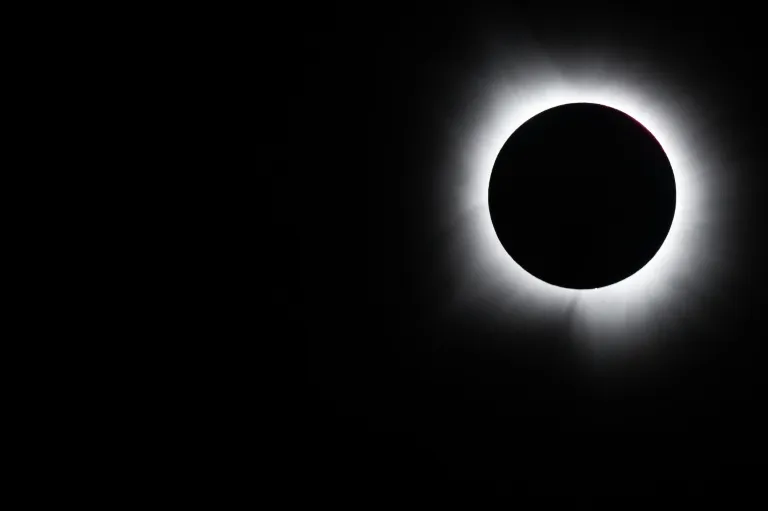
A total solar eclipse, a celestial event where the Moon completely obscures the Sun, will soon be visible in specific regions, offering a dramatic spectacle. This phenomenon, the first total solar eclipse visible in mainland Europe since 2006, occurs when the Moon aligns perfectly between the Sun and Earth, casting a shadow that creates a temporary twilight on our planet. While ancient cultures often interpreted eclipses as omens, modern science explains them as a remarkable cosmic alignment. NASA highlights that despite the Sun being approximately 400 times larger than the Moon, its vastly greater distance—also about 400 times farther away—allows the Moon to precisely cover the Sun from certain vantage points, revealing the Sun’s outer atmosphere, known as the corona.
Path and Timing of the Eclipse
The upcoming total solar eclipse will commence on August 12 in a remote part of northern Russia. From there, the path of totality, the narrow track where the Sun is fully hidden, will traverse across Greenland, Iceland, Spain, and the northeasternmost part of Portugal. In Spain, the eclipse’s trajectory is expected to move from the northern city of Oviedo towards the island of Mallorca. Notably, this path crosses regions in Spain that have recently experienced severe wildfires, events scientists have linked to human-induced climate change, underscoring the complex interplay between natural phenomena and environmental shifts.
Duration and Visibility
For observers situated within the path of totality in Spain, the period of complete darkness will be brief, lasting just under two minutes, occurring shortly before sunset. For instance, the city of Burgos will experience exactly one minute and 48 seconds of totality. Slightly longer durations, though still under two-and-a-half minutes, are anticipated in parts of Russia and Greenland. However, the entire process of the eclipse, including the partial phases where the Moon only partially covers the Sun, will extend for approximately one hour and 45 minutes. These partial eclipses will be observable across a much wider area, including most of Europe, Canada, the northwestern United States, and northwest Africa. While viewers of a partial eclipse will notice a decrease in solar brightness and a drop in temperature, the experience differs significantly from a total eclipse. As astrophysicist Alain Doressoundiram of the Paris Observatory explained, even a small, unobscured portion of the Sun remains thousands of times brighter than the full Moon, emphasizing the unique visual impact of totality.
Rarity and Future Eclipses
Solar eclipses, in general, occur one to two times annually. However, the specific phenomenon of a total solar eclipse is much rarer for any given location due to the narrowness of the path of totality. It is not uncommon for a particular area to wait centuries for a repeat viewing. Looking ahead, another significant total solar eclipse is scheduled for August 2, 2027, which will journey across southern Spain, North Africa, and the Arabian Peninsula. This event promises a longer duration of totality, lasting six minutes and 23 seconds, with no longer total solar eclipse predicted until 2114. Spain will again be in a prime viewing position on January 26, 2028, for an annular solar eclipse, often referred to as a “ring of fire” eclipse, which will cross its southern regions.
Eye Safety During an Eclipse
Crucially, direct viewing of the Sun during any phase of a solar eclipse, even a partial one, can cause severe and permanent eye damage. This is because the eyes lack pain receptors to signal injury, meaning damage can occur without immediate sensation. Experts strongly advise using specialized eclipse glasses that meet the ISO 12312-2:2015 international safety standard. These glasses are designed to filter out harmful ultraviolet (UV) radiation. Following a total solar eclipse in the United States in 2024, research indicated a notable increase in online searches for terms like “my eyes hurt,” highlighting the importance of adhering to safety guidelines. Proper eye protection is paramount to safely enjoy the awe-inspiring experience of a solar eclipse.
Understanding the Phenomenon
The alignment that creates a total solar eclipse is a fascinating astronomical event. The Moon, though significantly smaller than the Sun, appears to be the same size in our sky due to its proximity. This perfect cosmic coincidence allows for the Moon to block the Sun’s bright face entirely during totality. The visible corona, the Sun’s ethereal outer atmosphere, becomes apparent only when the Sun’s direct light is completely obscured. This fleeting glimpse of the corona is one of the most captivating aspects of a total solar eclipse, transforming the familiar Sun into a celestial marvel.
Preparing for the Event
For those fortunate enough to be in the path of totality, preparation is key to maximizing the experience. Checking weather forecasts for the viewing location is advisable, as clouds can significantly obscure the view. It’s also wise to arrive at viewing spots early, as popular locations can become crowded. Beyond specialized eyewear, consider bringing a comfortable chair and perhaps a camera equipped with a solar filter if you plan to photograph the event. Remember that even during the partial phases, the Sun’s intensity requires caution. Understanding the timing of the eclipse for your specific location is also essential to avoid missing the brief window of totality.
