

Thirty-Seven Years On: Unpacking the Tiananmen Square Events
June 4, 2026, marks the anniversary of a pivotal and heavily suppressed event of the 20th century. For those unfamiliar with the history, this is an account of what transpired at Tiananmen Square.
The Seeds of Discontent: China in the 1980s
To comprehend the events of Tiananmen Square, one must first understand the socio-economic landscape of China in the 1980s. Following the tumultuous Cultural Revolution, which had severely damaged the nation’s economy and social structure, paramount leader Deng Xiaoping initiated a period of economic reform and opening. This era saw the decollectivization of farming, the allowance of private enterprise, and the welcoming of foreign investment, leading to remarkable economic growth. However, this rapid development was not without its destabilizing effects. Government corruption became pervasive, particularly through a dual-pricing system that allowed well-connected officials to profit immensely. Inflation surged, with consumer prices in Beijing rising by approximately 30% between 1987 and 1988, making basic goods unaffordable for ordinary wage earners.
Intellectuals and students faced their own set of frustrations. Despite expanding universities, graduates found that career opportunities were often dictated by political connections rather than merit. The Communist Party maintained strict controls on political expression while simultaneously implementing an economic system that deviated from socialist principles without offering democratic accountability.
From Mourning to Protest: The Death of Hu Yaobang
By the mid-1980s, societal cracks began to appear. Student protests erupted in various cities in 1986, advocating for political reform, the rule of law, and increased freedoms. Hu Yaobang, then General Secretary of the Communist Party, was perceived as sympathetic to the students’ cause. He was compelled to resign in January 1987, ostensibly for his lenient handling of the protests, but remained a popular figure among students, intellectuals, and reform-minded party members.
On April 15, 1989, Hu Yaobang passed away at the age of 73. His death deeply affected his student admirers, many of whom believed his forced resignation had contributed to his declining health. Within hours, students began gathering at Tiananmen Square in Beijing to mourn. What began as a memorial quickly transformed into a larger movement. Thousands of students from Beijing’s universities soon occupied the square, demanding not only Hu’s rehabilitation but also an end to corruption, transparency in official income, freedom of the press, and the right to peaceful assembly.
By April 22, the day of Hu’s state funeral, over 100,000 students had converged on the square. The government held the funeral ceremony inside the Great Hall of the People, located on the western edge of the square, thus keeping the protesters outside. Three students knelt on the steps of the hall, presenting a petition and requesting to speak with Premier Li Peng. The absence of any official response intensified the students’ anger.
Key Developments in the Protests
Widespread Demonstrations and Growing Demands
Throughout late April, the protests escalated and spread across China. Students, workers, and various other groups joined the movement, articulating their demands for reform, accountability, and an end to corruption. Demonstrations reached approximately 400 cities nationwide. Workers voiced their own grievances concerning inflation and the erosion of the welfare system that had once guaranteed housing, healthcare, and job security.
The Communist Party leadership was divided. General Secretary Zhao Ziyang advocated for a conciliatory approach, acknowledging the students’ legitimate concerns and emphasizing the importance of dialogue. Premier Li Peng, however, adopted a harder stance, characterizing the movement as a conspiracy aimed at undermining Communist Party rule. On April 26, the People’s Daily, the Party’s official newspaper, published an editorial labeling the student movement a planned act of rebellion, a tone reminiscent of the Cultural Revolution. This editorial, rather than intimidating the students, further fueled their resolve, giving the movement a more determined edge.
The following day, an estimated 50,000 to 100,000 students marched through Beijing towards Tiananmen Square, breaking through police blockades and receiving enthusiastic support from factory workers and onlookers. This marked one of the largest unauthorized demonstrations in the history of the People’s Republic of China. Shaken by the scale of the protests, the government agreed to hold talks with student representatives. However, these discussions yielded little progress, and the government’s refusal to broadcast the dialogue live further frustrated the student leaders.
The Hunger Strike and International Attention
On May 13, just two days before Soviet leader Mikhail Gorbachev’s scheduled state visit to Beijing, students initiated a hunger strike in Tiananmen Square. Their timing was strategic, aiming to leverage the presence of an international press corps to deter any potential government crackdown. The hunger strike significantly shifted public sentiment, drawing massive support. By the afternoon of May 13, approximately 300,000 people had gathered around the square, with millions more participating in solidarity marches across the city. Workers, journalists, civil servants, and even lower-ranking Communist Party officials joined the demonstrations.
Zhao Ziyang made his final public appearance on May 19, visiting the hunger strikers in the early hours of the morning. His emotional appeal for the students to protect their health marked a significant moment and his political farewell. He was subsequently stripped of all his positions and placed under house arrest, where he remained until his death in 2005.
Martial Law and Military Mobilization
With Gorbachev’s visit concluded and the protests showing no signs of abating, Deng Xiaoping made the decision to impose martial law. On May 20, the State Council declared martial law in Beijing, and the People’s Liberation Army began mobilizing, with approximately 300,000 troops ordered to the capital from various regions. The initial attempt to move troops into the city was met with resistance from ordinary Beijingers, many of them factory workers, who physically surrounded army vehicles, preventing their advance. Soldiers were offered food by the crowds, and the military did not force its way through. After two days, the troops withdrew to the outskirts.
For a brief period, it appeared the movement might achieve a concession. However, the leadership had merely paused. Protests continued throughout May, though they became increasingly disorganized. By late May, the prolonged occupation of the square led to overcrowding and deteriorating sanitation. Student leaders debated their next steps, with some advocating for withdrawal and others insisting on remaining. A vote was taken, but its outcome was unclear, and the students ultimately stayed.
The Night of June 3-4: Crackdown and Casualties
On the evening of June 3, 1989, the government broadcast emergency announcements urging citizens to stay off the streets. Simultaneously, student radio networks called for people to gather at Tiananmen Square. Shortly after 10 p.m. on June 3, troops from the 38th Army, advancing along Chang’an Avenue from the west, opened fire with live ammunition on crowds obstructing their path. Reports indicate that soldiers used ammunition that was illegal under international law for interstate conflict. Fatalities occurred not within the square itself, but on the streets and pavements leading to it, with the heaviest casualties reported in the Muxidi neighborhood, several kilometers west of the square.
Armored vehicles entered Tiananmen Square in the early hours of June 4. Many exhausted and frightened protesters had already begun to leave. Student leaders negotiated with military commanders, and by approximately 4 a.m., an agreement was reached allowing those remaining in the square to depart peacefully through the southeastern exit. At 5:23 a.m., soldiers dismantled the Goddess of Democracy, a large sculpture resembling the Statue of Liberty that students had erected days earlier.
The violence extended beyond the square. As columns of retreating students moved west along Chang’an Avenue, reports emerged of soldiers firing into the crowds. Violence continued throughout June 4 in the streets of Beijing, with residents caught in their homes and on balconies becoming victims of gunfire.
The “Tank Man” and Enduring Images
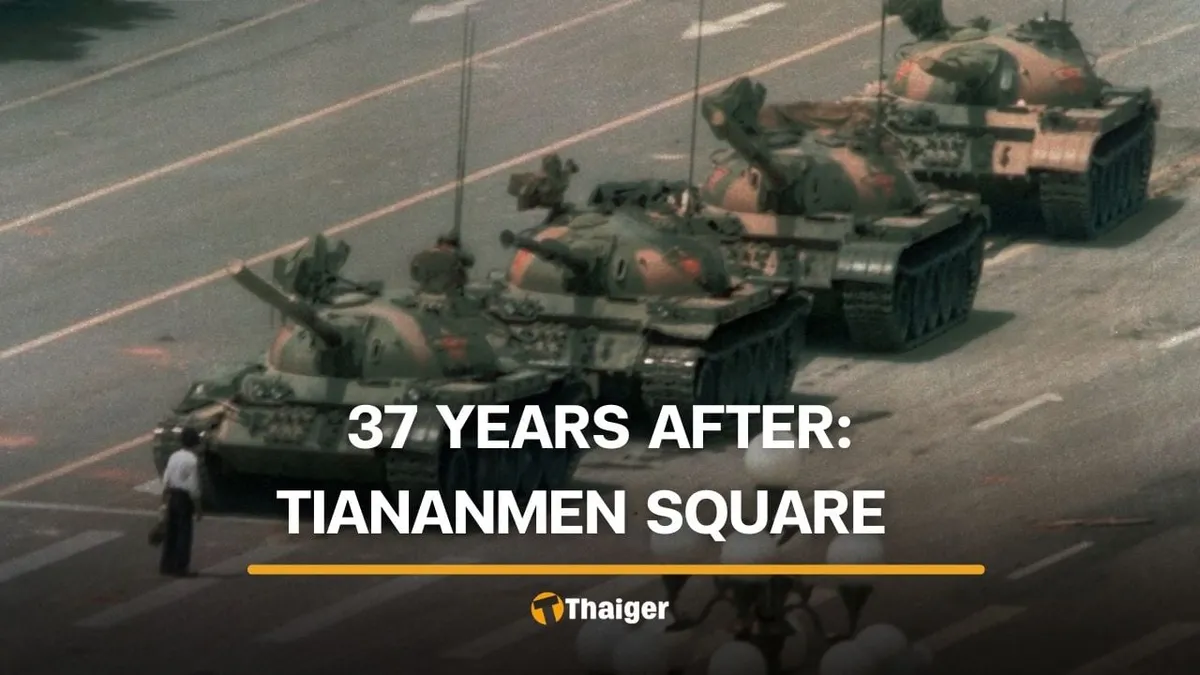
On the morning of June 5, as a convoy of tanks proceeded east along Chang’an Avenue, a lone man stepped into the road and stood directly in front of the lead vehicle. The tank halted. The man moved to block its path as it attempted to maneuver around him. This standoff repeated several times before bystanders intervened and pulled the man away. His identity has never been confirmed, and his fate remains unknown. When questioned about the incident in 1990, Jiang Zemin, who had succeeded Zhao Ziyang as China’s top leader, stated he did not believe the man had been killed.
The iconic photograph of this individual, dubbed “Tank Man” by Western photographers who captured the image from an upper floor of the Beijing Hotel, became one of the most recognized images of the 20th century. Within China, this image is heavily censored, suppressed from search engines, deleted from social media, and largely unknown to younger generations.
Casualty Estimates and Government Figures
Initial figures released by the Chinese government put the number of dead at around 300, including soldiers. An internal Party reports June 1989 stated a civilian death toll of 218, along with 36 student deaths. However, other estimates have been significantly higher. The Chinese Red Cross initially announced 2,600 deaths before retracting the figure. A Swiss diplomat estimated 2,700 fatalities. A compilation of Beijing hospital records documented at least 478 confirmed deaths and 920 injuries. Amnesty International estimated several hundred to nearly 1,000 deaths.
The Tiananmen Mothers, a group of bereaved families who have dedicated decades to documenting individual cases, had verified 202 deaths by 2011, acknowledging that their count was likely incomplete due to the challenges of research under constant government surveillance. The precise number of fatalities has never been independently established, and no official investigation has ever been permitted.
Arrests, Exile, and Political Purges
In the weeks following the crackdown, a wave of arrests swept across China, with tens of thousands detained. A list of 21 most-wanted student leaders was broadcast on state television, featuring their photographs and biographical details. Seven of these individuals managed to escape abroad, aided by Western intelligence services and Hong Kong activists in an operation known as Yellowbird. The remaining fourteen were eventually apprehended and imprisoned.
Leaders of the student movement faced varied consequences. Some, like Wang Dan, served lengthy prison sentences. Others, such as Wuer Kaixi and Chai Ling, escaped to the West and have lived in exile for decades, unable to return to China. Zhao Ziyang, stripped of his political positions, spent the last 16 years of his life under house arrest in Beijing. He secretly recorded his memoirs on audio tapes, which were smuggled out of China and published internationally after his death under the title Prisoner of the State.
Within the Party, individuals who had shown sympathy for the students were purged. Jiang Zemin, the Shanghai party chief who had suppressed protests in his city without bloodshed, was elevated to General Secretary of the Communist Party and subsequently became China’s paramount leader. The United States, the European Community, and Japan imposed economic sanctions and arms embargoes on China. The arms embargo imposed by the European Union remains in effect to this day.
The Lingering Shadow of Tiananmen
Suppression and Amnesia within China
Thirty-seven years later, the Tiananmen Square massacre continues to influence Chinese politics in ways that are rarely openly discussed within the country. The event has been effectively erased from public consciousness, with school textbooks containing virtually no references to it. Internet searches for related terms yield no results or are blocked. Social media posts using associated phrases are routinely deleted.
On each anniversary, security services heavily patrol Tiananmen Square. Individuals who linger too long, photograph sensitive subjects, or display even a blank piece of paper are likely to be quietly removed. The Tiananmen Mothers, now comprised of elderly women in their seventies and eighties, continue their documentation efforts under constant surveillance. They have submitted open letters to the National People’s Congress annually since the early 1990s, but have received no formal response.
Hong Kong and Taiwan’s Perspectives
In Hong Kong, the situation has drastically changed in recent years. For three decades following 1989, tens of thousands gathered annually at Victoria Park for a candlelight vigil, one of the world’s largest commemorations of the event. However, after Beijing imposed the National Security Law in 2020, the vigils were banned, the organizing group disbanded, and the June 4th Museum was forced to close. Several of its organizers were arrested.
In Taiwan, the Tiananmen crackdown is frequently cited as a stark example of what democratic societies could face under mainland Chinese control.
The Chinese Government’s Stance
The official position of the Chinese Communist Party has remained largely unchanged for 37 years. The crackdown is defended as a necessary measure to prevent chaos, restore order, and safeguard the economic development that has lifted hundreds of millions of Chinese out of poverty. Officials consistently describe the 1989 movement as a “counter-revolutionary riot” instigated by foreign interference. At an international security forum in 2019, China’s defense minister asserted that the crackdown was a correct policy that ensured the stability enabling China’s subsequent rise.
Privately, some former officials have expressed regret. Chen Xitong, the Beijing mayor who read the martial law declaration, reportedly stated before his death in 2013 that he was sorry for the deaths of innocent civilians. Former Party elder Yang Shangkun is reported to have told his physician before his death in 1998 that June 4th was the worst mistake the Communist Party had ever made. However, none of these private admissions have led to any official reassessment. The Party’s stance and its enforcement of silence on the subject remain unaltered.
The Unanswered Questions and Lasting Impact
The Tiananmen Square protests were more than just a student demonstration; they represented a mass movement involving workers, intellectuals, journalists, and ordinary citizens across hundreds of Chinese cities, all demanding accountability from the Communist Party. The response, involving martial law, military force, mass arrests, and decades of enforced amnesia, established the parameters of governance in China ever since. It settled, at least for a generation, the question of whether rapid economic development and political liberalization could coexist in China, with the Party ultimately choosing that they could not.
Today, Tiananmen Square is a busy tourist destination. Mao Zedong’s portrait hangs from the gate of the Forbidden City, and officers discreetly patrol the crowds. The identity of the man who stood before the tanks remains unknown, and the families of those killed have never received an apology. The students who survived have either spent years in prison, live in exile, or reside in a country where they cannot openly discuss their experiences. As artist Ai Weiwei wrote on the 30th anniversary of the crackdown, “Without memory, there is no civilized society or nation. Our past is all we have.”
