

Peace Talks Under Strain as Key Negotiator Issues Warning
Negotiations aimed at de-escalating regional tensions have encountered immediate challenges, with Iran’s chief negotiator asserting that Tehran will not compromise on its fundamental principles. These remarks come as shipping activity in the vital Strait of Hormuz shows signs of resurgence, following a period of significant disruption.
The recently established agreement, forged between President Donald Trump and his Iranian counterpart Masoud Pezeshkian, seeks to end a protracted conflict that erupted on February 28. The hostilities commenced following strikes by US and Israeli forces that resulted in the death of Iran’s former supreme leader, Ayatollah Ali Khamenei.
A crucial objective of the accord was to halt the ongoing hostilities in Lebanon, a condition Iran has consistently stipulated for any comprehensive agreement. The conflict in Lebanon had become a point of contention for Washington.
Escalating Violence in Lebanon Undermines Ceasefire Efforts
The fragile peace was further tested by renewed military actions. Israel’s military reported striking over 80 Hezbollah targets in Lebanon on Friday, claiming the deaths of numerous members of the Iran-backed group. This action was described by Israeli officials as a response to alleged ceasefire violations.
Lebanon reported that 18 individuals lost their lives on Friday due to Israeli airstrikes in the southern regions. Concurrently, Israel’s military confirmed the deaths of four of its soldiers, sparking significant public outcry within the country.
Prime Minister Benjamin Netanyahu stated that the Israeli army would maintain its presence in Lebanon for “as long as necessary” and vowed to make Hezbollah accountable for a “heavy price” for its attacks. In a more extreme statement, Israeli National Security Minister Itamar Ben Gvir commented on the soldier’s deaths, suggesting that “all of Lebanon must burn.”
France, whose President Emmanuel Macron played a role in the signing of the deal, has urged Israel to “respect” the accord, according to Foreign Minister Jean-Noel Barrot.
Diplomatic Hurdles and Internal Opposition
Preparations were underway to host delegations from Iran and the United States, led by Mohammad Bagher Ghalibaf, Iran’s top negotiator, and US Vice President JD Vance, at the Swiss resort of Burgenstock. These discussions were intended to initiate a two-month period of negotiations to address outstanding issues not covered by the initial agreement, particularly Iran’s nuclear program.
Switzerland’s foreign ministry confirmed the postponement of the talks but reiterated its readiness to facilitate future discussions. Unconfirmed reports financial news outlets indicate that Israel’s actions in Lebanon were the cause of the delay, though this has not been officially confirmed.
A diplomatic source from the United Arab Emirates, a key regional player, identified “two spoilers” to the deal: a perceived lack of support from Israel and significant hardline opposition within Iran.
Iran’s Negotiator Issues Stern Warning
Mohammad Bagher Ghalibaf stated on Friday that any discussions with the United States would remain within Tehran’s established “red lines.” He remarked, “If the enemy seeks to be excessive, we have proven that our fingers are on the trigger and we have no hesitation in giving a crushing response to the enemy,” according to remarks published by the official IRNA news agency.
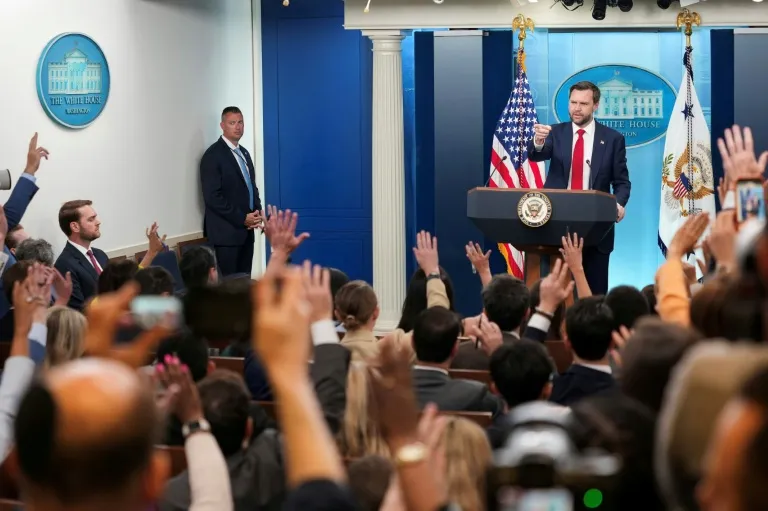
Meanwhile, US Vice President JD Vance expressed a notable level of frustration with the Israeli government. He was quoted telling a major newspaper, “you can’t just kill your way out of solving every single national security problem that you have.”
Iran’s new supreme leader, Ayatollah Mojtaba Khamenei, who succeeded his father, confirmed on Thursday that he had approved the accord with the US, despite holding a “different view.”
Strait of Hormuz Reopens, Sanctions Relief Imminent
A significant development under the deal was the immediate reopening of the Strait of Hormuz, a critical shipping chokepoint whose closure had previously driven up global energy prices. Data from maritime tracking services indicates that 25 commercial vessels transited the Strait of Hormuz on Thursday, marking the highest number since mid-April.
Economists note that approximately one-fifth of the world’s oil and liquefied natural gas exports typically pass through this strait during peacetime.
American forces lifted their naval blockade of Iranian ports on Thursday, which had restricted maritime traffic to and from the Islamic Republic. The US military confirmed that American warships will continue to operate in the vicinity.
Under the terms of the agreement, Washington is committed to immediately lifting oil sanctions that have severely impacted Iran’s economy. Furthermore, upon the finalization of an agreement concerning Iran’s nuclear program, the United States will facilitate the release of a $300 billion reconstruction fund, supported by regional nations.
